New device to remove stroke-causing blood clots proves better than standard tool
August 26, 2012 in Cardiology

New device to remove stroke-causing blood clots proves better than standard tool

Enlarge

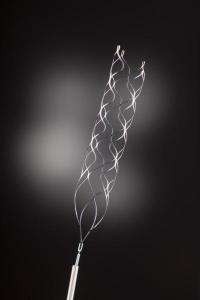
The Solitaire FR Revascularization Device is a new device that restores blood flow and retrieves clots from blocked blood vessels in patients experiencing acute ischemic stroke. Credit: Covidien

Stroke is the fourth leading cause of death and a common cause of long-term disability in the United States, but doctors have very few proven treatment methods. Now a new device that mechanically removes stroke-causing clots from the brain is being hailed as a game-changer.

In a recent clinical trial, the SOLITAIRE Flow Restoration Device dramatically outperformed the standard mechanical treatment. Findings from the trial, called SOLITAIRE With the Intention for Thrombectomy (SWIFT), are published online today in the journal The Lancet and will also appear in a later print edition of the journal.

SOLITAIRE, which was approved by the U.S. Food and Drug Administration in March, is among an entirely new generation of devices designed to remove blood clots from blocked brain arteries in patients experiencing an ischemic stroke. It has a self-expanding, stent-like design, and once inserted into a blocked artery using a thin catheter tube, it compresses and traps the clot. The clot is then removed by withdrawing the device, reopening the blocked blood vessel.

"This new device is significantly changing the way we can treat ischemic stroke," said the study's lead author, Dr. Jeffrey L. Saver, director of the UCLA Stroke Center and a professor of neurology at the David Geffen School of Medicine at UCLA. "We are going from our first generation of clot-removing procedures, which were only moderately good in reopening target arteries, to now having a highly effective tool."

This video is not supported by your browser at this time.

Results of the study showed that the device opened blocked vessels without causing symptomatic bleeding in or around the brain in 61 percent of patients. The standard FDA–approved mechanical device—a corkscrew-type clot remover called the MERCI Retriever—was effective in 24 percent of cases. The use of SOLITAIRE also led to better survival three months after a stroke. There was a 17.2 percent mortality rate with the new device, compared with a 38.2 percent rate with the older one.

About 87 percent of all strokes are caused by blood clots blocking a blood vessel supplying the brain. The stroke treatment that has received the most study is an FDA–approved clot-busting drug known as tissue plasminogen activator, but this drug must be given within four-and-a-half hours of the onset of stroke symptoms, and even more quickly in older patients.

When clot-busting drugs cannot be used or are ineffective, the clot can sometimes be mechanically removed during, or beyond, the four-and-a-half–hour window. The current study, however, did not compare mechanical clot removal to drug treatment.

For the trial, researchers randomly assigned 113 stroke patients at 18 hospitals to receive either SOLITAIRE or MERCI therapy within eight hours of stroke onset, between January 2010 and February 2011. The patients' average age was 67, and 68 percent were male. The time from the beginning of stroke symptoms to the start of the clot-retriever treatment averaged 5.1 hours. Forty percent of the patients had not improved with standard clot-busting medication prior to the study, while the remainder had not received it.

At the suggestion of a safety monitoring committee, the trial was ended nearly a year earlier than planned due to significantly better outcomes with the experimental device.

Other statistically significant findings included:

  • 2 percent of SOLITAIRE-treated patients had symptoms of bleeding in the brain, compared with 11 percent of MERCI patients.
  • At the 90-day follow-up, overall adverse event rates, including bleeding in the brain, were similar for the two devices.
  • 58 percent of SOLITAIRE-treated patients had good mental/motor functioning at 90 days, compared with 33 percent of MERCI patients.
  • The SOLITARE device also opened more vessels when used as the first treatment approach, necessitating fewer subsequent attempts with other devices or drugs.
"Nearly a decade ago, our UCLA Stroke Center team invented the first stroke retrieval device—the MERCI Retriever—and now we are pleased to have helped develop and successfully test a superior, next-generation clot removing device," said Dr. Reza Jahan, associate professor of radiology at UCLA and the study's principal neurointerventional investigator, who also led the pre-clinical studies. "It is exciting to have a highly effective new tool that can improve the outcomes for more stroke patients."

Journal reference: The Lancet search and more info website

Provided by University of California, Los Angeles search and more info website

4.5 /5 (4 votes)  

Rank 4.5 /5 (4 votes)
Relevant PhysicsForums posts
  • Magnetic field and repulsion bewteen wires
    created1 hour ago
  • Enthalpy of reaction
    created7 hours ago
  • Harmonic oscillation problem -Dancing pot
    created8 hours ago
  • Ultracapacitor to power electromagnet?
    created9 hours ago
  • Confusion in Electro Statics
    created9 hours ago
  • simple gravity question
    created10 hours ago
  • More from Physics Forums - Classical Physics

More news stories

Hospitals' cardiac arrest incidence and survival rates go hand in hand

Hospitals with the highest rates of cardiac arrests tend to have the poorest survival rates for those cases, new University of Michigan Health System research shows.

Cardiology created 56 minutes ago | popularity not rated yet | comments 0

Effect of fluid and sodium restrictions on weight loss among patients with heart failure

A clinical trial of 75 patients hospitalized with acute decompensated heart failure (ADHF) suggests that aggressive fluid and sodium restriction has no effect on weight loss or clinical stability at three days but was associated ...

Cardiology created 56 minutes ago | popularity not rated yet | comments 0

Which women should be screened for high cholesterol?

National guidelines recommend that at-risk women be screened for elevated cholesterol levels to reduce their chances of developing cardiovascular disease. But who is 'at risk?' The results of a study by investigators ...

Cardiology created 4 hours ago | popularity not rated yet | comments 0

Atherosclerotic disease heredity mapped in nationwide study

Researchers at Lund University in Sweden have mapped the significance of heredity for common forms of atherosclerotic disease. No studies have previously examined whether different forms of the disease share heredity.

Cardiology created 5 hours ago | popularity not rated yet | comments 0

Study finds improved CPR quality saves lives

(Medical Xpress)—Life-saving CPR has been a foundation of emergency medicine for more than a half century. But researchers at the University of Arizona College of Medicine-Phoenix are continuing to refine the procedure, ...

Cardiology created 7 hours ago | popularity not rated yet | comments 0


Study shows how bilinguals switch between languages

(Medical Xpress)—Individuals who learn two languages at an early age seem to switch back and forth between separate "sound systems" for each language, according to new research conducted at the University of Arizona.

Study suggests new source of kidneys for transplant

Nearly 20 percent of kidneys that are recovered from deceased donors in the U.S. are refused for transplant due to factors ranging from scarring in small blood vessels of the kidney's filtering units to the organ going too ...

Discovery of circadian clock in mice hair reveals period of time when damage from radiotherapy can be quickly repaired

Discovering that mouse hair has a circadian clock - a 24-hour cycle of growth followed by restorative repair - researchers suspect that hair loss in humans from toxic cancer radiotherapy and chemotherapy ...

SARS-like virus claims new life in Saudi

A Saudi man who had contracted the coronavirus has died, raising the death toll in the kingdom from the SARS-like virus to 16, the health ministry announced on Monday on its Internet website.

Gym class reduces probability of obesity, study finds for first time

Little is known about the effect of physical education (PE) on child weight, but a new study from Cornell University finds that increasing the amount of time that elementary schoolchildren spent in gym class reduces the probability ...

Human-like opponents lead to more aggression in video game players, study finds

Video games that pit players against human-looking characters may be more likely to provoke violent thoughts and words than games where monstrous creatures are the enemy, according to a new study by researchers ...