Copeptin predicts prognosis in HF patients
Copeptin predicts prognosis in patients with heart failure, according to research presented at the ESC Congress today, August 25, by Professor Stefan Störk from Germany.
Increased levels of copeptin were associated with increased frequencies of typical co-morbidities of heart failure, increased severity of heart failure, and increased risk of all-cause death.
"Knowledge on the prognosis of patients with a chronic condition enables the physician to tailor the speed and intensity of treatment options to the individual patient," said Professor Störk. "Copeptin, a stress hormone involved in water and sodium balance holds promise to improve the prediction of prognosis in patients with heart failure."
Heart failure has become one of the most frequent hospital discharge diagnoses and represents one of the most cost-intensive conditions of industrialized countries. The aging population and improved treatment strategies of coronary heart disease further contribute to the steep rise of heart failure prevalence. "Prognosis in heart failure very much depends on the early success of treatment tailored to the individual patient," said Professor Störk. "In clinical practice, it is crucial to get a reliable estimate of the prognosis of an individual patient since prognosis determines the urgency and intensity of treatment. Depending on the success of treatment, prognosis may be modified.
This estimate of prognosis may be drawn from clinical information describing the patient´s general condition, dedicated diagnostic examinations, or laboratory measurements."
Heart failure is a condition associated with fluid overload. It leads to congestion of the lungs, other internal organs, and peripheral oedema. So far, only natriuretic peptides that are markers of cardiac muscle stretch have been established as simple-to-use prognostic markers. Vasopressin is a hormone that is centrally involved in the regulation of sodium and water balance and renal function. Direct measurement of vasopressin is not possible in clinical routine, but its prohormone copeptin (i.e., the C-terminal fragment of the vasopressin precursor peptide) is very stable and reliably to measure.
Professor Störk said: "Copeptin is viewed as a general marker of stress; recently, it was shown that copeptin can be used to improve the speed of diagnosing or ruling out myocardial infarction."
For the study, the association of copeptin with clinical characteristics, laboratory parameters, comorbidities and outcome were investigated in 926 patients of the Interdisciplinary Network Heart Failure Study. Subjects with reduced cardiac pump function (i.e., left ventricular ejection fraction below 40%) were enrolled into the study prior to discharge after a hospitalisation for cardiac decompensation. All patients underwent a very detailed clinical assessment and diagnostic work-up. Patients were seen for a series of follow-up visits at six month intervals at the outpatients' clinic or were monitored via a structured telephone call.
Heart failure is a disorder of the elderly. Accordingly, the mean age of subjects was 68 years, and 71% were male. About half of the patients suffered from advanced heart failure (44% were in NYHA functional class III or IV). Important comorbidities such as diabetes, poor kidney function and anaemia were frequent.
The table shows relevant differences in relation to increasing steps (i.e., quartiles) of copeptin levels measured at baseline. Higher copeptin levels were linked with higher patient age, and more advanced heart failure (NYHA functional class III/IV). Patients in all quartiles had similar blood sodium levels and similar rates of heart failure caused by ischaemia.
As copeptin levels rose, patients were more likely to have a low glomerular filtration rate. "This indicates that a higher copeptin level predicts poorer kidney function," said Professor Störk. The proportion of patients with diabetes mellitus and anaemia also increased as copeptin levels rose.
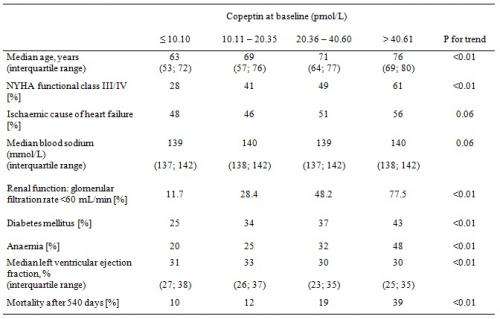
Left ventricular ejection fraction decreased as copeptin levels increased. Professor Störk said: "This shows that copeptin measurements are linked with the strength of cardiac contractility. Patients with higher copeptin levels had lower left ventricular ejection fraction, which indicates that their heart was pumping less effectively."
The risk of mortality from all causes increased with rising copeptin levels. Patients in the lowest quartile of copeptin (<10.10pmol/L) had a 10% risk of mortality from all causes after 540 days. This risk rose to 12% in the second quartile (10.11-20.35 pmol/L), 19% in the third quartile (20.36-40.60 pmol/L) and 39% in the highest quartile (>40.61). "The risk of all-cause death strongly depended on the copeptin levels," said Professor Störk. "It was about four-fold higher in the highest quartile compared to the lowest quartile.
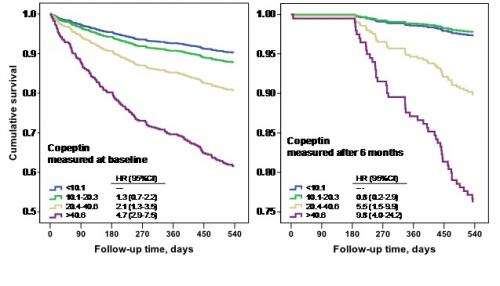
The researchers calculated the cumulative survival rate (i.e., the proportion of patients alive) at 90, 180, 270, 360, 450 and 540 days for each of the four quartiles of copeptin levels. Figure 1 shows the cumulative survival rate of patients in the four quartiles of copeptide levels measured at baseline. The cumulative survival rate dropped as copeptin levels increased, from about 10% in the lowest quartile (<10.1) to about 40% in the highest quartile (>40.6). The risk of death (as measured by the hazard ratio [HR]) during the entire follow up period of 540 days increased with rising copeptin levels. Patients in the highest quartile were 4.7 times more likely to be dead at 540 days than patients in the lowest quartile.
If other heart failure characteristics like age, sex, NYHA functional class and renal function were accounted for, this association weakened but was still highly significant (doubled risk in the highest quartile).
Subjects who survived to 6 months and attended the follow-up visit had another blood sample taken for copeptin measurement. Figure 2 shows the cumulative survival rate of patients in the four quartiles of copeptide levels measured after 6 months. Again, the cumulative survival rate dropped as copeptide levels increased, from about 2.5% in the lowest quartile (<10.1) to about 25% in the highest quartile (>40.6). The risk of death (as measured by the hazard ratio [HR]) during the 180-540 day follow up period increased with rising copeptide levels. Patients in the highest quartile were nearly 10 times more likely to be dead at 540 days than patients in the lowest quartile.
Professor Störk said: "The prognostic ability of copeptin was retained. Copeptin also predicted the risk of all-cause death amongst those subjects who had survived the first critical 6 months."
Professor Störk said: "The current study found that elevated levels of copeptin are associated with the typical co-morbidities of heart failure, severity of heart failure, and the risk of all-cause death. When the copeptin measurement was repeated in survivors after six months, the prognostic ability of copeptin was retained."
He added: "Future studies need to show whether measurement of copeptin can improve the management of patients with heart failure. Physicians may be able to use copeptin levels to help them choose the best treatment strategy for their patients with heart failure."


