Fragile X and Down syndromes share signalling pathway for intellectual disability
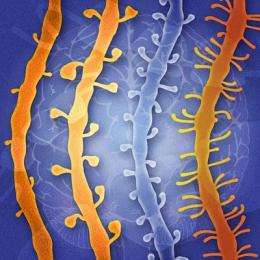
Healthy dendritic spines on the surface of nerve cells are essential for intellectual ability Credit: Uta Mackensen, EMBO
Intellectual disability due to Fragile X and Down syndromes involves similar molecular pathways report researchers in The EMBO Journal. The two disorders share disturbances in the molecular events that regulate the way nerve cells develop dendritic spines, the small extensions found on the surface of nerve cells that are crucial for communication in the brain.
"We have shown for the first time that some of the proteins altered in Fragile X and Down syndromes are common molecular triggers of intellectual disability in both disorders," said Kyung-Tai Min, one of the lead authors of the study and a professor at Indiana University and the Ulsan National Institute of Science and Technology in Korea. "Specifically, two proteins interact with each other in a way that limits the formation of spines or protrusions on the surface of dendrites." He added: "These outgrowths of the cell are essential for the formation of new contacts with other nerve cells and for the successful transmission of nerve signals. When the spines are impaired, information transfer is impeded and mental retardation takes hold."
Intellectual disability is a developmental brain disorder that leads to impaired cognitive performance and mental retardation. Two of the most prevalent genetic causes of intellectual disability in humans are Fragile X and Down syndromes. Fragile X syndrome arises from a single gene mutation that prevents the synthesis of a protein required for neural development (Fragile X mental retardation protein). The presence of all or a part of a third copy of chromosome 21 in cells causes Down syndrome. Although both syndromes arise due to these fundamental genetic differences, the researchers identified a shared molecular pathway in mice that leads to intellectual disability for both disorders.
The mice that were used in the experiments are model systems for the study of Fragile X syndrome and Down syndrome. Down syndrome mice have difficulties with memory and brain function, and the formation of the heart is often compromised, symptoms that are also observed in humans with Down syndrome. Both model systems are very useful to scientists looking to dissect the molecular events that occur as the disorders take hold.
The scientists revealed that the Down syndrome critical region 1 protein (DSCR1) interacts with Fragile X mental retardation protein (FMRP) to regulate dendritic spine formation and local protein synthesis. By using specific antibodies that bind to the proteins as well as fluorescent labeling techniques they showed that DSCR1 specifically interacts with the phosphorylated form of FMRP. The overlapping molecular pathways of intellectual disability in both genetic disorders suggest that a common therapeutic approach might be feasible for both syndromes.
Min remarked: "We believe these experiments provide an important step forward in understanding the multiple roles of DSCR1 in neurons and in identifying a molecular interaction that is closely linked to intellectual disability for both syndromes."
DSCR1 interacts with FMRP and is required for spine morphogenesis and local protein synthesis.
More information: Wei Wang, John Z. Zhu, Karen T. Chang, Kyung-Tai Min, doi:10.1038/emboj.2012.190
Journal reference:
EMBO Journal
Provided by
European Molecular Biology Organization
-
Most common form of inherited intellectual disability may be treatable
May 17, 2011 |
not rated yet |
0
-
Measuring intellectual disability
Jun 24, 2009 |
not rated yet |
0
-
Workings of brain protein suggest therapies for inherited intellectual disability, autism
Jul 21, 2011 |
not rated yet |
0
-
New clue found for Fragile X syndrome-epilepsy link
Apr 12, 2011 |
not rated yet |
0
-
Researchers restore memory process in most common form of mental disability
Oct 05, 2007 |
not rated yet |
0
-
Motion perception revisited: High Phi effect challenges established motion perception assumptions
Apr 23, 2013 |
3 / 5 (2) |
2
-
Anything you can do I can do better: Neuromolecular foundations of the superiority illusion (Update)
Apr 02, 2013 |
4.5 / 5 (11) |
5
-
The visual system as economist: Neural resource allocation in visual adaptation
Mar 30, 2013 |
5 / 5 (2) |
9
-
Separate lives: Neuronal and organismal lifespans decoupled
Mar 27, 2013 |
4.9 / 5 (8) |
0
-
Sizing things up: The evolutionary neurobiology of scale invariance
Feb 28, 2013 |
4.8 / 5 (10) |
14
-
Classical and Quantum Mechanics via Lie algebras
Apr 15, 2011
- More from Physics Forums - Independent Research
More news stories
Researchers identify new circadian clock component
Northwestern University scientists have shown a gene involved in neurodegenerative disease also plays a critical role in the proper function of the circadian clock.
Genetics
May 16, 2013 |
3 / 5 (1) |
0
|
Returning genetic incidental findings without patient consent violates basic rights, experts say
Informed consent is the backbone of patient care. Genetic testing has long required patient consent and patients have had a "right not to know" the results. However, as 21st century medicine now begins to use the tools of ...
Genetics
May 16, 2013 |
5 / 5 (1) |
3
|
Ethicists provide framework supporting new recommendations on reporting incidental findings in gene sequencing
In a paper published in Science Express, a group of experts led by bioethicists in the Center for Medical Ethics and Health Policy at Baylor College of Medicine provide a framework for the new American College of Medical Geneti ...
Genetics
May 16, 2013 |
not rated yet |
0
Experts urge caution over use of new genetic sequencing techniques
The use of genome-wide analysis (GWA), where the entirety of an individual's DNA is examined to look for the genomic mutations or variants which can cause health problems is a massively useful technology for diagnosing disease. ...
Genetics
May 16, 2013 |
not rated yet |
0
Collecting DNA for human rights: How to help while safeguarding privacy
DNA databases might help identify victims of crime and human trafficking, but how do we safeguard the personal privacy of innocent victims and family members? A new report online May 15 in the Cell Press journal Trends in ...
Genetics
May 15, 2013 |
not rated yet |
0
'Gap' for HIV vaccine efforts after latest setback
The hunt for an HIV vaccine has gobbled up $8 billion in the past decade, and the failure of the most recent efficacy trial has delivered yet another setback to 26 years of efforts.
Consuming coffee linked to lower risk of detrimental liver disease, study finds
Regular consumption of coffee is associated with a reduced risk of primary sclerosing cholangitis (PSC), an autoimmune liver disease, Mayo Clinic research shows. The findings were being presented at the Digestive Disease ...
Ketamine shows significant therapeutic benefit in people with treatment-resistant depression
Patients with treatment-resistant major depression saw dramatic improvement in their illness after treatment with ketamine, an anesthetic, according to the largest ketamine clinical trial to-date led by researchers from the ...
Research examines new methods for managing digestive health
Research presented at Digestive Disease Week (DDW) explores new methods for managing digestive health through diet and lifestyle.
New research identifies risks, interventions for children's GI health
An increasing number of U.S. children are experiencing gastrointestinal issues that require interventions to resolve, according to research presented at Digestive Disease Week (DDW).
New smartphone application improves colonoscopy preparation
The use of a smartphone application significantly improves patients' preparation for a colonoscopy, according to new research presented today at Digestive Disease Week (DDW). The preparation process, which begins days in ...