Research identifies mechanism responsible for eye movement disorder
August 21, 2012 in Diseases, Conditions, Syndromes
A genetic mutation acts during the development of nerves responsible for controlling eye muscles.
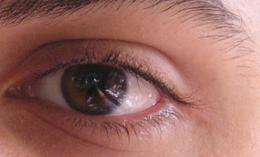
A research team from King's College London and the University of Exeter Medical School has identified how a genetic mutation acts during the development of nerves responsible for controlling eye muscles, resulting in movement disorders such as Duane Syndrome, a form of squint.
The findings could provide the key to reversing the condition and unlocking the causes of movement disorders in other parts of the body.
The research is published in Proceedings of the National Academy of Sciences.
As nerves develop in the womb they respond to signals that tell them in which direction to grow. Some signals encourage them to grow to a particular part of the body, while other signals tell them to avoid certain areas.
When the system works as it should, the right type of nerve grows to the appropriate part of the body.
The surface of growing nerves includes identification receptors that respond to signals from secreted proteins. The protein mutated in Duane Syndrome acts as a switch that weighs up incoming signals from the receptors in this way the nerve knows whether it must grow towards a part of the body or be repulsed away.
In conditions such as Duane Syndrome, the signalling breaks down and the nerve cells are unable to distinguish between a signal of attraction or repulsion. As a result, the nerves that control eye movements grow to the wrong muscles causing limited or complete loss of eye movement. If not corrected surgically, this can lead to partial blindness in later life.
This recent research has provided new insights into how this 'switch signal' system works and how it has failed in cases of Duane Syndrome, causing the 'wiring up' of the wrong muscle or 'overshooting' of nerve development past the correct muscle.
The findings are likely to lead to further study which will identify how the 'switch signal' mechanism could be harnessed to selectively change nerve cell development behaviour, how the protein could be targeted to encourage damaged cells to re-grow, and how the 'switch' could be manipulated to reverse damage.
Dr. John Chilton, senior lecturer at the University of Exeter Medical School, commented: "We have focused our research on eye movements and conditions such as Duane Syndrome because it is a relatively simple anatomical system six muscles controlled by three nerves - and there is not much cross over with other nerves in the developing head. Our findings are exciting for two reasons: the first is that they provide real hope for the development of therapies that could reverse eye movement disorders; the second is that, with additional research, they could be applied to other, more complex nerve and muscle groups that control, say, legs or arms. The scope could be phenomenal."
Sarah Guthrie, Professor of Developmental Neurobiology at King's College London said: "Investigating the signalling pathways that regulate alpha2-chimaerin helps us to understand defects in the cranial nerves which lead to eye movement disorders and visual problems. The results of this early study are very exciting, and could have an impact on the approach to treating eye movement disorders and other nerve wiring defects in the future."
Duane Syndrome is an eye movement disorder that causes eye muscles to contract and relax when they should not. It develops in the womb where it affects nerve growth in the eye. Sufferers of the syndrome have limited eye movement sideways towards the ear or nose. When the eye moves towards the nose the eyeball pulls into the socket, closing the eyelids and sometimes forcing the eye movement up or down.
Duane Syndrome usually causes vision problems. It can be accompanied by malformations of the skeleton, eyes, ears, kidneys and nervous system but more commonly occurs in isolation.
Most sufferers of the condition are diagnosed by the age of 10. It is more prevalent in women and in the left eye. It is believed to affect around half a million people worldwide.
Journal reference:
Proceedings of the National Academy of Sciences
Provided by
The Peninsula College of Medicine and Dentistry
-
Genetic mutation identified for eye complaint
Jul 24, 2008 |
not rated yet |
0
-
Guiding light: how the brain gets wired for stereo vision
Jun 15, 2011 |
not rated yet |
0
-
Motor nerve targeting to limb muscles is controlled by ephrin proteins
Dec 24, 2008 |
not rated yet |
0
-
Aligning the eyes: A simpler surgery for a complex condition
Feb 13, 2012 |
not rated yet |
0
-
Better treatment sought for blinding traumatic optic nerve damage
Apr 06, 2011 |
not rated yet |
0
-
Motion perception revisited: High Phi effect challenges established motion perception assumptions
Apr 23, 2013 |
3 / 5 (2) |
2
-
Anything you can do I can do better: Neuromolecular foundations of the superiority illusion (Update)
Apr 02, 2013 |
4.5 / 5 (11) |
5
-
The visual system as economist: Neural resource allocation in visual adaptation
Mar 30, 2013 |
5 / 5 (2) |
9
-
Separate lives: Neuronal and organismal lifespans decoupled
Mar 27, 2013 |
4.9 / 5 (8) |
0
-
Sizing things up: The evolutionary neurobiology of scale invariance
Feb 28, 2013 |
4.8 / 5 (10) |
14
-
Classical and Quantum Mechanics via Lie algebras
Apr 15, 2011
- More from Physics Forums - Independent Research
More news stories
Novel mechanism allows Legionella to hide in body
(Medical Xpress)—The feared Legionella pneumophila is responsible for legionellosis, an infectious disease that can lead to pneumonia. To infect humans, this pathogen has developed a complex method that allows it to camouflage ...
Diseases, Conditions, Syndromes
1 hour ago |
not rated yet |
0
Powerful imaging tool unlocks kidneys' secrets
(Medical Xpress)—A powerful new way of imaging kidneys is providing scientists with insights into the importance of the body's filtering system and how it is affected by cardiovascular disease, stroke and ...
Diseases, Conditions, Syndromes
1 hour ago |
not rated yet |
0
Measles surges in UK years after vaccine scare
More than a decade ago, British parents refused to give measles shots to at least a million children because of a vaccine scare that raised the specter of autism. Now, health officials are scrambling to catch ...
Diseases, Conditions, Syndromes
2 hours ago |
not rated yet |
0
Commonly used catheters double risk of blood clots in ICU and cancer patients
Touted for safety, ease and patient convenience, peripherally inserted central catheters have become many clinicians' go-to for IV delivery of antibiotics, nutrition, chemotherapy, and other medications.
Diseases, Conditions, Syndromes
6 hours ago |
not rated yet |
0
Ginger compounds may be effective in treating asthma symptoms
Gourmands and foodies everywhere have long recognized ginger as a great way to add a little peppery zing to both sweet and savory dishes; now, a study from researchers at Columbia University shows purified components of the ...
Diseases, Conditions, Syndromes
18 hours ago |
5 / 5 (1) |
0
Vitamin D could provide new and effective treatments for asthma
(Medical Xpress)—Scientists at King's College London have discovered that Vitamin D has the potential to significantly reduce the symptoms of asthma. The study, led by Professor Catherine Hawrylowicz from ...
Rethinking treatment goals improves results for 'untreatable' anorexics
(Medical Xpress)—Patients with the most severe and dangerous form of chronic anorexia are more likely to make a significant improvement towards recovery and stay in therapy if traditional psychological treatments are re-focused ...
Rise in type 2 diabetes amongst young
The number of young people diagnosed with type 2 diabetes has seen the sharpest rise over the last twenty years compared to a background of a general increase across the board, new University research has ...
Pre-proceedings process fails to reduce length of care proceedings, but can help divert cases from court
A major new report on a procedure that aims to reduce the duration of care proceedings for children has found it made no significant difference to what happened in court, and cases lasted just as long regardless of whether ...
Report reveals impact of public injecting
New research undertaken on the streets of Richmond and Abbotsford has revealed increasing health risks for people who inject drugs and significant community concern over the impact of injecting in public ...
Wireless ultrasound transducers help physicians
Siemens has presented the world's first ultrasound system with wireless transducers. The system's transducers, which can be easily operated with one hand, transmit ultrasound images via radio waves to the ...