New obesity measure predicts early death better than BMI
August 3, 2012 in Overweight and Obesity

New obesity measure predicts early death better than BMI

Enlarge

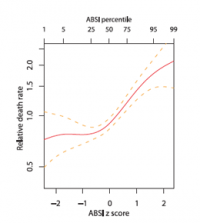
Death rate rises as ABSI score goes up. People with very high ABSI (in the 98th percentile) have more than twice the average risk of dying early.

(Medical Xpress) -- A new measure of obesity developed by a City College of New York researcher and a physician predicts early death better than BMI.

BMI, or , has long been the most common and convenient way to estimate a person’s percentage of body fat. is a leading cause of death worldwide. However, BMI is a poor predictor of when someone has entered the danger zone and is at risk of dying early.

“One criticism leveled at BMI is that it doesn’t distinguish muscle and fat mass, so that it doesn’t tell you if you have too much fat,” said Dr. Nir Krakauer, assistant professor of civil engineering in CCNY’s Grove School of Engineering, and study coauthor.

Professor Krakauer and his co-author, Jesse Krakauer – a physician who happens to be his father – set out to correct this weakness. They improved on BMI’s predictive power by creating a new index that incorporates body shape into the calculation called ABSI for “A Body Shape Index.” Their report appeared July 18 in the journal PLoS ONE.

As ABSI increases, the mortality risk from obesity climbs. “We were able to demonstrate that those that have a high ABSI showed high rate of death over a five-year period,” said Professor Krakauer.

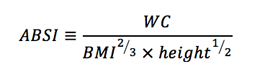
Unlike BMI, the calculation of ABSI includes waist circumference; another measurement used to estimate body fat. The additional variable helps account for the increased hazard faced by people who carry most of their fat around the middle – those with the so-called “apple” body shape.
New obesity measure predicts early death better than BMI
Enlarge

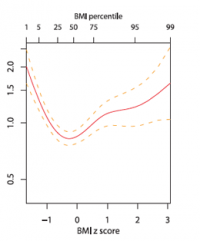
Death rate from obesity plotted again BMI score and percentile.

As a civil engineer, Professor Krakauer focuses mainly on how climate change and human activities affect the Earth’s water and carbon cycles. He turned his hand to medical data, in part, because analysis in both fields involves extracting patterns from huge data sets. These patterns help test hypotheses about what is going on in a system.

Through his endocrinologist father he learned about the similarities between the fields. “My dad had been doing work for a long time, but there was always the problem of a lack of evidence for how useful (body composition) was for quantifying risk,” he explained. “My experience with looking at large data sets helped in evaluating hypotheses.”
New obesity measure predicts early death better than BMI

Formula to calculate ABSI. (WC = waist circumference, BMI = Body Mass Index.)

The father-son team analyzed medical exam and mortality data for more than 14,000 adults who participated in the National Health and Nutrition Examination Survey. Professor Krakauer wrote programs to pull patterns out of the data. They found that death rates in the group increased with ABSI, growing nearly exponentially as the ABSI score rose above average.

Individuals with very high ABSI (in the 98th percentile) had more than double the average risk of dying early. Those with a low ABSI showed a less than average risk.

An equally high BMI, on the other hand, predicts an elevated risk of death only one and a half times the average. A very low also shows a mortality rate twice the average, making it a confusing indicator.

ABSI predicted risk of death across age, sex and weight. It also correctly forecast mortality for Americans of European and African origin, but was less effective for those of Mexican ancestry, something the Krakauers do not have data to explain.

Although the researchers cannot yet address the effect of dropping one’s ABSI, the authors speculate that building muscle in a way that reduces belt size could make a person healthier, even without losing weight.

For those with the highest scores, “you could treat them more aggressively,” said Professor Krakauer. “You could reduce waist circumference and ABSI and you might be able to reduce their risk.”

Going forward, the team may look at how body composition x-rays, which directly measure fat and muscle mass, could act as a health-screening tool to give an even more detailed picture of risk.

More information: Nir Y. Krakauer, Jesse C. Krakauer. A new Body Shape Index predicts mortality hazard independently of Body Mass Index. PLoS ONE, Vol. 7, No. 7. (18 July 2012), e39504, doi:10.1371/journal.pone.0039504


ABSI Calculator (type “unit converter” into Google for metric equivalents)

Journal reference: PLoS ONE search and more info website

Provided by The City University of New York search and more info website

3.5 /5 (2 votes)  

Filter


Move the slider to adjust rank threshold, so that you can hide some of the comments.


Display comments: newest first

tadchem
Aug 03, 2012

Rank: not rated yet
AFAIK, the death rate is constant - one to a customer.
It would make more sense to index 'early death' to the difference between life expectancies of people with different ABSIs, but that would require a larger database of ABSI vs age at death.
This looks like an ad hoc formula obtained by multiple linear regression of logarithms of various variables against each other, searching for a linear combination that would give a high covariance with simple exponents. This type of procedure unfortunately masks a lot of uncertainty in the data, enable the neglect of common causes, and can lead to confounding causes and effects in many cases.
Rank 3.5 /5 (2 votes)
Relevant PhysicsForums posts

More news stories

Young children appear to reject story characters who are obese

(Medical Xpress)—Research by the University of Leeds has shown that very young children appear to reject story book characters who are overweight, but not those who are disabled.

Overweight and Obesity created May 16, 2013 | popularity 3 / 5 (1) | comments 2

Gene variations may explain weight gain among men, women

(HealthDay)—Weight gain in men and women is predicted by two different genetic variations—so-called polymorphisms, according to a new study from the Netherlands.

Overweight and Obesity created May 15, 2013 | popularity 5 / 5 (1) | comments 0 | with audio podcast

ECO: Distilled water doesn't up resting energy expenditure

(HealthDay)—Drinking 500 ml of purified water is not associated with increases in resting energy expenditure (REE), according to a study presented at the annual meeting of the European Congress on Obesity, ...

Overweight and Obesity created May 14, 2013 | popularity 2 / 5 (2) | comments 1

ECO: Industry-funded reviews query sweet drink, obesity tie

(HealthDay)—Reviews that are funded by industry tend to find the evidence weak for a causal link between sugar-sweetened beverages (SSBs) and the increasing prevalence of obesity, while other reviews consider ...

Overweight and Obesity created May 14, 2013 | popularity not rated yet | comments 0

The smart phone app that helps weight loss

Researchers at the University of Liverpool have developed a smart phone app that helps users lose weight by carefully recording their food consumption.

Overweight and Obesity created May 13, 2013 | popularity 5 / 5 (1) | comments 0


AIDS science at 30: 'Cure' now part of lexicon

Big names in medicine are set to give an upbeat assessment of the war on AIDS on Tuesday, 30 years after French researchers identified the virus that causes the disease.

For combat veterans suffering from post-traumatic stress disorder, 'fear circuitry' in the brain never rests

Chronic trauma can inflict lasting damage to brain regions associated with fear and anxiety. Previous imaging studies of people with post-traumatic stress disorder, or PTSD, have shown that these brain regions can over-or ...

Temporal processing in the olfactory system

The neural machinery underlying our olfactory sense continues to be an enigma for neuroscience. A recent review in Neuron seeks to expand traditional ideas about how neurons in the olfactory bulb might encode information about ...

Melon focus headband turns to Kickstarter for rollout plans

(Medical Xpress)—What if the quality of your work depends more on your focus on the piano keys or canvas or laptop than your musical or painting or computing skills? If target users can be convinced, they ...

Now we know why old scizophrenia medicine works on antibiotics-resistant bacteria

In 2008 researchers from the University of Southern Denmark showed that the drug thioridazine, which has previously been used to treat schizophrenia, is also a powerful weapon against antibiotic-resistant bacteria such as ...

Study identifies new approach to improving treatment for MS and other conditions

(Medical Xpress)—Working with lab mice models of multiple sclerosis (MS), UC Davis scientists have detected a novel molecular target for the design of drugs that could be safer and more effective than current FDA-approved ...