Protein that boosts longevity may protect against diabetes
August 8, 2012 by Anne Trafton in Medical research
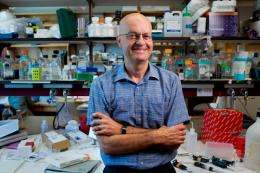
Leonard Guarente, the Novartis Professor of Biology at MITPhoto: M. Scott Brauer
A protein that slows aging in mice and other animals also protects against the ravages of a high-fat diet, including diabetes, according to a new MIT study.
MIT biology professor Leonard Guarente 74 discovered SIRT1s longevity-boosting properties more than a decade ago and has since explored its role in many different body tissues. In his latest study, appearing in the Aug. 8 print edition of the journal Cell Metabolism, he looked at what happens when the SIRT1 protein is missing from adipose cells, which make up body fat.
When put on a high-fat diet, mice lacking the protein started to develop metabolic disorders, such as diabetes, much sooner than normal mice given a high-fat diet.
We see them as being poised for metabolic dysfunction, says Guarente, the Novartis Professor of Biology at MIT. Youve removed one of the safeguards against metabolic decline, so if you now give them the trigger of a high-fat diet, theyre much more sensitive than the normal mouse.
The finding raises the possibility that drugs that enhance SIRT1 activity may help protect against obesity-linked diseases.
Guarente first discovered the effects of SIRT1 and other sirtuin proteins while studying yeast in the 1990s. Since then, these proteins have been shown to coordinate a variety of hormonal networks, regulatory proteins and other genes, helping to keep cells alive and healthy.
In recent years, Guarente and his colleagues have deleted the gene from organs such as brain and liver to pinpoint its effects more precisely. Their previous work has revealed that in the brain, SIRT1 protects against the neurodegeneration seen in Alzheimers, Huntingtons and Parkinsons diseases.
SIRT1 is a protein that removes acetyl groups from other proteins, modifying their activity. The possible targets of this deacetylation are numerous, which is likely what gives SIRT1 its broad range of protective powers, Guarente says.
In the Cell Metabolism study, the researchers analyzed the hundreds of genes that were turned on in mice lacking SIRT1 but fed a normal diet, and found that they were almost identical to those turned on in normal mice fed a high-fat diet.
This suggests that in normal mice, development of metabolic disorders is a two-step process. The first step is inactivation of SIRT1 by the high-fat diet, and the second step is all the bad things that follow that, Guarente says.
The researchers investigated how this occurs and found that in normal mice given a high-fat diet, the SIRT1 protein is cleaved by an enzyme called caspase-1, which is induced by inflammation. Its already known that high-fat diets can provoke inflammation, though its unclear exactly how that happens, Guarente says. What our study says is that once you induce the inflammatory response, the consequence in the fat cells is that SIRT1 will be cleaved, he says.
That finding provides a nice molecular mechanism to understand how inflammatory signals in adipose tissue could lead to rapid derangement of metabolic tissue, says Anthony Suave, an associate professor of pharmacology at Weill Cornell Medical College, who was not part of the research team.
Drugs that target that inflammatory process, as well as drugs that enhance sirtuin activity, might have some beneficial therapeutic effect against obesity-related disorders, Suave says.
The researchers also found that as normal mice aged, they were more susceptible to the effects of a high-fat diet than younger mice, suggesting that they lose the protective effects of SIRT1 as they age. Aging is known to increase inflammation, so Guarente is now studying whether that age-related inflammation also provokes SIRT1 loss.
This research was funded by the National Institutes of Health, the Glenn Medical Foundation and the American Heart Association.
More information: Paper online: www.cell.com/cell-… 41311200280X
Journal reference:
Cell Metabolism
Provided by
Massachusetts Institute of Technology
This story is republished courtesy of MIT News (web.mit.edu/newsoffice/), a popular site that covers news about MIT research, innovation and teaching.
-
Researchers link gene to cholesterol
Oct 11, 2007 |
not rated yet |
0
-
Study strengthens link between sirtuins proteins and life extension
Dec 14, 2009 |
not rated yet |
0
-
Proteins linked to longevity may be involved in mood control
Dec 09, 2011 |
not rated yet |
0
-
Gene linked to aging also linked to Alzheimer's
Jul 22, 2010 |
not rated yet |
0
-
Proteins linked to longevity also linked to Alzheimer's
Jul 27, 2010 |
not rated yet |
0
-
Motion perception revisited: High Phi effect challenges established motion perception assumptions
Apr 23, 2013 |
3 / 5 (2) |
2
-
Anything you can do I can do better: Neuromolecular foundations of the superiority illusion (Update)
Apr 02, 2013 |
4.5 / 5 (11) |
5
-
The visual system as economist: Neural resource allocation in visual adaptation
Mar 30, 2013 |
5 / 5 (2) |
9
-
Separate lives: Neuronal and organismal lifespans decoupled
Mar 27, 2013 |
4.9 / 5 (8) |
0
-
Sizing things up: The evolutionary neurobiology of scale invariance
Feb 28, 2013 |
4.8 / 5 (10) |
14
-
Pressure-volume curve: Elastic Recoil Pressure don't make sense
May 18, 2013
-
If you became brain-dead, would you want them to pull the plug?
May 17, 2013
-
MRI bill question
May 15, 2013
-
Ratio of Hydrogen of Oxygen in Dessicated Animal Protein
May 13, 2013
-
Alcohol and acetaminophen
May 13, 2013
-
Marie Curie's leukemia
May 13, 2013
- More from Physics Forums - Medical Sciences
More news stories
New study finds blind people have the potential to use their 'inner bat' to locate objects
New research from the University of Southampton has shown that blind and visually impaired people have the potential to use echolocation, similar to that used by bats and dolphins, to determine the location of an object.
Medical research
46 minutes ago |
not rated yet |
0
|
Germ-fighting vaccine system makes great strides in delivery
A novel vaccine study from South Dakota State University (SDSU) will headline the groundbreaking research that will be unveiled at the American Association of Pharmaceutical Scientists' (AAPS) National Biotechnology Conference ...
Medical research
1 hour ago |
not rated yet |
0
Discovery of novel medicine for treatment of chronic wounds
Every 20 seconds, a limb is lost as a consequence of diabetic foot ulcer that does not heal. To date, medical solutions that can change this situation are very limited. In his doctoral thesis Yue Shen from the Industrial ...
Medical research
5 hours ago |
not rated yet |
0
Lymphatic fluid takes detour
When tumours metastasise, they can block lymphatic vessels, as researchers from ETH Zurich have discovered using a new method. The lymphatic fluid subsequently has to find a new path through the tissue. Such ...
Medical research
5 hours ago |
not rated yet |
0
|
Computational tool translates complex data into simplified 2-dimensional images
In their quest to learn more about the variability of cells between and within tissues, biomedical scientists have devised tools capable of simultaneously measuring dozens of characteristics of individual ...
Medical research
23 hours ago |
5 / 5 (3) |
0
|
Researchers find far-reaching, microvascular damage in uninjured side of brain after stroke
While the effects of acute stroke have been widely studied, brain damage during the subacute phase of stroke has been a neglected area of research. Now, a new study by the University of South Florida reports that within a ...
Breakup of physician, drug company relationship could improve health care, cut cost
A new report suggests that improved health care and significant reductions in drug costs might be attained by breaking up the age-old relationship between physicians and drug company representatives who promote the newest, ...
Food laboratory accuracy remains a concern
Food microbiology laboratories continue to submit false negative results and false positive results on a routine basis. A retrospective study of nearly 40,000 proficiency test results over the past 14 years, presented today ...
Study supports 'aggressive' treatment for posterior fossa hematoma in newborns
Posterior fossa subdural hematoma (PFSDH) is a serious and rare condition in newborns, generally occurring after difficult deliveries. But with appropriate treatment, there's an excellent chance of good long-term outcomes ...
Which women should be screened for high cholesterol?
National guidelines recommend that at-risk women be screened for elevated cholesterol levels to reduce their chances of developing cardiovascular disease. But who is 'at risk?' The results of a study by investigators ...
First long-term study reveals link between childhood ADHD and obesity
A new study conducted by researchers at the Child Study Center at NYU Langone Medical Center found men diagnosed as children with attention-deficit/hyperactivity disorder (ADHD) were twice as likely to be obese in a 33-year ...
Aug 08, 2012
Rank: 2.3 / 5 (3)