Moving toward regeneration: Scientists show how pluripotent stem cells mobilize in wounded planarian worms
August 30, 2012 in Medical research
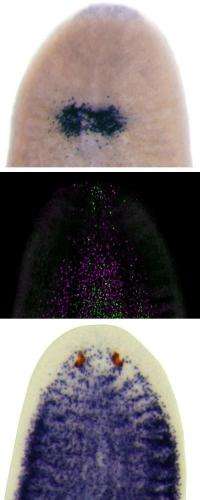
After transplantation of healthy tissue and subsequent decapitation, planarian stem cells (shown in blue, top panel) leave the graft (shown in green, middle panel) and migrate towards the amputation site while proliferating and producing progeny (magenta). This wound-induced migration rescues the lethally irradiated host animal and eventually the stem cell compartment is completely repopulated with fully functional stem cells (shown in blue, bottom panel). Courtesy of Dr. Otto C. Guedelhoefer, IV, University of California, Berkeley
The skin, the blood, and the lining of the gut—adult stem cells replenish them daily. But stem cells really show off their healing powers in planarians, humble flatworms fabled for their ability to rebuild any missing body part. Just how adult stem cells build the right tissues at the right times and places has remained largely unanswered.
Now, in a study published in an upcoming issue of Development, researchers at the Stowers Institute for Medical Research describe a novel system that allowed them to track stem cells in the flatworm Schmidtea mediterranea. The team found that the worms' stem cells, known as neoblasts, march out, multiply, and start rebuilding tissues lost to amputation.
"We were able to demonstrate that fully potent stem cells can mobilize when tissues undergo structural damage," says Howard Hughes Medical Institute and Stowers Investigator Alejandro Sánchez Alvarado, Ph.D., who led the study. "And these processes are probably happening to both you and me as we speak, but are very difficult to visualize in organisms like us."
Stem cells hold the potential to provide an unlimited source of specialized cells for regenerative therapy of a wide variety of diseases but delivering human stem cell therapies to the right location in the body remains a major challenge. The ability to follow individual neoblasts opens the door to uncovering the molecular cues that help planarian stem cells navigate to the site of injury and ultimately may allow scientists to provide therapeutic stem cells with guideposts to their correct destination.
"Human counterparts exist for most of the genes that we have found to regulate the activities of planarian stem cells," says Sánchez Alvarado. "But human beings have these confounding levels of complexity. Planarians are much simpler making them ideal model systems to study regeneration."
Scientists had first hypothesized in the late 1800s that planarian stem cells, which normally gather near the worms' midlines, can travel toward wounds. The past century produced evidence both for and against the idea. Sánchez Alvarado, armed with modern tools, decided to revisit the question.
For the new study, first author Otto C. Guedelhoefer, IV, Ph.D., a former graduate student in Sánchez Alvarado's lab, exposed S. mediterranea to radiation, which killed the worms' neoblasts while leaving other types of cells unharmed. The irradiated worms would wither and die within weeks unless Guedelhoefer transplanted some stem cells from another worm. The graft's stem cells sensed the presence of a wound—the transplant site—migrated out of the graft, reproduced and rescued their host. Unlike adult stem cells in humans and other mammals, planarian stem cells remain pluripotent in fully mature animals and remain so even as they migrate.
But when Guedelhoefer irradiated only a part of the worm's body, the surviving stem cells could not sense the injury and did not mobilize to fix the damage, which showed that the stem cells normally stay in place. Only when a fair amount of irradiated tissue died did the stem cells migrate to the injured site and start to rebuild. Next, Guedelhoefer irradiated a worm's body part and cut it with a blade. The surviving stem cells arrived at the scene within days.
To perform the experiments, Guedelhoefer adapted worm surgery and x-ray methods created sixty to ninety years ago. "Going back to the old literature was essential and saved me tons of time," says Guedelhoefer, currently a postdoctoral fellow at the University of California, Santa Barbara. He was able to reproduce and quantify results obtained in 1949 by F. Dubois, a French scientist, who first developed the techniques for partially irradiating planarians with x-rays.
But Guedelhoefer went further. He pinpointed the locations of stem cells and studied how far they dispersed using RNA whole-mount in situ hybridization (WISH), specifically adapted to planarians in Sánchez Alvarado's lab. Using WISH, he observed both original stem cells and their progeny by tagging specific pieces of mRNA . The technique allowed him to determine that pluripotent stem cells can travel and produce different types of progeny at the same time.
"In other systems, most migrating stem cell progeny are not pluripotent," says Guedelhoefer. "For the most part, blood stem cells in humans stay in the bone marrow but their progeny leave and turn into a few other cell types." But in planarians, it looks like those two things are completely separate. Stem cells can move and maintain the full potential to turn into other types of cells."
Next, Sánchez Alvarado looks forward to implementing genetic screens and transplantation experiments to disrupt or enhance the cellular behaviors the team observed, to figure out the "rules of engagement" for stem cell migration, he says.
"Why can some animals regenerate whole body parts but you and I are not good at it?" says Sánchez Alvarado. "Can we write an extra rule or erase one? Is it possible, for instance, to get rid of cancer while gaining regenerative properties? These are questions we'd love to have answers to."
Journal reference:
Development
Provided by
Stowers Institute for Medical Research
-
DNA 'tattoos' link adult, daughter stem cells in planarians
Sep 10, 2008 |
not rated yet |
0
-
From a single adult cell, flatworm crafts a new body
May 12, 2011 |
not rated yet |
0
-
Scientists identify gene involved in stem cell self-renewal in planaria
Aug 07, 2006 |
not rated yet |
0
-
Planarian genes that control stem cell biology identified
Mar 01, 2012 |
not rated yet |
0
-
New methods allow for insights into molecular mechanisms of regeneration
Jul 05, 2011 |
not rated yet |
0
-
Motion perception revisited: High Phi effect challenges established motion perception assumptions
Apr 23, 2013 |
3 / 5 (2) |
2
-
Anything you can do I can do better: Neuromolecular foundations of the superiority illusion (Update)
Apr 02, 2013 |
4.5 / 5 (11) |
5
-
The visual system as economist: Neural resource allocation in visual adaptation
Mar 30, 2013 |
5 / 5 (2) |
9
-
Separate lives: Neuronal and organismal lifespans decoupled
Mar 27, 2013 |
4.9 / 5 (8) |
0
-
Sizing things up: The evolutionary neurobiology of scale invariance
Feb 28, 2013 |
4.8 / 5 (10) |
14
-
Pressure-volume curve: Elastic Recoil Pressure don't make sense
15 hours ago
-
If you became brain-dead, would you want them to pull the plug?
May 17, 2013
-
MRI bill question
May 15, 2013
-
Ratio of Hydrogen of Oxygen in Dessicated Animal Protein
May 13, 2013
-
Alcohol and acetaminophen
May 13, 2013
-
Marie Curie's leukemia
May 13, 2013
- More from Physics Forums - Medical Sciences
More news stories
Now we know why old scizophrenia medicine works on antibiotics-resistant bacteria
In 2008 researchers from the University of Southern Denmark showed that the drug thioridazine, which has previously been used to treat schizophrenia, is also a powerful weapon against antibiotic-resistant bacteria such as ...
Medical research
May 17, 2013 |
3.7 / 5 (3) |
0
|
SUMO wrestling cells reveal new protective mechanism target for stroke
Scientists investigating the interaction of a group of proteins in the brain responsible for protecting nerve cells from damage have identified a new target that could increase cell survival.
Medical research
May 17, 2013 |
5 / 5 (1) |
0
How serotonin receptors can shape drug effects, from LSD to migraine medication
New findings by researchers carrying out experiments at the U.S. Department of Energy Office of Science's Advanced Photon Source (APS) help explain why some drugs that interact with two kinds of human serotonin ...
Medical research
May 17, 2013 |
not rated yet |
0
|
Preventing blood poisoning
Peptide molecules derived from the body's natural immune system can help boost the body's defence against life-threatening blood poisoning, joint University research has uncovered.
Medical research
May 17, 2013 |
4 / 5 (1) |
0
|
New mechanism to prevent type 2 diabetes in obese individuals
A new Montréal study conducted by Dr. May Faraj, associate research professor at the Université de Montréal and invited scientist at the IRCM, along with her research team and medical collaborators, shows ...
Medical research
May 17, 2013 |
not rated yet |
0
|
New research identifies risks, interventions for children's GI health
An increasing number of U.S. children are experiencing gastrointestinal issues that require interventions to resolve, according to research presented at Digestive Disease Week (DDW).
US psychiatry gets makeover in new manual
The latest makeover to a massive psychiatric tome honored by some, reviled by others and even called the "Bible" of mental disorders is being released Saturday with a host of new changes.
New case of SARS-like virus in Saudi: ministry
A new case of the deadly coronavirus has been detected in Saudi Arabia where 15 people have already died after contracting it, the health ministry announced on Saturday on its Internet website.
AIDS science at 30: 'Cure' now part of lexicon
Big names in medicine are set to give an upbeat assessment of the war on AIDS on Tuesday, 30 years after French researchers identified the virus that causes the disease.
For combat veterans suffering from post-traumatic stress disorder, 'fear circuitry' in the brain never rests
Chronic trauma can inflict lasting damage to brain regions associated with fear and anxiety. Previous imaging studies of people with post-traumatic stress disorder, or PTSD, have shown that these brain regions can over-or ...
New colonoscope provides ground-breaking view of colon
A ground-breaking advance in colonoscopy technology signals the future of colorectal care, according to research presented today at Digestive Disease Week(DDW). Additional research focuses on optimizing the minimal withdrawal ...