Scientist creates new cancer drug that is ten times more potent
August 29, 2012 in Cancer

Scientist creates new cancer drug that is ten times more potent

Enlarge

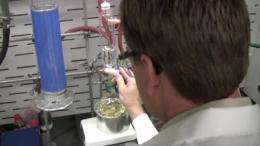
Lee and his research team used carboranes to create a new cancer drug that is 10 times more potent than current cancer-fighting drugs. Credit: Nathan Hurst/University of Missouri

Legend has it that Ralph Waldo Emerson once said, "Build a better mousetrap, and the world will beat a path to your door." University of Missouri researchers are doing just that, but instead of building mousetraps, the scientists are targeting cancer drugs. In a new study, MU medicinal chemists have taken an existing drug that is being developed for use in fighting certain types of cancer, added a special structure to it, and created a more potent, efficient weapon against cancer.

"Over the past decade, we have seen an increasing interest in using carboranes in drug design," said Mark W. Lee Jr., assistant professor of chemistry in College of Arts and Science. "Carboranes are clusters of three elements—, carbon and hydrogen. Carboranes don't fight cancer directly, but they aid in the ability of a drug to bind more tightly to its target, creating a more potent mechanism for destroying the ."

In the study, Lee and his research team used carboranes to build new drugs designed to shut off a cancer cell's energy production, which is vital for the cell's survival. All cells produce energy through complex, multi-step processes. The key to an effective drug is targeting the process that cancer cells depend on more than healthy cells. By increasing the of a drug, a smaller dose is required, minimizing side effects and increasing the effectiveness of the therapy. With carboranes, Lee found that the drug is able to bind 10 times more powerfully.

This video is not supported by your browser at this time.

Mark W. Lee Jr., an assistant professor of chemistry at the University of Missouri, and his research team have used carboranes to enhance cancer-fighting drugs. They recently created one drug that is 10 times more potent than current cancer-fighting drugs. The technology could be used to address other problems such as migraine headaches or Alzheimer's. Credit: Nathan Hurst/University of Missouri

"The reason why these drugs bind stronger to their target is because carboranes exploit a unique and very strong form of hydrogen bonding, the strongest form of interactions for drugs," Lee said.

Lee said that this discovery also will lead to further uses for the drug.

"Too often, after radiation or , cancer cells repair themselves and reinvade the body," Lee said. "This drug not only selectively shuts off the for the cancer cells, but it also inhibits the processes that allow those cancer cells to repair themselves. When we tested our carborane-based drugs, we found that they were unimaginably potent. So far, we have tested this on breast, lung and colon cancer, all with exceptional results."

According to Lee, this is the first study to show systematically how carboranes can improve the activity of a drug. Lee believes this discovery will open additional possibilities of improving drugs that are used to treat other diseases, not just cancer.

"The end result is that these could be many thousands of times more potent than the drugs that are used in the clinics today," Lee said.

While it will be several years before the new drug would be available on the market, Lee said that clinical trials could begin within the next two years. Additionally, further testing on other is underway. The study was published in the Journal of Medicinal Chemistry, a publication of the American Chemical Society.

Journal reference: Journal of Medicinal Chemistry search and more info website

Provided by University of Missouri-Columbia search and more info website

5 /5 (9 votes)  

Filter


Move the slider to adjust rank threshold, so that you can hide some of the comments.


Display comments: newest first

Smarrelli
Aug 30, 2012

Rank: not rated yet
This sounds incredible. A couple of questions though..

I don't think I saw it mentioned in the article, but how would the drug be administered? Tablet, injection etc.

Secondly, where would this drug fit in the general approach to treating cancer? Would it be used in conjunction with chemo? i.e. taken after chemo to prevent the reparation of cancer cells, or could this be an alternative to chemo depending on the type, and progression of the cancer?
Rank 5 /5 (9 votes)
Relevant PhysicsForums posts

More news stories

Study of young Israelis emphasizes need for avoidance of sun exposure for the very young

A new study conducted using extensive medical records of over one million Israeli adolescents before military service shows clearly how exposure to the Israeli sun of young, light-skinned children increases substantially ...

Cancer created 22 minutes ago | popularity not rated yet | comments 0

Genetic diversity within tumors predicts outcome in head and neck cancer

A new measure of the heterogeneity – the variety of genetic mutations – of cells within a tumor appears to predict treatment outcomes of patients with the most common type of head and neck cancer. In the May 20 issue ...

Cancer created 4 hours ago | popularity not rated yet | comments 0

Molecular marker from pancreatic 'juices' helps identify pancreatic cancer

Researchers at Mayo Clinic have developed a promising method to distinguish between pancreatic cancer and chronic pancreatitis—two disorders that are difficult to tell apart. A molecular marker obtained from pancreatic ...

Cancer created 4 hours ago | popularity not rated yet | comments 0

New smartphone application improves colonoscopy preparation

The use of a smartphone application significantly improves patients' preparation for a colonoscopy, according to new research presented today at Digestive Disease Week (DDW). The preparation process, which begins days in ...

Cancer created May 19, 2013 | popularity not rated yet | comments 0

Research examines new methods for managing digestive health

Research presented at Digestive Disease Week (DDW) explores new methods for managing digestive health through diet and lifestyle.

Cancer created May 19, 2013 | popularity not rated yet | comments 1


Lymphatic fluid takes detour

When tumours metastasise, they can block lymphatic vessels, as researchers from ETH Zurich have discovered using a new method. The lymphatic fluid subsequently has to find a new path through the tissue. Such ...

Research uncovers a potential role of two proteins in diabetes

(Medical Xpress)—Flinders University researchers are breaking new ground in a decade-long journey to pinpoint the function of two closely related proteins.

Discovery of novel medicine for treatment of chronic wounds

Every 20 seconds, a limb is lost as a consequence of diabetic foot ulcer that does not heal. To date, medical solutions that can change this situation are very limited. In his doctoral thesis Yue Shen from the Industrial ...

Novel mechanism allows Legionella to hide in body

(Medical Xpress)—The feared Legionella pneumophila is responsible for legionellosis, an infectious disease that can lead to pneumonia. To infect humans, this pathogen has developed a complex method that allows it to camouflage ...

Genetic screening could reveal hidden high risk for coronary heart disease

Finnish researchers have shown that genetic marker information can improve risk evaluation of coronary heart disease. The study comprised over 24,000 Finnish subjects and was led by Professor Samuli Ripatti. The results revealed ...

Powerful imaging tool unlocks kidneys' secrets

(Medical Xpress)—A powerful new way of imaging kidneys is providing scientists with insights into the importance of the body's filtering system and how it is affected by cardiovascular disease, stroke and ...