Yet another tick-borne illness emerges in U.S.
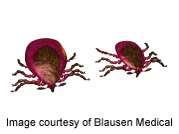
(HealthDay)—Scientists have identified a new tick-borne illness in the United States—which hospitalized two men in Missouri—adding to the steadily creeping number of diseases known to be transmitted by various species of the seed-sized parasites.
In a new study, researchers from the U.S. Centers for Disease Control and Prevention said the new "phlebovirus," a distant cousin to one recently identified in China, was likely carried on the lone star tick and caused severe symptoms such as fever, fatigue, headache, diarrhea, weight loss and low blood-cell counts.
Experts aren't sure whether more tick-borne illnesses are emerging or whether having better tests to identify them account for the increase observed. In addition to the well-known Lyme disease and Rocky Mountain spotted fever, other conditions passed by ticks in the United States include babesiosis, anaplasmosis and ehrlichiosis. All cause similar flu-like symptoms and can be fatal in extreme cases.
"This is a unique virus that's never before been seen . . . [though] I'm sure it's been around for some time and we didn't know about it," said study co-author William Nicholson, chief of pathogen biology and disease ecology activity at the CDC's National Center for Emerging and Zoonotic Infectious Diseases. "It's very likely that other people have had this, but we don't know the true public health impact at this point."
The study is published Aug. 30 in the New England Journal of Medicine.
Both phlebovirus patients from northwestern Missouri, ages 57 and 67, lived on farms and were hospitalized for extended periods in 2009 after noticing tick bites and developing symptoms. Doctors originally suspected ehrlichiosis, but sophisticated blood tests and genome sequencing done by the CDC revealed the novel virus. The men, who were treated with antibiotics, recovered but dealt with short-term memory problems and fatigue after discharge.
"We're seeing an increase in tick-borne diseases, whether existing or emerging," Nicholson said. "There's probably been a bigger increase in existing diseases, but all over the world we're seeing a rise. In general, we're concerned we're seeing this increase and we know that ticks seem to be being found in places where they weren't found before."
Dr. Gary Wormser, chief of infectious diseases at New York Medical College and Westchester Medical Center in Valhalla, N.Y., praised the CDC's use of technology to identify the new tick-borne virus and contended that such sophisticated techniques account for the growing number of such diseases.
"I suspect that if they just assumed it was ehrlichiosis, the patients would have gotten better [anyway] . . . and they wouldn't have thought twice," Wormser said. "But for some reason, these cases were more closely evaluated using the CDC's resources, and I really take my hat off to them for the elegant evaluation these patients underwent that allowed them to identify the new pathogen."
To understand the new virus more clearly—including determining whether many others have contracted it unknowingly due to milder symptoms—epidemiologists should conduct more research, said Dr. Bruce Hirsch, an attending physician in infectious diseases at North Shore University Hospital in Manhasset, N.Y.
"We don't know if these symptoms were typical for a case of this virus," Hirsch said, "and if this virus might be killing people."
Nicholson recommended people take precautions to avoid tick bites, including using insect repellent, tucking long pants inside socks while in wooded areas, and doing all-body tick checks after outings.
Lone star ticks, common in northwestern Missouri, are found in the southcentral and southeastern states, and along the East Coast up to Maine. They are brown or tan, and the female is distinguished by a white spot, or star, on her back.
More information: Visit the U.S. Centers for Disease Control and Prevention to learn more about tick-borne illnesses.
Copyright © 2012 HealthDay. All rights reserved.


