Research breakthrough opens door to new strategy for battling HIV
September 26, 2012 by Michele Mcdonald in HIV & AIDS
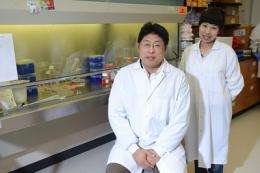
Researchers Yuntao Wu and Jia Guo in Mason’s National Center for Biodefense and Infectious Diseases. Photo by Evan Cantwell
(Medical Xpress)—New research showing how the HIV virus targets "veterans" or memory T-cells could change how drugs are used to stop the virus, according to new research by George Mason University.
The research will appear in the Journal of Biological Chemistry's October edition and currently is available online.
"It's a big breakthrough for us," says Yuntao Wu, an author of the study and professor at the Mason-based National Center for Biodefense and Infectious Diseases. "I think this will impact the field."
Helper T-cells support the body's immune system by organizing forces to fight off infection. The HIV virus hijacks helper T-cells. When helper T-cell numbers plummet, the body is vulnerable to disease.
Not all helper T-cells are the same; some are experienced ones called memory helper T-cells, and others, naive cells or "virgin" cells, haven't encountered an infection. Mason researchers studied why HIV preferentially goes after memory helper T-cells, while shunning their close colleagues. Memory and naive T-cells appear similar.
"In the body, HIV is able to kill most memory helper cells," says Weifeng Wang, the study's main author. "We wanted to pursue what makes the difference between memory and naive T-cells on a molecular level."
Unlike naive helper T-cells, memory T-cells are on the go, and much more mobile. And it's that momentum that attracts the HIV virus and makes the memory cell vulnerable, says Wang, who's currently a research fellow in the Dana-Farber Cancer Institute at Harvard Medical School.
When a memory cell moves, inside the cell, it looks like a waterfall on the moving edge. "It's called 'treadmilling'," Wu says. "The cytoskeleton or the cell's supporting bone is acting like a muscle. The treadmilling of cytoskeleton pushes the cell to migrate. That's how it pushes itself. In the past year we've been studying how HIV infects those memory cells. It has to go to the center, into the nucleus. It has to go past the cytoskeleton barriers to go into the center. For many years we didn't understand how the virus could cross such a structure. It's like a wall. It has to cross that wall."
HIV jumps over the wall by exploiting the cell's treadmilling process, Wu says. "The HIV virus uses a receptor to attach to the cell for entry," he says. "When the virus touches that receptor it's like someone ringing the doorbell. That triggers a signal—someone comes out and opens the door. Now the HIV virus can start the treadmill to 'walk' along the cytoskeleton towards the center. If the virus goes to naive cells, it cannot do it. Naive cells aren't sensitive enough. The cytoskeleton of these 'virgin' cells is different from the memory cells, and it is not easy for the virus to start the treadmilling process."
HIV's knack for mutating makes it a tough target for drugs, Wang says. By shifting the focus to the cell, away from the virus itself, researchers may find a new way to tackle the virus, he says.
"Basically, our new strategy will be finding a cellular target, something HIV needs to depend on," Wu says. "It's as if the virus says 'give me a house.' The cell is the house. The house has to have electricity and everything so it can live there. Our approach is to look for something the virus needs to live in that house and then to reduce it or shut it down. The challenge will be if you shut that down, that it doesn't impact normal cell functions. It's a very tricky balance. You want to kill the virus but not healthy cells along with it."
Wu is looking at existing drugs, including those used for cancer. "There is something shared between cancer cells and HIV-infected cells because cancer cells also like to migrate. So some drugs that are used to slow down cancer migration could also be used to treat HIV."
More information: www.jbc.org/conten… 400.abstract
Journal reference:
Journal of Biological Chemistry
Provided by
George Mason University
-
New memory for HIV patients
Mar 26, 2012 |
not rated yet |
0
-
Scientists uncover new factor in HIV infection
Aug 24, 2011 |
not rated yet |
0
-
Sugar-binding protein may play a role in HIV infection
Jun 14, 2011 |
not rated yet |
0
-
HIV's effect on white blood cells questioned by new research
May 22, 2007 |
not rated yet |
0
-
Under the right conditions, peptide blocks HIV infection at multiple points along the way
Jul 24, 2012 |
not rated yet |
0
-
Motion perception revisited: High Phi effect challenges established motion perception assumptions
Apr 23, 2013 |
3 / 5 (2) |
2
-
Anything you can do I can do better: Neuromolecular foundations of the superiority illusion (Update)
Apr 02, 2013 |
4.5 / 5 (11) |
5
-
The visual system as economist: Neural resource allocation in visual adaptation
Mar 30, 2013 |
5 / 5 (2) |
9
-
Separate lives: Neuronal and organismal lifespans decoupled
Mar 27, 2013 |
4.9 / 5 (8) |
0
-
Sizing things up: The evolutionary neurobiology of scale invariance
Feb 28, 2013 |
4.8 / 5 (10) |
14
-
Classical and Quantum Mechanics via Lie algebras
Apr 15, 2011
- More from Physics Forums - Independent Research
More news stories
Integrating mental health care into HIV care
The integration of mental health interventions into HIV prevention and treatment platforms can reduce the opportunity costs of care and improve treatment outcomes, argues a new Policy Forum article published in this week's ...
HIV & AIDS
7 hours ago |
not rated yet |
0
After a decade, global AIDS program looks ahead
(AP)—The decade-old law that transformed the battle against HIV and AIDS in developing countries is at a crossroads. The dream of future generations freed from the epidemic is running up against an era ...
HIV & AIDS
20 hours ago |
not rated yet |
0
'Gap' for HIV vaccine efforts after latest setback
The hunt for an HIV vaccine has gobbled up $8 billion in the past decade, and the failure of the most recent efficacy trial has delivered yet another setback to 26 years of efforts.
HIV & AIDS
May 19, 2013 |
5 / 5 (1) |
0
AIDS science at 30: 'Cure' now part of lexicon
Big names in medicine are set to give an upbeat assessment of the war on AIDS on Tuesday, 30 years after French researchers identified the virus that causes the disease.
HIV & AIDS
May 18, 2013 |
5 / 5 (2) |
0
Peer-referral programs can increase HIV-testing in emergency departments
Researchers at the University of Cincinnati (UC) have found that incorporating a peer-referral program for HIV testing into emergency departments can reach new groups of high-risk patients and brings more patients into the ...
HIV & AIDS
May 17, 2013 |
not rated yet |
0
If you can remember it, you can remember it wrong
(Medical Xpress)—Native peoples in regions where cameras are uncommon sometimes react with caution when their picture is taken. The fear that something must have been stolen from them to create the photo ...
B vitamins could delay dementia
(Medical Xpress)—Despite spending billions of dollars on research and development, drug companies have been unable to come up with effective treatments for dementia and Alzheimer's Disease (AD). Now, A. ...
New sleeping pill poised to hit US markets
An experimental sleeping pill from US drug company Merck is effective at helping people fall and stay asleep, according to reviewers at the US Food and Drug Administration, which could soon approve the new drug.
Reducing caloric intake delays nerve cell loss
Activating an enzyme known to play a role in the anti-aging benefits of calorie restriction delays the loss of brain cells and preserves cognitive function in mice, according to a study published in the May ...
Insight into the dazzling impact of insulin in cells
Australian scientists have charted the path of insulin action in cells in precise detail like never before. This provides a comprehensive blueprint for understanding what goes wrong in diabetes.
Antidepressant reduces stress-induced heart condition
A drug commonly used to treat depression and anxiety may improve a stress-related heart condition in people with stable coronary heart disease, according to researchers at Duke Medicine.