Understanding the chemical mechanism behind antidepressants
September 21, 2012 by Adam Piore in Neuroscience
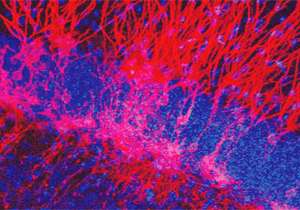
Adult-born neurons in the hippocampus have been engineered to express channelrhodopsin (red), a protein that allows the activation of these neurons and the study of their impact on pattern separation and mood. Credit: Mazen Kheirbek and René Hen
(Medical Xpress)—Millions of Americans take antidepressants such as Prozac, Effexor, and Paxil, but the explanations for how they work never satisfied René Hen, a professor of psychiatry, neuroscience and pharmacology.
So the French-born researcher began a series of experiments a decade ago that are now helping to overturn conventional wisdom about the class of antidepressants known as selective serotonin reuptake inhibitors (SSRIs) and providing new insights into the biological mechanisms in the brain that affect mood and cognition.
SSRIs, it has long been thought, work by inhibiting brain cells from reabsorbing serotonin, a signaling agent in the brain associated with positive mood. Yet unlike with psychoactive substances, the effects of the drugs take weeks to be felt—even though the increase in serotonin circulating in the brain begins almost immediately. Something more, Hen concluded, must be happening after that to create such a profound effect in depressed patients.
In 2003, Hen demonstrated an important finding in mice: The change in mood—measured by the amount of time it took the animals to overcome anxiety and feed in new environments—appeared to be due in part to the production of new brain cells in the hippocampus, an area of the brain associated with learning and memory. And those new brain cells, Hen thinks, are the result of growth-stimulating chemicals released in the brain, in response to the increased serotonin.
Last year, Hen published another groundbreaking study, suggesting how these new brain cells might affect mood. The new brain cells are located in the dentate gyrus, an area of the hippocampus involved in pattern separation, a cognitive process that helps us to recognize that something is new and different from similar experiences and stimuli. This information is then sent to other brain regions where the new stimulus is assigned a positive or negative emotional value.
Using genetic manipulations that block or enhance the production of brain cells in the dentate gyrus, Hen demonstrated that the new brain cells led to a marked improvement not just in the cognitive abilities of mice, but also in their mood. "What we think, even though it hasn't been proven yet, is that some depressed human patients also have a problem with pattern separation," Hen says. "What we are hoping is, if we can boost production of new neurons in their hippocampus, maybe we can improve pattern separation in patients and decrease general symptoms."
Hen sees numerous ways that a disruption in pattern separation might lead to negative emotions such as anxiety and depression. The hippocampus is located next to, and is strongly linked with, another brain structure, the almond-shaped amygdala, thought to be the seat of our emotions.
If wrong judgments were assigned to novel stimuli in the amygdala, that could easily trigger the brain's fight-or-flight instinct or, at the very least, produce fear. That might help explain features of anxiety disorders—why survivors of the 9/11 terrorist attacks suffering from post-traumatic stress disorder, for instance, might be hit with a panic attack whenever they see an airplane fly over a skyscraper, Hen says.
A deficit in pattern separation might also help explain why depressed patients often are unable to experience pleasure, exhibit a lack of interest in novel experiences, and feel profound malaise. Perhaps they are simply unable to register an experience as novel or pleasurable because they are unable to recognize it as sufficiently different from prior experiences.
Hen is quick to point out that new brain cell production in the hippocampus is just one effect of a cascade of neurochemical changes unleashed by SSRIs. Other researchers have demonstrated, among other things, that the drugs also have a strong impact on the prefrontal cortex, the area of the brain associated with executive functions such as decision-making and restraint.
Even so, Hen hopes his findings will have significant implications for some depressed patients—and perhaps even reveal why certain antidepressants work for some people and not others. Over the next several years, he plans to explore his hypotheses further by evaluating the pattern-separation abilities of depressed patients before and after they are treated with SSRIs.
"There is still a long way to go, but we are at least starting to provide a theoretical framework," Hen says. "With complex disorders such as anxiety and depression, you are dealing with many parts of the brain. We think we have identified the biological basis for one of the symptoms present in a subgroup of patients, and maybe by targeting it, we will be able to help them."
Provided by
Columbia University
-
Surplus of serotonin receptors may explain failure of antidepressants in some patients
Jan 13, 2010 |
not rated yet |
0
-
Nurturing newborn neurons sharpens minds in mice
Apr 03, 2011 |
not rated yet |
0
-
New mouse model of depression/anxiety enhances understanding of antidepressant drugs
May 27, 2009 |
not rated yet |
0
-
Prozac reorganizes brain plasticity
Mar 16, 2011 |
not rated yet |
0
-
Blood test might predict how well a depressed patient responds to antidepressants
Dec 15, 2011 |
not rated yet |
0
-
Motion perception revisited: High Phi effect challenges established motion perception assumptions
Apr 23, 2013 |
3 / 5 (2) |
2
-
Anything you can do I can do better: Neuromolecular foundations of the superiority illusion (Update)
Apr 02, 2013 |
4.5 / 5 (11) |
5
-
The visual system as economist: Neural resource allocation in visual adaptation
Mar 30, 2013 |
5 / 5 (2) |
9
-
Separate lives: Neuronal and organismal lifespans decoupled
Mar 27, 2013 |
4.9 / 5 (8) |
0
-
Sizing things up: The evolutionary neurobiology of scale invariance
Feb 28, 2013 |
4.8 / 5 (10) |
14
-
Pressure-volume curve: Elastic Recoil Pressure don't make sense
May 18, 2013
-
If you became brain-dead, would you want them to pull the plug?
May 17, 2013
-
MRI bill question
May 15, 2013
-
Ratio of Hydrogen of Oxygen in Dessicated Animal Protein
May 13, 2013
-
Alcohol and acetaminophen
May 13, 2013
-
Marie Curie's leukemia
May 13, 2013
- More from Physics Forums - Medical Sciences
More news stories
For combat veterans suffering from post-traumatic stress disorder, 'fear circuitry' in the brain never rests
Chronic trauma can inflict lasting damage to brain regions associated with fear and anxiety. Previous imaging studies of people with post-traumatic stress disorder, or PTSD, have shown that these brain regions can over-or ...
Neuroscience
May 18, 2013 |
5 / 5 (1) |
0
|
Temporal processing in the olfactory system
The neural machinery underlying our olfactory sense continues to be an enigma for neuroscience. A recent review in Neuron seeks to expand traditional ideas about how neurons in the olfactory bulb might encode information about ...
Neuroscience
May 17, 2013 |
4 / 5 (1) |
0
|
Melon focus headband turns to Kickstarter for rollout plans
(Medical Xpress)—What if the quality of your work depends more on your focus on the piano keys or canvas or laptop than your musical or painting or computing skills? If target users can be convinced, they ...
Neuroscience
May 17, 2013 |
3.7 / 5 (3) |
0
|
Deep brain stimulation: A fix when the drugs don't work
Neurological disorders can have a devastating impact on the lives of sufferers and their families.
Neuroscience
May 17, 2013 |
5 / 5 (1) |
0
|
Brain makes call on which ear is used for cell phone
If you're a left-brain thinker, chances are you use your right hand to hold your cell phone up to your right ear, according to a newly published study from Henry Ford Hospital in Detroit.
Neuroscience
May 16, 2013 |
2 / 5 (2) |
0
|
Researchers identify a potential new risk for sleep apnea: Asthma
Researchers at the University of Wisconsin have identified a potential new risk factor for obstructive sleep apnea: asthma. Using data from the National Institutes of Health (Heart, Lung, and Blood Institute)-funded Wisconsin ...
Computational tool translates complex data into simplified 2-dimensional images
In their quest to learn more about the variability of cells between and within tissues, biomedical scientists have devised tools capable of simultaneously measuring dozens of characteristics of individual ...
Study finds that sleep apnea and Alzheimer's are linked
A new study looking at sleep-disordered breathing (SDB) and markers for Alzheimer's disease (AD) risk in cerebrospinal fluid (CSF) and neuroimaging adds to the growing body of research linking the two.
New theory on genesis of osteoarthritis comes with successful therapy in mice
Scientists at Johns Hopkins have turned their view of osteoarthritis (OA) inside out. Literally. Instead of seeing the painful degenerative disease as a problem primarily of the cartilage that cushions joints, ...
'Gap' for HIV vaccine efforts after latest setback
The hunt for an HIV vaccine has gobbled up $8 billion in the past decade, and the failure of the most recent efficacy trial has delivered yet another setback to 26 years of efforts.
Ginger compounds may be effective in treating asthma symptoms
Gourmands and foodies everywhere have long recognized ginger as a great way to add a little peppery zing to both sweet and savory dishes; now, a study from researchers at Columbia University shows purified components of the ...
Sep 22, 2012
Rank: 1 / 5 (1)
oh did he? hm. funny how this whole article is about sensible interesting fluffy hypothesis . and then just glosses over the science part. yes, it is remarkarable how little we know about the brain and how the 'wisdom' on understanding the neurocircuitry basis for mood does not exist. we DONT understand the brain's ability to create 'mood' .