Improving diagnosis of thyroid nodules
September 6, 2012 in Cancer

Improving diagnosis of thyroid nodules

Enlarge

Thyroid nodules are thought to be present in about half of all people, but very few of these are cancerous. Credit: Dr. Sara Tomei

Thyroid nodules are thought to be present in about half of all people, but very few of these are cancerous. New research published in BioMed Central's open access journal BMC Cancer presents a set of diagnostic biomarkers which are able to distinguish between malignant and benign thyroid nodules.

Thyroid nodules are first assessed using (FNA) cytology. But about a third of results come back as indeterminate and require a diagnostic thyroidectomy. Of these, only about 20% turn out to be malignant. Obviously that 20% require further treatment (usually a full thyroidectomy) but the other 80% have had unnecessary, but currently unavoidable, surgery. If only there was a better way.

Researchers from University of Pisa and Pisa University Hospital, Italy led by Dr. Chiara Mazzanti, have addressed this problem using a Bayesian model to examine from over 90 different FNA. They found eight biomarkers each capable alone, or in combination, to distinguish between malignant and benign samples. In a test group the gene activity set (KIT, CDH1, LSM7, C21orf4, DDI2, TC1, Hs.296031 and BRAF) was able to correctly identify malignant and benign tumours 89% of the time.

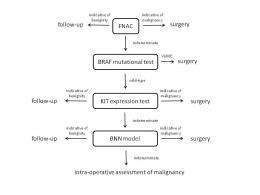
Dr Sara Tomei, explained, "Almost half of all the malignant samples (but none of the benign samples) carried the V600E mutation in the gene BRAF. We would recommend that a sample with unclear cytology which contains this mutation be treated as malignant. The gene with the highest predictive power was KIT. KIT activity is turned down in , so BRAF-normal samples, with low levels of KIT, should also be treated as suspected cancer."

Following on from this, the team suggests that patients' samples with BRAF-normal, but indeterminate KIT activity, be tested against the entire test. Any remaining ambiguous results can then be tested with the current diagnostic . Following this stepwise approach, they suggest, could potentially reduce the numbers of people with benign nodules being treated with radical surgery by almost 50%, yet still identify the people who require thyroidectomies to treat their cancer.

More information: A molecular computational model improves the preoperative diagnosis of thyroid nodules, Sara Tomei, Ivo Marchetti, Katia Zavaglia, Francesca Lessi, Alessandro Apollo, Paolo Aretini, Giancarlo Di Coscio, Generoso Bevilacqua and Chiara Mazzanti, BMC Cancer (in press)

Journal reference: BMC Cancer search and more info website

Provided by BioMed Central search and more info website

not rated yet  

Rank not rated yet
Relevant PhysicsForums posts

More news stories

New smartphone application improves colonoscopy preparation

The use of a smartphone application significantly improves patients' preparation for a colonoscopy, according to new research presented today at Digestive Disease Week (DDW). The preparation process, which begins days in ...

Cancer created 17 hours ago | popularity not rated yet | comments 0

Research examines new methods for managing digestive health

Research presented at Digestive Disease Week (DDW) explores new methods for managing digestive health through diet and lifestyle.

Cancer created 17 hours ago | popularity not rated yet | comments 1

New colonoscope provides ground-breaking view of colon

A ground-breaking advance in colonoscopy technology signals the future of colorectal care, according to research presented today at Digestive Disease Week(DDW). Additional research focuses on optimizing the minimal withdrawal ...

Cancer created May 18, 2013 | popularity 5 / 5 (2) | comments 0

ASCO: combo antibody therapy effective for melanoma

(HealthDay)—Concurrent use of two immune checkpoint antibodies—ipilimumab and nivolumab—may be effective for the treatment of advanced melanoma, according to a proof-of-principal study presented in ...

Cancer created May 17, 2013 | popularity not rated yet | comments 0

Risk factors ID'd for poor cutaneous cell CA outcomes

(HealthDay)—The risks of metastasis and death associated with cutaneous squamous cell carcinoma (CSCC) are low, but significant, and risk factors for poor outcome include tumor diameter, invasion beyond ...

Cancer created May 17, 2013 | popularity not rated yet | comments 0 | with audio podcast


Researchers identify a potential new risk for sleep apnea: Asthma

Researchers at the University of Wisconsin have identified a potential new risk factor for obstructive sleep apnea: asthma. Using data from the National Institutes of Health (Heart, Lung, and Blood Institute)-funded Wisconsin ...

Study finds that sleep apnea and Alzheimer's are linked

A new study looking at sleep-disordered breathing (SDB) and markers for Alzheimer's disease (AD) risk in cerebrospinal fluid (CSF) and neuroimaging adds to the growing body of research linking the two.

Computational tool translates complex data into simplified 2-dimensional images

In their quest to learn more about the variability of cells between and within tissues, biomedical scientists have devised tools capable of simultaneously measuring dozens of characteristics of individual ...

New theory on genesis of osteoarthritis comes with successful therapy in mice

Scientists at Johns Hopkins have turned their view of osteoarthritis (OA) inside out. Literally. Instead of seeing the painful degenerative disease as a problem primarily of the cartilage that cushions joints, ...

Ginger compounds may be effective in treating asthma symptoms

Gourmands and foodies everywhere have long recognized ginger as a great way to add a little peppery zing to both sweet and savory dishes; now, a study from researchers at Columbia University shows purified components of the ...

'Gap' for HIV vaccine efforts after latest setback

The hunt for an HIV vaccine has gobbled up $8 billion in the past decade, and the failure of the most recent efficacy trial has delivered yet another setback to 26 years of efforts.