Gambling addiction—working to understand
Odds are that you imagine gamblers as people simply trying to get lucky and win a big payoff. But when Natasha Schull, an associate professor in MIT's Program in Science, Technology, and Society (STS), began researching the lives of gamblers in Las Vegas, she found a very different motivation at work.
Take, for instance, Mollie, a mother and hotel worker who compulsively played video poker, running through her paychecks in two-day binges, and cashing in her life insurance to get more money to play. "The thing people never understand is that I'm not playing to win," Mollie told Schull. Instead, Mollie's goal was to enter a state of total gambling immersion: "to keep playing—to stay in that machine zone where nothing else matters."
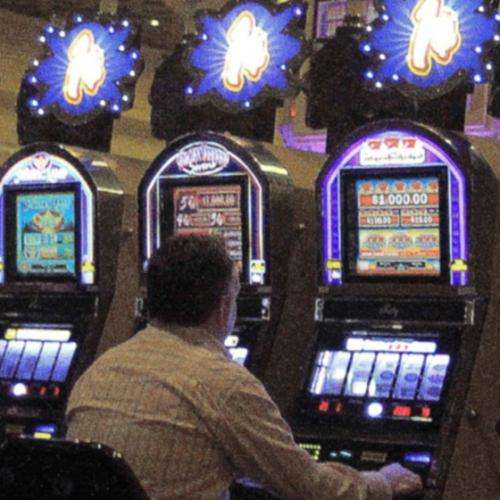
Now, in her new book, Addiction by Design, published this month by Princeton University Press, Schull delves into the lives of such gamblers. In particular, she looks at compulsive machine gamblers—not the folks playing social games around a table, such as poker, but those who play alone at electronic slot-machine terminals. For a small percentage of the population, these games become an all-consuming pursuit, a way of shutting out the world and its problems for long, long stretches of time.
But eventually, most compulsive machine gamblers recognize the hold that high-tech gaming has come to have over them. As one gambling addict told Schull: "I could say that for me the machine is a lover, a friend, a date, but really it's none of those things; it's a vacuum cleaner that sucks the life out of me, and sucks me out of life."
Schull thinks this point—that for machine gamblers, it's not about the money, but the escape into the "zone," as Mollie and other gamblers call it—has eluded politicians who wrangle over casino openings and expansions throughout the United States, where more than 30 states currently have some form of legalized machine gambling.
"It's a real stumbling block for policymakers to understand that," Schull says. She adds: "Everyone believes the harm is how much money is spent, and that what's driving the compulsive gamblers is a desire to make money. But … the 'zone' is really what's driving this experience. The idea of winning money falls away when you get to the point of addiction."
We've all visited the 'zone'—but few people live there
Schull's book is the culmination of a long process of research: She started delving into the subject in the early 1990s, when she wrote an undergraduate thesis at the University of California at Berkeley on the ways casino architecture helped drive customers to gamble more. By the late 1990s, she had moved to Las Vegas to conduct research on compulsive gamblers, talking to a vast number of addicts and industry executives, and even working in a gambling-addiction treatment program.
The phenomenon Schull wound up studying is both one that most of us can relate to—we've all tuned out the world while online, or playing games—and one that gets carried to extremes in gambling addicts.
"This experience of being in the zone is one we've all had, whether it's eBay auctions or sitting on the train compulsively using our phones," says Schull, an anthropologist by training.
On the other hand, "disordered gambling," as the American Psychiatric Association now calls gambling addiction, seems to afflict just 1 to 2 percent of Americans, according to studies.
Yet according to a long string of studies, and as Schull notes in her book, those people can generate 30 to 60 percent of revenues for the machine-gambling business. In Addiction by Design, Schull chronicles not only the nature of gambling addiction, but also the ways in which the gaming industry has deployed sophisticated technology to create machines that are extraordinarily compelling for players.
The newest video slot machines, for instance, deliver a frequent stream of small wins rather than infrequent large jackpots. Why? Because after immersion in electronic slot machines, many users resemble one gambler Schull studied at length, who "felt irritated when she won, because it took time for the jackpot to go up, so she had to sit there—and her flow was interrupted," Schull says. "It's the flow of the experience that people are after. Money to them is a means to sit there longer, not an end. They don't win a jackpot and leave, they win a jackpot and sit there until it's gone."
Talking to gamblers themselves, Schull notes, provided "great insight" into the phenomenon of gambling addiction. "There were no real dupes. There was no single person who tried to tell me, 'I have a system, I have it figured out.' These were jaded, savvy, aware people. They were not sitting there expecting to win."
Meanwhile, of gambling industry employees, such as game designers, Schull says, "You've got really intelligent guys focused on making technology work, and they don't think about the larger consequences." She adds: "Not one of these people is sitting there saying, 'How can we addict people?' They are talking about how to increase profits … [and they] insulate themselves ethically from the outcome as best they can."
'People lose track of time and space'
Scholars who have read the book praise its exploration of the psyche of gamblers. Tanya Luhrmann, an anthropologist at Stanford University, lauds the way it "captures the intense relationship between humans and machines that is so much part of what people call the addiction experience." Luhrmann adds that until reading Addiction by Design, she "hadn't realized gambling was so much about the experience" of playing, rather than winning.
Schull's research had attracted considerable attention well in advance of the book's publication: She has appeared on "60 Minutes" and testified about the subject in front of the Massachusetts state legislature.
Yet Schull holds off on offering specific regulatory remedies concerning the way games should be structured. In some countries, legislators have suggested slowing down the pace of electronic slot machines to stretch out payoffs and water down the intensity of the experience—a technological fix Schull calls "wrongheaded" because it may simply encourage gamblers to play for longer periods using an equal amount of money.
Machine gambling, Schull emphasizes, "is not like buying a movie ticket or making a purchase at a store and then going home. This is rapid, fast, continuous spending where people lose track of time and space, and their ability to make decisions shifts over the course of the encounter."
Instead, Schull asks, "Given the nature of this product and this interface, shouldn't policymakers, state legislatures, be learning a little bit more about how this product affects people?" She adds: "I think my work is part of an emerging conversation."
This story is republished courtesy of MIT News (web.mit.edu/newsoffice/), a popular site that covers news about MIT research, innovation and teaching.


