Geometry plays a role in GPCR transmembrane signaling
September 26, 2012 in Medical research

Geometry plays a role in GPCR transmembrane signaling

Enlarge

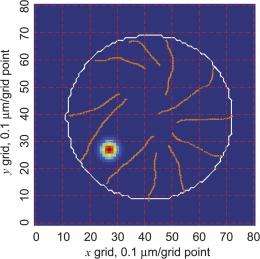
In a recent JGP article, researchers developed a novel approach to study GPCR movement within a living cell. This image shows the grid used for modeling diffusion, with tracings from the image of a rod outer segment indicating disc perimeter (white) and incisures (orange). Credit: Najafi, M., et al. 2012. J. Gen. Physiol. 140:249-266.

A recent study in The Journal of General Physiology characterizes the movement of rhodopsin, a GPCR and member of a large family of transmembrane receptors responsible for many cellular responses and involved in many human diseases.

In living Xenopus rod photoreceptor cells, rhodopsin is found in stacks of disc membranes that are difficult to study due to their small size. Now, Peter Calvert (SUNY Upstate Medical University) and colleagues have developed an approach with two- that, for the first time, allows direct examination within the living cell of how the geometry of the micro-compartment will affect its signaling.

The team focused on the effect of micro-compartments formed by "incisures", radial membrane boundaries that segment the discs into smaller regions. These micro-compartments, defined by the rim and incisures, have a similar to that of a human or mouse rod photoreceptor disc, so that the total number of components in the GPCR signaling cascade are conserved, and the downstream effects of a captured photon of light are similar. Calvert and colleagues used a novel high-resolution approach to monitor fluorescently labeled rhodopsin as it diffused in the disc membrane.

The team developed a model of to interpret the results that explicitly took the measured micro-compartments into account, and found that the boundary geometry, not heterogeneity in diffusion or a "bound fraction," was sufficient to explain differences in the extent of diffusion or rhodopsin in different regions of the disc.

More information: Najafi, M., et al. 2012. J. Gen. Physiol. 140:249. Adler, E.M. 2012. J. Gen. Physio. 140:341.

Journal reference: Journal of General Physiology search and more info website

Provided by Rockefeller University

not rated yet  

Rank not rated yet
Relevant PhysicsForums posts

More news stories

Study reveals new mechanism for estrogen suppression of liver lipid synthesis

By discovering the new mechanism by which estrogen suppresses lipid synthesis in the liver, UC Irvine endocrinologists have revealed a potential new approach toward treating certain liver diseases.

Medical research created May 23, 2013 | popularity 5 / 5 (1) | comments 0 | with audio podcast

MRI-based measurement helps predict vascular disease in the brain

Aortic arch pulse wave velocity, a measure of arterial stiffness, is a strong independent predictor of disease of the vessels that supply blood to the brain, according to a new study published in the June issue the journal ...

Medical research created May 23, 2013 | popularity not rated yet | comments 0

Antibiotics: A new understanding of sulfonamide nervous system side effects

Since the discovery of Prontosil in 1932, sulfonamide antibiotics have been used to combat a wide spectrum of bacterial infections, from acne to chlamydia and pneumonia. However, their side effects can include serious neurological ...

Medical research created May 23, 2013 | popularity not rated yet | comments 0 | with audio podcast

Scientists discover molecule triggers sensation of itch

Scientists at the National Institutes of Health report they have discovered in mouse studies that a small molecule released in the spinal cord triggers a process that is later experienced in the brain as ...

Medical research created May 23, 2013 | popularity 5 / 5 (3) | comments 0 | with audio podcast

Discarded immune cells induce the relocation of stem cells

Spanish researchers have discovered that the daily clearance of neutrophils from the body stimulates the release of hematopoietic stem cells from the bone marrow into the bloodstream, according to a report published today ...

Medical research created May 23, 2013 | popularity 5 / 5 (2) | comments 0


Engineered cytomegalovirus protects monkeys from HIV equivalent

(Medical Xpress)—A new study by researchers in the US has shown that an ancient virus can be modified to help in the fight against the simian immunodeficiency virus SIV, which is the equivalent in monkeys ...

Researchers identify first drug targets in childhood genetic tumor disorder

Two mutations central to the development of infantile myofibromatosis (IM)—a disorder characterized by multiple tumors involving the skin, bone, and soft tissue—may provide new therapeutic targets, according to researchers ...

Hormone levels may provide key to understanding psychological disorders in women

Women at a particular stage in their monthly menstrual cycle may be more vulnerable to some of the psychological side-effects associated with stressful experiences, according to a study from UCL.

Going live: Immune cell activation in multiple sclerosis

Biological processes are generally based on events at the molecular and cellular level. To understand what happens in the course of infections, diseases or normal bodily functions, scientists would need to ...

Help at hand for people with schizophrenia

How can healthy people who hear voices help schizophrenics? Finding the answer for this is at the centre of research conducted at the University of Bergen.

Alzheimer's disease, the soft target of the euthanasia debate

(Medical Xpress)—The way Alzheimer's disease is portrayed by advocacy groups and the media is having undue influence on the euthanasia debate, according to a Deakin University nursing ethics professor.