Hepatitis risk a concern for baby boomers
September 24, 2012 by Keith Brannon in Diseases, Conditions, Syndromes

Hepatitis risk a concern for baby boomers

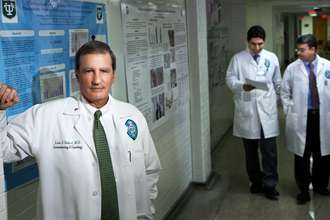
With one in 30 baby boomers at risk for hepatitis C, more screening is needed to address potential liver problems, says Dr. Luis Balart of Tulane. Credit: Guillermo Cabrera-Rojo

(Medical Xpress)—Older adults are asking more questions about liver health now that the Centers for Disease Control and Prevention has formally called for baby boomers to get tested for Hepatitis C, says Dr. Luis Balart, chief of gastroenterology and hepatology at Tulane Medical Center.

"This is the first time that a generation has been determined to be of such high-risk factor that they need to be screened," says Balart, who also is professor of medicine at Tulane.

The guidelines, which came out this summer, came about after health officials were finding more seniors testing positive for the disease. One in 30 —the generation born from 1945 through 1965—have the virus, and most don't realize it. If left untreated, can cause serious , including , and is the leading cause of in the United States.

"Roughly 75 percent of those who have exposure don't know it because they haven't been tested," says Balart, who points out that most people with the disease don't notice any symptoms except very mild fatigue. "And fatigue can be due to many things so they don't question it."

He admits that some adults are afraid to get tested because they think there's no cure for the disease or because it has a stigma associated with intravenous drug use. The most important part of testing is getting treatment to prevent any further liver damage, he says, pointing out that newly available therapies can cure up to 70 percent of infections.

The CDC estimates one-time hepatitis C testing of baby boomers could identify more than 800,000 additional people with the disease. Hepatitis C is transmitted by blood and can be spread from sharing needles, tattoo instruments and even razors and toothbrushes. Since most boomers infected with the virus likely acquired it years ago, many are mystified as to how they got it.

Provided by Tulane University search and more info website

not rated yet  

Filter


Move the slider to adjust rank threshold, so that you can hide some of the comments.


Display comments: newest first

AnyLabTestNow
Sep 24, 2012

Rank: not rated yet
The screeening test is a simple blood draw that can be done in any doctors office. Or go to ANY LAB TEST NOW and they do the test for $49.00 and you have the results next day!
Rank not rated yet
Related Stories
Relevant PhysicsForums posts

More news stories

Researchers find genetic risk factor for pulmonary fibrosis

A paper recently published in the New England Journal of Medicine and co-written by physicians and scientists at the University of Colorado School of Medicine finds that an important genetic risk factor for pulmonary fibros ...

Diseases, Conditions, Syndromes created 11 hours ago | popularity not rated yet | comments 0

Biomarkers discovered for inflammatory bowel disease

Using the Department of Defense Serum Repository (DoDSR), University of Cincinnati (UC) researchers have identified a number of biomarkers for inflammatory bowel disease (IBD), which could help with earlier diagnosis and ...

Diseases, Conditions, Syndromes created 11 hours ago | popularity 5 / 5 (1) | comments 0

CDC says high number of public pools contain microbes

(HealthDay)—Three-quarters of public schools in the metro Atlanta area contain microbes, including bacteria indicating the presence of fecal matter, according to research published in the May 17 issue of ...

Diseases, Conditions, Syndromes created 12 hours ago | popularity not rated yet | comments 0

Study examines outbreak of spinal infections in Michigan

(HealthDay)—Factors such as increased case finding may explain why Michigan had half of the total spinal infections associated with contaminated methylprednisolone acetate in the recent fungal meningitis ...

Diseases, Conditions, Syndromes created 12 hours ago | popularity not rated yet | comments 0

World not ready for mass flu outbreak, WHO says

The world is unprepared for a massive virus outbreak, the deputy chief of the World Health Organization warned Tuesday, amid fears that H7N9 bird flu striking China could morph into a form that spreads easily among people.

Diseases, Conditions, Syndromes created 12 hours ago | popularity not rated yet | comments 0


Phthalates: Study links chemicals widely found in plastics, processed food to elevated blood pressure in children, teens

Plastic additives known as phthalates (pronounced THAL-ates) are odorless, colorless and just about everywhere: They turn up in flooring, plastic cups, beach balls, plastic wrap, intravenous tubing and—according to the ...

If you can remember it, you can remember it wrong

(Medical Xpress)—Native peoples in regions where cameras are uncommon sometimes react with caution when their picture is taken. The fear that something must have been stolen from them to create the photo ...

B vitamins could delay dementia

(Medical Xpress)—Despite spending billions of dollars on research and development, drug companies have been unable to come up with effective treatments for dementia and Alzheimer's Disease (AD). Now, A. ...

Insight into the dazzling impact of insulin in cells

Australian scientists have charted the path of insulin action in cells in precise detail like never before. This provides a comprehensive blueprint for understanding what goes wrong in diabetes.

New sleeping pill poised to hit US markets

An experimental sleeping pill from US drug company Merck is effective at helping people fall and stay asleep, according to reviewers at the US Food and Drug Administration, which could soon approve the new drug.

Reducing caloric intake delays nerve cell loss

Activating an enzyme known to play a role in the anti-aging benefits of calorie restriction delays the loss of brain cells and preserves cognitive function in mice, according to a study published in the May ...