Research sheds light on lack of healthcare for migrant workers
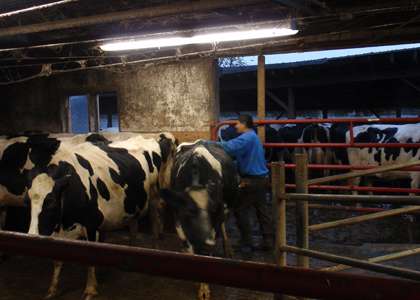
(Medical Xpress)—The classic scene of an old-time Vermonter sitting on a stool milking a cow on his family farm remains a powerful image strongly connected to the heritage of the state. If accuracy is the goal, however, a new image would be portrayed: a Spanish-speaking Latino migrant worker most likely from the southern region of Mexico.
Driven by a lack of laborers on the state's 1,007 dairy farms, Vermont's Latino population has grown 24 times faster than the state's total population between 2000 and 2010. Since 2007, more than 50 percent of the milk in the 12th-largest milk producing state in the nation was harvested by the hands of Latino migrant workers, making Vermont one of America's new Latino destinations.
With such a dramatic demographic change come a host of new issues related to health, education, language, law enforcement and immigration, especially in the state's two largest agricultural counties, where Latino populations increased by 73 percent and 111 percent, respectively. Dan Baker, assistant professor in Community Development and Applied Economics, has produced some of the first survey data in the nation on the health of migrant workers on dairy farms based on interviews with 120 Latino workers on 59 dairy farms that included self-assessment health status information and perceived barriers to healthcare.
The results, published in the article, "Health Status and Needs of Latino Dairy Farm Workers in Vermont," in the July 2012 issue of the Journal of Agromedicine showed that migrant workers rarely seek medical attention despite experiencing back and neck pain, dental issues, allergies, flu, rashes or skin problems, eye and vision issues, gastrointestinal problems, and psychological issues such as anxiety, depression and isolation. The top reason for not seeking medical attention was "fear of immigration/law enforcement," followed by language barriers, lack of transportation and cost of care.
Consequently, most Latino workers wait until they return to Mexico to access medical care, according to Baker, who cites community-based initiatives involving greater education and outreach to farmers about health resources for migrants, including partnerships with colleges and universities, and the adoption of "bias-free policing" that enables foreign-born workers to travel to clinics without concern about deportation, as strategies that may reduce barriers to care.
"There were a number of surprising findings," says Baker. "Many of the workers reported feeling healthy, but this is a relatively new phenomenon in Vermont, so there hasn't been time for chronic issues to develop. There were a high percentage of people who reported feeling depression and anxiety most likely because they are so isolated on Vermont farms and far from home."
Conducting research with impact
Baker's most current study flows out of earlier research from 2007 focusing on language barriers between Vermont farmers and Hispanic dairy workers, resulting in the launching of the Vermont Dairy Spanish Program through the Vermont Agency of Agriculture. Farmers "made significant improvement in their ability to understand and adapt to a foreign labor force" after taking the course, writes Baker in an article in the June 2012 edition of the Journal of Extension, "In Vermont, Se Habal Espanol: Using Occupational Spanish to Help Dairy Farmers manage a Changing Workforce." His recommendations for designing the course have been used by other governmental agencies. They include the prioritizing of phrase lists that farmers use most frequently; addressing cultural barriers to communication as well as language; emphasizing repetition and memorization; and being flexible in course design.
"It has been an evolution of figuring out what type of useful research we can provide to help Vermont deal with an influx of Spanish workers in the state," says Baker, who is organizing a statewide roundtable discussion at UVM in February on all issues related to Latino immigrants. "We're focused on sharing our research with policy makers and activist groups like Migrant Justice because they can make a difference in the lives of the people who need it most."
Putting a face on the statistics
Health and safety issues on farms came to the forefront in 2009 when José Obeth Santis Cruz was killed in a Vermont farming accident. The death of Cruz played a key role in the co-founding of Burlington-based immigrant advocacy group Migrant Justice by UVM alumnus Brendan O'Neill G'05 and with major support from founding member Natalia Fajardo '06, both of whom have worked tirelessly on behalf of Latinos living in Vermont. They've found Baker's research useful, especially when trying to humanize the data.
"We try to get people to think of immigrants as more than work machines and more in terms of a shared humanity—to value each other beyond what we can contribute to an industry," says O'Neill. "Dan has sought to objectively identify problems. He does numbers, and we do the stories behind them. He provides helpful academic background and research data, and we're mobilizing to change some of the outcomes. It works well together."
Danilo Lopez is one of the faces behind the numbers. After working on a farm in Charlotte in 2009 he started advocating on behalf of fellow migrant workers and is now in a leadership and advocacy role at Migrant Justice. Lopez, who is spearheading Migrant Justice's driver's license campaign, says Vermont is a welcoming place that cares about its people and communities, but that because it's very rural and white, migrant workers are often treated as outsiders and experience discrimination.
"Migrant workers are afraid to leave the farm or don't have transportation," says Lopez, who has been harassed by state and federal officials and was arrested at a Wal-Mart when a customer called border patrol after hearing him speaking Spanish. "Migrant workers should be able to drive (legally) to the store, because right now they are working hard to produce milk that they can't even buy at the store."
Dairy industry would crash without migrant workers
The State of Vermont has relied on information and research from Migrant Justice and Baker, who testified before the Vermont Senate Agriculture Committee in February of 2012. In his report, "Public Policy Research: Implications for Foreign Labor Policy in Vermont," Baker presented survey data from farmers, Latino workers, domestic workers and some of the first opinion-based information gathered from the general public.
If legislators, who are well aware that the dairy industry accounts for more than 65 percent of total state farm receipts in 2011, were concerned about passing laws that might not sit well with voters, Baker's presentation may have put them at ease.
In short, he found that 49 percent of Vermonters view the impact of undocumented workers on Vermont communities as "generally positive" with another 32 another percent feeling "neither positive nor negative." With just under 63 percent "strongly disagreeing" that undocumented farm workers take jobs away from Vermonters and 59 percent believing that undocumented farm workers are helping Vermont farms stay in business, it's not surprising that 82.6 percent of Vermonters are in favor of a guest worker program that allows foreign laborers to work legally on Vermont dairy farms for up to three years.
"That's the contradiction," O'Neill says. "We have a community that our government is unwilling to recognize, yet the state's economy is heavily dependent on migrant labor. Our dairy economy would completely crash if there was a sweep by border patrol or immigration."


