Mathematics or memory? Posterior medial cortex study charts collision course in brain
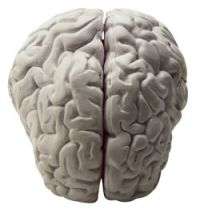
You already know it's hard to balance your checkbook while simultaneously reflecting on your past. Now, investigators at the Stanford University School of Medicine—having done the equivalent of wire-tapping a hard-to-reach region of the brain—can tell us how this impasse arises.
The researchers showed that groups of nerve cells in a structure called the posterior medial cortex, or PMC, are strongly activated during a recall task such as trying to remember whether you had coffee yesterday, but just as strongly suppressed when you're engaged in solving a math problem.
The PMC, situated roughly where the brain's two hemispheres meet, is of great interest to neuroscientists because of its central role in introspective activities.
"This brain region is famously well-connected with many other regions that are important for higher cognitive functions," said Josef Parvizi, MD, PhD, associate professor of neurology and neurological sciences and director of Stanford's Human Intracranial Cognitive Electrophysiology Program. "But it's very hard to reach. It's so deep in the brain that the most commonly used electrophysiological methods can't access it."
In a study to be published online Sept. 3 in Proceedings of the National Academy of Sciences, Parvizi and his Stanford colleagues found a way to directly and sensitively record the output from this ordinarily anatomically inaccessible site in human subjects. By doing so, the researchers learned that particular clusters of nerve cells in the PMC that are most active when you are recalling details of your own past are strongly suppressed when you are performing mathematical calculations. Parvizi is the study's senior author. The first and second authors, respectively, are postdoctoral scholars Brett Foster, PhD, and Mohammed Dastjerdi, PhD.
Much of our understanding of what roles different parts of the brain play has been obtained by techniques such as functional magnetic resonance imaging, which measures the amount of blood flowing through various brain regions as a proxy for activity in those regions. But changes in blood flow are relatively slow, making fMRI a poor medium for listening in on the high-frequency electrical bursts (approximately 200 times per second) that best reflect nerve-cell firing. Moreover, fMRI typically requires pooling images from several subjects into one composite image. Each person's brain physiognomy is somewhat different, so the blending blurs the observable anatomical coordinates of a region of interest.
Nonetheless, fMRI imaging has shown that the PMC is quite active in introspective processes such as autobiographical memory processing ("I ate breakfast this morning") or daydreaming, and less so in external sensory processing ("How far away is that pedestrian?"). "Whenever you pay attention to the outside world, its activity decreases," said Parvizi.
To learn what specific parts of this region are doing during, say, recall versus arithmetic requires more-individualized anatomical resolution than an fMRI provides. Otherwise, Parvizi said, "if some nerve-cell populations become less active and others more active, it all washes out, and you see no net change." So you miss what's really going on.
For this study, the Stanford scientists employed a highly sensitive technique to demonstrate that introspective and externally focused cognitive tasks directly interfere with one another, because they impose opposite requirements on the same brain circuitry.
The researchers took advantage of a procedure performed on patients who were being evaluated for brain surgery at the Stanford Epilepsy Monitoring Unit, associated with Stanford University Medical Center. These patients were unresponsive to drug therapy and, as a result, suffered continuing seizures. The procedure involves temporarily removing small sections of a patient's skull, placing a thin plastic film containing electrodes onto the surface of the brain near the suspected point of origin of that patient's seizure (the location is unique to each patient), and then monitoring electrical activity in that region for five to seven days—all of it spent in a hospital bed. Once the epilepsy team identifies the point of origin of any seizures that occurred during that time, surgeons can precisely excise a small piece of tissue at that position, effectively breaking the vicious cycle of brain-wave amplification that is a seizure.
Implanting these electrode packets doesn't mean piercing the brain or individual cells within it. "Each electrode picks up activity from about a half-million nerve cells," Parvizi said. "It's more like dotting the ceiling of a big room, filled with a lot of people talking, with multiple microphones. We're listening to the buzz in the room, not individual conversations. Each microphone picks up the buzz from a different bunch of partiers. Some groups are more excited and talking more loudly than others."
The experimenters found eight patients whose seizures were believed to be originating somewhere near the brain's midline and who, therefore, had had electrode packets placed in the crevasse dividing the hemispheres. (The brain's two hemispheres are spaced far enough apart to slip an electrode packet between them without incurring damage.)
The researchers got permission from these eight patients to bring in laptop computers and put the volunteers through a battery of simple tasks requiring modest intellectual effort. "It can be boring to lie in bed waiting seven days for a seizure to come," said Foster. "Our studies helped them pass the time." The sessions lasted about an hour.
On the laptop would appear a series of true/false statements falling into one of four categories. Three categories were self-referential, albeit with varying degrees of specificity. Most specific was so-called "autobiographical episodic memory," an example of which might be: "I drank coffee yesterday." The next category of statements was more generic: "I eat a lot of fruit." The most abstract category, "self-judgment," comprised sentences along the lines of: "I am honest."
A fourth category differed from the first three in that it consisted of arithmetical equations such as: 67 + 6 = 75. Evaluating such a statement's truth required no introspection but, instead, an outward, more sensory orientation.
For each item, patients were instructed to press "1" if a statement was true, "2" if it was false.
Significant portions of the PMC that were "tapped" by electrodes became activated during self-episodic memory processing, confirming the PMC's strong role in recall of one's past experiences. Interestingly, true/false statements involving less specifically narrative recall—such as, "I eat a lot of fruit"—induced relatively little activity. "Self-judgment" statements—such as, "I am attractive"—elicited none at all. Moreover, whether a volunteer judged a statement to be true or false made no difference with respect to the intensity, location or duration of electrical activity in activated PMC circuits.
This suggests, both Parvizi and Foster said, that the PMC is not the brain's "center of self-consciousness" as some have proposed, but is more specifically engaged in constructing autobiographical narrative scenes, as occurs in recall or imagination.
Foster, Dastjerdi and Parvizi also found that the PMC circuitry activated by a recall task took close to a half-second to fire up, ruling out the possibility that this circuitry's true role was in reading or making sense of the sentence on the screen. (These two activities are typically completed within the first one-fifth of a second or so.) Once activated, these circuits remained active for a full second.
Yet all the electrodes that lit up during the self-episodic condition were conspicuously deactivated during arithmetic calculation. In fact, the circuits being monitored by these electrodes were not merely passively silent, but actively suppressed, said Parvizi. "The more a circuit is activated during autobiographical recall, the more it is suppressed during math. It's essentially impossible to do both at once."


