New method of resurfacing bone improves odds of successful grafts
September 25, 2012 in Medical research
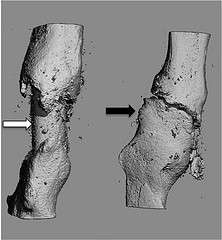
Bone graft coated with inorganic material. Credit: Henry Donahue
(Medical Xpress)—Coating a bone graft with an inorganic compound found in bones and teeth may significantly increase the likelihood of a successful implant, according to Penn State researchers.
Natural bone grafts need to be sterilized and processed with chemicals and radiation before implantation into the body to ensure that disease is not transmitted by the graft. Human bones have a rough surface. However, once a graft is sterilized the surface changes and is not optimal for stimulating bone formation in the body.
"We created a method for resurfacing bone that had been processed, and resurfacing that bone so that it is now nearly as osteogenic as unprocessed bone—meaning it works nearly as well as bone that hadn't been processed at all," said Henry J. Donahue, Michael and Myrtle Baker Professor of Orthopaedics and Rehabilitation, Penn State College of Medicine. "That's the bottom line."
Donahue, who is also a faculty member of the Huck Institutes of the Life Sciences, and Alayna Loiselle, postdoctoral fellow in orthopaedics and rehabilitation, Penn State College of Medicine, teamed up with Akhlesh Lakhtakia, Charles Godfrey Binder Professor of Engineering Science and Mechanics. They developed a way to create a rough surface on bone grafts that is similar in texture to the surface of an untreated bone. This similarity promotes healing in the bone.
The researchers found that by coating a bone with the inorganic compound hydroxyapatite, using physical vapor deposition, they could closely mimic the rough surface of an untreated bone.
To find the optimum thickness of hydroxyapatite, Donahue and Loiselle sterilized the graft samples in their lab at Penn State Hershey Medical Center. After sterilization, the samples went to the University Park campus, where physical vapor deposition layered different amounts of hydroxyapatite on the grafts. Then the samples were returned to Hershey for Donahue and Loiselle to test.
The researchers saw that the optimum thickness of hydroxyapatite was in the middle of what they tested. If the hydroxyapatite coating was not thick enough—or there was none—the graft implant worked, but did not integrate as well as if there were a few nanometers more layered onto the surface. If the hydroxyapatite was too thick, the graft implant again worked, but did not integrate as well as the researchers had seen was possible.
"I thought we wouldn't need to coat the bone more than a couple of hundred nanometers. As it turns out, it was much less than that," said Lakhtakia.
A hundred nanometers is about the size of a single virus.
Fifteen years ago Lakhtakia started an area called sculptured thin films. He thought these might be used to heal broken bones, but wasn't sure how. He suggested that for two bones to be joined, coating the two opposing faces with sculptured thin film might bring them together. Bone is living tissue, so bone would grow through the sculptured thin film and fuse together and create some sort of adhesive bond.
"When [Dr. Donahue] said he had this particular problem and asked if I could do something about it, I thought about that," said Lakhtakia. "In 15 years or so, my understanding had considerably evolved, and the one thing that I thought was that whatever needs to be done on the bone should not take too much time and should be little in size. If it is little, there is a better chance of integration inside the body—less foreign material inside the human body."
The researchers also believe this method could be used for soft musculoskeletal tissue implants and orthopedic device implants.
Provided by
Pennsylvania State University
-
Microwave heating improves artificial bone
Jul 24, 2012 |
not rated yet |
0
-
Nanotubes inspire new technique for healing broken bones
Jul 07, 2005 |
not rated yet |
0
-
Toward a better material for hip replacement and other joint implants
Sep 19, 2012 |
not rated yet |
0
-
Researcher develops new coating to help bone implants last
Sep 20, 2012 |
not rated yet |
0
-
Crowning glory: Bonelike coating for dental implants makes everyone smile
Apr 04, 2008 |
not rated yet |
0
-
Motion perception revisited: High Phi effect challenges established motion perception assumptions
Apr 23, 2013 |
3 / 5 (2) |
2
-
Anything you can do I can do better: Neuromolecular foundations of the superiority illusion (Update)
Apr 02, 2013 |
4.5 / 5 (11) |
5
-
The visual system as economist: Neural resource allocation in visual adaptation
Mar 30, 2013 |
5 / 5 (2) |
9
-
Separate lives: Neuronal and organismal lifespans decoupled
Mar 27, 2013 |
4.9 / 5 (8) |
0
-
Sizing things up: The evolutionary neurobiology of scale invariance
Feb 28, 2013 |
4.8 / 5 (10) |
14
-
Why is zone 1 in liver more prone to ischemic injury?
May 23, 2013
-
How can there be villous adenoma in colon, if there are no villi there
May 22, 2013
-
How can there be a term called "intestinal metaplasia" of stomach
May 21, 2013
-
Pressure-volume curve: Elastic Recoil Pressure don't make sense
May 18, 2013
-
If you became brain-dead, would you want them to pull the plug?
May 17, 2013
-
MRI bill question
May 15, 2013
- More from Physics Forums - Medical Sciences
More news stories
Study reveals new mechanism for estrogen suppression of liver lipid synthesis
By discovering the new mechanism by which estrogen suppresses lipid synthesis in the liver, UC Irvine endocrinologists have revealed a potential new approach toward treating certain liver diseases.
Medical research
May 23, 2013 |
5 / 5 (1) |
0
|
MRI-based measurement helps predict vascular disease in the brain
Aortic arch pulse wave velocity, a measure of arterial stiffness, is a strong independent predictor of disease of the vessels that supply blood to the brain, according to a new study published in the June issue the journal ...
Medical research
May 23, 2013 |
not rated yet |
0
Antibiotics: A new understanding of sulfonamide nervous system side effects
Since the discovery of Prontosil in 1932, sulfonamide antibiotics have been used to combat a wide spectrum of bacterial infections, from acne to chlamydia and pneumonia. However, their side effects can include serious neurological ...
Medical research
May 23, 2013 |
3 / 5 (1) |
0
|
Scientists discover molecule triggers sensation of itch
Scientists at the National Institutes of Health report they have discovered in mouse studies that a small molecule released in the spinal cord triggers a process that is later experienced in the brain as ...
Medical research
May 23, 2013 |
5 / 5 (3) |
0
|
Discarded immune cells induce the relocation of stem cells
Spanish researchers have discovered that the daily clearance of neutrophils from the body stimulates the release of hematopoietic stem cells from the bone marrow into the bloodstream, according to a report published today ...
Medical research
May 23, 2013 |
5 / 5 (2) |
0
First drug to improve heart failure mortality in over a decade
Coenzyme Q10 decreases all cause mortality by half, according to the results of a multicentre randomised double blind trial presented today at Heart Failure 2013 congress. It is the first drug to improve heart failure mortality ...
Heart failure accelerates male 'menopause'
Heart failure accelerates the aging process and brings on early andropausal syndrome (AS), according to research presented today at the Heart Failure Congress 2013. AS, also referred to as male 'menopause', was four times ...
Death highest in heart failure patients admitted in January, on Friday, and overnight
Mortality and length of stay are highest in heart failure patients admitted in January, on Friday, and overnight, according to research presented today at the Heart Failure Congress 2013. The analysis of nearly 1 million ...
Feds fight morning-after pill age ruling in NY
(AP)—Department of Justice lawyers have again asked a federal appeals court in New York to delay lifting age restrictions and prescription requirements on an emergency contraceptive popularly known as the morning-after ...
Researchers identify first drug targets in childhood genetic tumor disorder
Two mutations central to the development of infantile myofibromatosis (IM)—a disorder characterized by multiple tumors involving the skin, bone, and soft tissue—may provide new therapeutic targets, according to researchers ...
Driving and hands-free talking lead to spike in errors, study shows
Talking on a hands-free device while behind the wheel can lead to a sharp increase in errors that could imperil other drivers on the road, according to new research from the University of Alberta.