How non-verbal cues can predict person's—and robot's—trustworthiness
September 11, 2012 in Psychology & Psychiatry

How non-verbal cues can predict person's—and robot's—trustworthiness

Enlarge

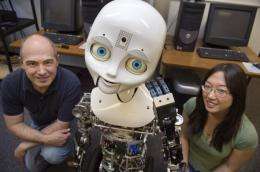
Nexi the robot has been furthering social science and social robotics studies for the past several years. Photo by Mary Knox Merrill.

People face this predicament all the time—can you determine a person's character in a single interaction? Can you judge whether someone you just met can be trusted when you have only a few minutes together? And if you can, how do you do it?

Using a robot named Nexi, Northeastern University David DeSteno and Cynthia Breazeal from MIT's Media Lab and Robert Frank and David Pizarro from Cornell University have figured out the answer. The findings were recently pub¬lished in the journal , a journal of the Association for Psychological Science.

It's What You're Not Saying…

In the absence of reliable information about a person's reputation, can offer a look into a person's likely actions. This concept has been known for years, but the cues that convey trustworthiness or untrustworthiness have remained a mystery. Collecting data from face-to-face conversations with research participants where money was on the line, DeSteno and his team realized that it's not one single non-verbal movement or cue that determines a person's trustworthiness, but rather sets of cues. When participants expressed these cues, they cheated their partners more, and, at a gut level, their partners expected it. "Scientists haven't been able to unlock the cues to trust because they've been going about it the wrong way," DeSteno said. "There's no one golden-cue. Context and coordination of movements is what matters."

This video is not supported by your browser at this time.

Robots Have Feelings, Too

People are fidgety – they're moving all the time. So how could the team truly zero-in on the cues that mattered? This is where Nexi comes in. Nexi is a humanoid that afforded the team an important benefit – they could control all its movements perfectly. In a second experiment, the team had research participants converse with Nexi for 10 minutes, much like they did with another person in the first experiment. While conversing with the participants, Nexi—operated remotely by researchers—either expressed cues that were considered less than trustworthy or expressed similar, but non-trust-related cues. Confirming their theory, the team found that participants exposed to Nexi's untrustworthy cues intuited that Nexi was likely to cheat them and adjusted their financial decisions accordingly. "Certain nonverbal gestures trigger emotional reactions we're not consciously aware of, and these reactions are enormously important for understanding how interpersonal relationships develop," said Frank. "The fact that a robot can trigger the same reactions confirms the mechanistic nature of many of the forces that influence human interaction."

Real-Life Application

This discovery has led the research team to not only answer enduring questions about if and how people are able to assess the of an unknown person, but also to show the human mind's willingness to ascribe trust-related intentions to technological entities based on the same movements. "This is a very exciting result that showcases how social robots can be used to gain important insights about human behavior," said Cynthia Breazeal of MIT's Media Lab. "This also has fascinating implications for the design of future robots that interact and work alongside people as partners." Accordingly, these findings hold important insights not only for security and financial endeavors and for the evolving design of robots and computer-based agents. The subconscious mind is ready to see these entities as social beings.

Journal reference: Psychological Science search and more info website

Provided by Association for Psychological Science search and more info website

3.3 /5 (3 votes)  

Rank 3.3 /5 (3 votes)
Related Stories
Relevant PhysicsForums posts

More news stories

Ketamine shows significant therapeutic benefit in people with treatment-resistant depression

Patients with treatment-resistant major depression saw dramatic improvement in their illness after treatment with ketamine, an anesthetic, according to the largest ketamine clinical trial to-date led by researchers from the ...

Psychology & Psychiatry created 23 hours ago | popularity 4.8 / 5 (5) | comments 1 | with audio podcast

US psychiatry gets makeover in new manual

The latest makeover to a massive psychiatric tome honored by some, reviled by others and even called the "Bible" of mental disorders is being released Saturday with a host of new changes.

Psychology & Psychiatry created May 18, 2013 | popularity not rated yet | comments 1

Study reviews readmissions in inpatient psychiatric facilities

(HealthDay)—Most Medicare beneficiaries treated in inpatient psychiatric facilities (IPFs) exhibit characteristics associated with hospital readmission, according to a report prepared for the National Association ...

Psychology & Psychiatry created May 17, 2013 | popularity not rated yet | comments 0

Skydiving is never plane sailing

Skydivers show the same level of physical stress before every jump whether a first-timer or experienced jumper, say Northumbria researchers.

Psychology & Psychiatry created May 17, 2013 | popularity not rated yet | comments 0 | with audio podcast

Kids, especially boys, perceive sadness of depressed parents

Children of depressed parents pick up on their parents' sadness—whether mom or dad realizes their mood or not.

Psychology & Psychiatry created May 17, 2013 | popularity 4.5 / 5 (2) | comments 1 | with audio podcast


New theory on genesis of osteoarthritis comes with successful therapy in mice

Scientists at Johns Hopkins have turned their view of osteoarthritis (OA) inside out. Literally. Instead of seeing the painful degenerative disease as a problem primarily of the cartilage that cushions joints, ...

Computational tool translates complex data into simplified 2-dimensional images

In their quest to learn more about the variability of cells between and within tissues, biomedical scientists have devised tools capable of simultaneously measuring dozens of characteristics of individual ...

Researchers identify a potential new risk for sleep apnea: Asthma

Researchers at the University of Wisconsin have identified a potential new risk factor for obstructive sleep apnea: asthma. Using data from the National Institutes of Health (Heart, Lung, and Blood Institute)-funded Wisconsin ...

Study finds that sleep apnea and Alzheimer's are linked

A new study looking at sleep-disordered breathing (SDB) and markers for Alzheimer's disease (AD) risk in cerebrospinal fluid (CSF) and neuroimaging adds to the growing body of research linking the two.

'Gap' for HIV vaccine efforts after latest setback

The hunt for an HIV vaccine has gobbled up $8 billion in the past decade, and the failure of the most recent efficacy trial has delivered yet another setback to 26 years of efforts.

Ginger compounds may be effective in treating asthma symptoms

Gourmands and foodies everywhere have long recognized ginger as a great way to add a little peppery zing to both sweet and savory dishes; now, a study from researchers at Columbia University shows purified components of the ...