Orangutan's cancer treatment similar to humans
September 17, 2012 by Suzette Laboy in Cancer
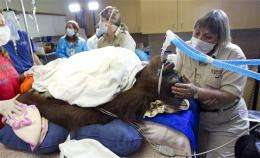
In this Sept. 5, 2012 photo, Jungle Island volunteer Linda Jacobs comforts Peanut, one of the orangutans from a private zoo, as a group of medical professionals gather over the medical table for R-CHOP therapy, a combination of drugs used in chemotherapy to treat her aggressive non-Hodgkin lymphoma in Miami. Human medical specialists are treading new ground in applying a standard chemotherapy regimen to treat cancer in an orangutan. Orangutans share about 96 percent of a human's genetic makeup, and Peanut's treatment plan is closer to that of what a human would receive for the same type of cancer, making this the first documented case of an orangutan being treated with this type of therapy (AP Photo/J Pat Carter)
(AP)—Peanut is an 8-year-old orangutan and a star attraction at Miami's Jungle Island. These days she's also got a team of cancer doctors huddling around her, watching as the chemo drip flows into her veins.
Peanut, who was diagnosed with non-Hogkin lymphoma, is not the first great ape to be treated for cancer like a human. An orangutan with advanced stage cancer at the National Zoo in Washington had surgery to remove a cancerous intestinal tumor in 2000. In 2009, two female gorillas at the North Carolina Zoo underwent radiation therapy. All three cases involved much older apes, in their 30s or 40s, and all had to be euthanized.
But while other animals are treated with chemotherapy, it's not common among orangutans.
Dr. Ryan DeVoe, senior veterinarian at the North Carolina Zoo where the two female gorillas lived, said he has found no record of other great apes being treated with chemo. But he also noted that many cases involving great apes with cancer are not reported or documented.
DeVoe said another unique aspect of Peanut's case is that, unlike the older apes, she has age on her side for either being cured or at least experiencing remission and living normally and comfortably for a long period of time.
The orangutan has been undergoing chemotherapy to treat the aggressive lymphoma since August.
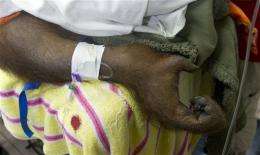
In this Sept. 5, 2012 photo, an IV line is stuck in Peanut's arm as she undergoes R-CHOP therapy, a combination of drugs used in chemotherapy to treat her aggressive non-Hodgkin lymphoma in Miami. Human medical specialists are treading new ground in applying a standard chemotherapy regimen to treat cancer in an orangutan. Orangutans share about 96 percent of a human's genetic makeup, and Peanut's treatment plan is closer to that of what a human would receive for the same type of cancer, making this the first documented case of an orangutan being treated with this type of therapy. (AP Photo/J Pat Carter)
Peanut's diagnosis came by chance when her veterinary team found she had an intestinal obstruction and further testing revealed the cancer. The private zoo had no board certified veterinary oncologist on staff and turned to the Sylvester Comprehensive Cancer Center at the University of Miami Miller School of Medicine. A team there, along with UM's Division of Comparative Pathology, which specializes in wildlife, confirmed the diagnosis and is now providing guidance for Peanut's treatment."I've never had the same combination of fear and enthusiasm in one patient before," said Dr. Joseph Rosenblatt, one of the doctors treating Peanut. "We don't know what to expect and yet we're intensely curious and potentially hopeful that we can help the animal."
Working on an orangutan is a first for Rosenblatt, who has never worked on an animal larger than a mouse.
"When the animal looks at you in the eye, it's both a sympathetic as well as a look that radiates intelligence," he said.
Peanut has a fraternal twin named Pumpkin, a rarity in the animal kingdom. They are the youngest of six orangutans at Jungle Island and a hit with park visitors. Both are highly intelligent and have been taught to use sign language and an iPad to communicate with their trainers, but they have distinct personalities. Peanut is welcoming and demanding, offering her doctor a twig in return for his water bottle. Pumpkin is quiet and her hair hangs low over her forehead. Pumpkin has not been diagnosed with the disease.
Rosenblatt said doctors chose a plan for treatment that has been most effective in humans, adding that they are treating Peanut's lymphoma with slightly reduced doses in an effort not to overshoot. The process that might take 4 to 5 hours in a human takes about 3 hours in Peanut, who will get six doses—21 days apart—unless her body can't handle it.
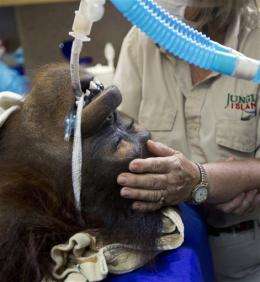
In this Sept. 5, 2012 photo, Jungle Island volunteer Linda Jacobs comforts Peanut, one of the orangutans from a private zoo, as she is treated with R-CHOP therapy, a combination of drugs used in chemotherapy to treat her aggressive non-Hodgkin lymphoma in Miami. Human medical specialists are treading new ground in applying a standard chemotherapy regimen to treat cancer in an orangutan. Orangutans share about 96 percent of a human's genetic makeup, and Peanut's treatment plan is closer to that of what a human would receive for the same type of cancer, making this the first documented case of an orangutan being treated with this type of therapy (AP Photo/J Pat Carter)
Peanut's doctors caution against raising expectations about her future and how effective the treatments will be."They work very well in human beings, but we don't know if they will work as well in this setting," Rosenblatt said.
Unlike humans, Peanut must be sedated for her treatments at an animal clinic in Miami. And although doctors know anesthesia causes nausea in animals, it is not clear if that or the chemo caused Peanut to vomit after her first treatment. She stays indoors out of sight of park visitors soon after the treatments and comes outside into an enclosure only when she feels up to it.
Her caretakers say explaining cancer to a human is difficult, but explaining it to a highly intelligent animal such as Peanut who communicates with her trainers and park visitors is nearly impossible.
"That is one part of cancer we do not have to deal with," said veterinarian Jason Chatfield, Jungle Island's general curator. "We made it a point not to even talk about the cancer in front of her because she may not comprehend cancer, disease, lymphoma and all these fancy words. She absolutely knows something is wrong, something is different with her." He said the team wants to keep a positive attitude around her.
Born in captivity, Peanut and Pumpkin came to the zoo when they were 6 months old.
"I have been with her since she was born," said Linda Jacobs, Peanut's trainer, holding back tears. "So I really am very sensitive to her needs and her moods."
Jacobs said Peanut is fatigued but hasn't lost much of her reddish-orange hair "and she still has that twinkle in her eye."
Despite possible complications and an uncertain outcome, Rosenblatt said Peanut is still a model patient "and God willing, she will be a cancer survivor."
Copyright 2012 The Associated Press. All rights reserved. This material may not be published, broadcast, rewritten or redistributed.
-
Peanut allergies overstated, study finds
May 16, 2007 |
not rated yet |
0
-
New peanut allergy treatment works, study shows
Mar 21, 2011 |
not rated yet |
0
-
Treating peanut allergy through a patch
Mar 02, 2011 |
not rated yet |
0
-
Study shows chimps capable of insightful reasoning ability
Jun 10, 2011 |
not rated yet |
0
-
Tillage, rotation impacts peanut crops
Nov 10, 2008 |
not rated yet |
0
-
Motion perception revisited: High Phi effect challenges established motion perception assumptions
Apr 23, 2013 |
3 / 5 (2) |
2
-
Anything you can do I can do better: Neuromolecular foundations of the superiority illusion (Update)
Apr 02, 2013 |
4.5 / 5 (11) |
5
-
The visual system as economist: Neural resource allocation in visual adaptation
Mar 30, 2013 |
5 / 5 (2) |
9
-
Separate lives: Neuronal and organismal lifespans decoupled
Mar 27, 2013 |
4.9 / 5 (8) |
0
-
Sizing things up: The evolutionary neurobiology of scale invariance
Feb 28, 2013 |
4.8 / 5 (10) |
14
-
Why is zone 1 in liver more prone to ischemic injury?
May 23, 2013
-
How can there be villous adenoma in colon, if there are no villi there
May 22, 2013
-
How can there be a term called "intestinal metaplasia" of stomach
May 21, 2013
-
Pressure-volume curve: Elastic Recoil Pressure don't make sense
May 18, 2013
-
If you became brain-dead, would you want them to pull the plug?
May 17, 2013
-
MRI bill question
May 15, 2013
- More from Physics Forums - Medical Sciences
More news stories
New fluorescent tools for cancer diagnosis
In recent years, microRNAs (miRNAs) and other non-coding RNAs are small molecules that help control the expression of specific proteins. In recent years they have emerged as disease biomarkers. miRNA profiles have been used ...
Cancer
15 hours ago |
not rated yet |
0
Modulating the immune system to combat metastatic cancer
Cancer cells spread and grow by avoiding detection and destruction by the immune system. Stimulation of the immune system can help to eliminate cancer cells; however, there are many factors that cause the immune system to ...
Cancer
15 hours ago |
5 / 5 (1) |
0
Scientists put bowel cancer under the microscope
Researchers from London's Kingston University have begun a two-year study which could help prolong the lives of people with colorectal tumours.
Cancer
19 hours ago |
5 / 5 (1) |
0
Researcher identifies breast cancer fighting hormone
Transformative research from Western University has identified new hormones in the body which may suppress breast cancer and stimulate the regression of breast tumors.
Cancer
19 hours ago |
5 / 5 (2) |
0
Ground breaking cancer research finds immune system link
(Medical Xpress)—Curtin University researchers have found evidence that targeting specific cells in the body can reverse the effects of cancer on the immune system.
Cancer
20 hours ago |
5 / 5 (4) |
0
Engineered cytomegalovirus protects monkeys from HIV equivalent
(Medical Xpress)—A new study by researchers in the US has shown that an ancient virus can be modified to help in the fight against the simian immunodeficiency virus SIV, which is the equivalent in monkeys ...
Researchers identify first drug targets in childhood genetic tumor disorder
Two mutations central to the development of infantile myofibromatosis (IM)—a disorder characterized by multiple tumors involving the skin, bone, and soft tissue—may provide new therapeutic targets, according to researchers ...
Hormone levels may provide key to understanding psychological disorders in women
Women at a particular stage in their monthly menstrual cycle may be more vulnerable to some of the psychological side-effects associated with stressful experiences, according to a study from UCL.
Going live: Immune cell activation in multiple sclerosis
Biological processes are generally based on events at the molecular and cellular level. To understand what happens in the course of infections, diseases or normal bodily functions, scientists would need to ...
Help at hand for people with schizophrenia
How can healthy people who hear voices help schizophrenics? Finding the answer for this is at the centre of research conducted at the University of Bergen.
Alzheimer's disease, the soft target of the euthanasia debate
(Medical Xpress)—The way Alzheimer's disease is portrayed by advocacy groups and the media is having undue influence on the euthanasia debate, according to a Deakin University nursing ethics professor.

