Pigs' cells used to create first 'living football'
September 10, 2012 in Medical research
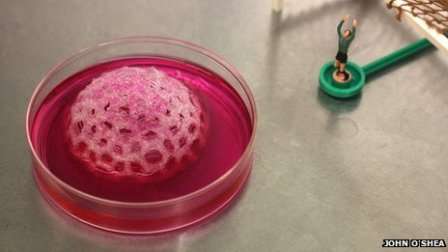
Special scaffold materials were created so the tissue could take on a football form. Credit: John O'Shea
(Medical Xpress)—The world's first 'living football' using cells from a pig's bladder has been created by an artist working with scientists in the University's Clinical Engineering laboratories.
Experimental artist, John O'Shea, worked with Professor John Hunt for more than two years to create the football, which was inspired by the very first footballs made from pigs' bladders.
Professor Hunt, from the Institute of Ageing and Chronic Disease, said: "When John first came to talk to us we had already supported the artists that came to Liverpool for the European Capital of Culture exhibitions in 2008. The idea of using a tissue engineering process to grow a football – using materials with cells in bioreactors – was an interesting concept.
"John spent the first six months learning how to manage and maintain cell populations in the lab. We undertook a number of experiments to develop the process for growing the ball, from obtaining the animal cells to creating special scaffold materials so that the tissue could take on a football form.
"Gathering the cells to build the artificial bladder was also a challenge as John wanted to use the same waste materials which were historically used to make footballs rather than use cells from a commercial supplier, which meant we had to ensure the material was not contaminated travelling to the lab."
John O'Shea said: "When I heard that an artificial human bladder transplant had been successful, I thought the football could be re-invented using a similar process.
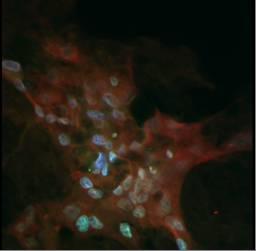
Cells in a scaffold.
"Football itself has many different forms all over the world and I had heard stories from people older than myself about the way, as children, they would make footballs from pigs' bladders. When we consider that footballs are now completely synthetic, this organic origin fascinated me, and I wanted to recreate it."The finished work has formed the centrepiece of Manchester's Abandon Normal Devices exhibition, which showcases a range of experimental art as part of the 2012 Cultural Olympiad. John O'Shea's work with Professor Hunt was funded through the Wellcome Trust's artist in residence program.
Provided by
University of Liverpool
-
Scientists move closer to bio-engineered bladders
Aug 01, 2007 |
not rated yet |
0
-
New World Cup football will unsettle goalkeepers, predicts scientist
Jun 07, 2006 |
not rated yet |
0
-
Stem cells make new heart valves
Sep 11, 2007 |
not rated yet |
0
-
How football playing robots have the future of artificial intelligence at their feet
Sep 13, 2010 |
not rated yet |
0
-
Scientists progress in successful tissue engineering
Mar 23, 2007 |
not rated yet |
0
-
Motion perception revisited: High Phi effect challenges established motion perception assumptions
Apr 23, 2013 |
3 / 5 (2) |
2
-
Anything you can do I can do better: Neuromolecular foundations of the superiority illusion (Update)
Apr 02, 2013 |
4.5 / 5 (11) |
5
-
The visual system as economist: Neural resource allocation in visual adaptation
Mar 30, 2013 |
5 / 5 (2) |
9
-
Separate lives: Neuronal and organismal lifespans decoupled
Mar 27, 2013 |
4.9 / 5 (8) |
0
-
Sizing things up: The evolutionary neurobiology of scale invariance
Feb 28, 2013 |
4.8 / 5 (10) |
14
-
Why is zone 1 in liver more prone to ischemic injury?
May 23, 2013
-
How can there be villous adenoma in colon, if there are no villi there
May 22, 2013
-
How can there be a term called "intestinal metaplasia" of stomach
May 21, 2013
-
Pressure-volume curve: Elastic Recoil Pressure don't make sense
May 18, 2013
-
If you became brain-dead, would you want them to pull the plug?
May 17, 2013
-
MRI bill question
May 15, 2013
- More from Physics Forums - Medical Sciences
More news stories
Study reveals new mechanism for estrogen suppression of liver lipid synthesis
By discovering the new mechanism by which estrogen suppresses lipid synthesis in the liver, UC Irvine endocrinologists have revealed a potential new approach toward treating certain liver diseases.
Medical research
May 23, 2013 |
not rated yet |
0
|
MRI-based measurement helps predict vascular disease in the brain
Aortic arch pulse wave velocity, a measure of arterial stiffness, is a strong independent predictor of disease of the vessels that supply blood to the brain, according to a new study published in the June issue the journal ...
Medical research
May 23, 2013 |
not rated yet |
0
Antibiotics: A new understanding of sulfonamide nervous system side effects
Since the discovery of Prontosil in 1932, sulfonamide antibiotics have been used to combat a wide spectrum of bacterial infections, from acne to chlamydia and pneumonia. However, their side effects can include serious neurological ...
Medical research
May 23, 2013 |
not rated yet |
0
|
Scientists discover molecule triggers sensation of itch
Scientists at the National Institutes of Health report they have discovered in mouse studies that a small molecule released in the spinal cord triggers a process that is later experienced in the brain as ...
Medical research
May 23, 2013 |
5 / 5 (3) |
0
|
Discarded immune cells induce the relocation of stem cells
Spanish researchers have discovered that the daily clearance of neutrophils from the body stimulates the release of hematopoietic stem cells from the bone marrow into the bloodstream, according to a report published today ...
Medical research
May 23, 2013 |
5 / 5 (2) |
0
Engineered cytomegalovirus protects monkeys from HIV equivalent
(Medical Xpress)—A new study by researchers in the US has shown that an ancient virus can be modified to help in the fight against the simian immunodeficiency virus SIV, which is the equivalent in monkeys ...
Researchers identify first drug targets in childhood genetic tumor disorder
Two mutations central to the development of infantile myofibromatosis (IM)—a disorder characterized by multiple tumors involving the skin, bone, and soft tissue—may provide new therapeutic targets, according to researchers ...
Hormone levels may provide key to understanding psychological disorders in women
Women at a particular stage in their monthly menstrual cycle may be more vulnerable to some of the psychological side-effects associated with stressful experiences, according to a study from UCL.
Going live: Immune cell activation in multiple sclerosis
Biological processes are generally based on events at the molecular and cellular level. To understand what happens in the course of infections, diseases or normal bodily functions, scientists would need to ...
Driving and hands-free talking lead to spike in errors, study shows
Talking on a hands-free device while behind the wheel can lead to a sharp increase in errors that could imperil other drivers on the road, according to new research from the University of Alberta.
Depression raises diabetics' risk of severe low blood sugar episodes
(Medical Xpress)—Patients with diabetes who are depressed are much more likely to develop episodes of dangerously low blood sugars, or hypoglycemia, than are those who are not depressed, a new study has ...