Surgery has a more profound effect than anesthesia on brain pathology and cognition in Alzheimer's animal model
September 14, 2012 in Alzheimer's disease & dementia
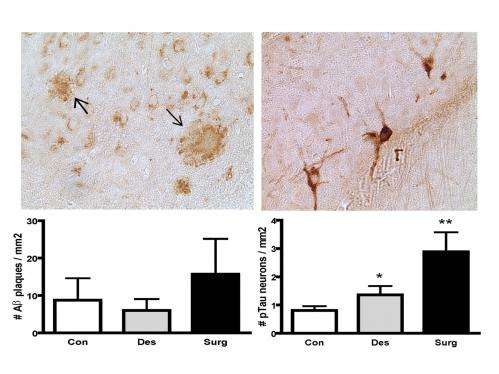
Shown are representative microscope images of amyloid plaque (on left, arrows), and intracellular tau (on right) in the mouse brain. Below each image are the data showing enhancement of both pathological features when surgery is added to anesthesia (desflurane). Credit: Tang et al, Annals of Surgery, 2012
(Medical Xpress)—A syndrome called "post-operative cognitive decline" has been coined to refer to the commonly reported loss of cognitive abilities, usually in older adults, in the days to weeks after surgery. In fact, some patients time the onset of their Alzheimer's disease symptoms from a surgical procedure. Exactly how the trio of anesthesia, surgery, and dementia interact is clinically inconclusive, yet of great concern to patients, their families and physicians.
A year ago, researchers at the Perelman School of Medicine at the University of Pennsylvania reported that Alzheimer's pathology, as reflected by cerebral spinal fluid biomarkers, might be increased in patients after surgery and anesthesia. However, it is not clear whether the anesthetic drugs or the surgical procedure itself was responsible. To separate these possibilities, the group turned to a mouse model of Alzheimer's disease.
The results, published online this month in the Annals of Surgery, show that surgery itself, rather than anesthesia, has the more profound impact on a dementia-vulnerable brain.
The team, led by Roderic Eckenhoff, MD, Austin Lamont Professor of Anesthesia, exposed mice with human Alzheimer disease genes, to either anesthesia alone, or anesthesia and an abdominal surgery. The surgery was similar to appendectomy or colectomy, very common procedures in humans. They found that surgery causes a lasting increase in Alzheimer's pathology, primarily through a transient activation of brain inflammation. Also, a significant cognitive impairment persisted for at least 14 weeks after surgery compared to controls receiving anesthesia alone. Neither surgery nor anesthesia produced changes in normal non-transgenic animals.
"In the mice, there was a clear and persistent decrement in learning and memory caused by surgery as compared with inhalational anesthesia – but only in the context of a brain made vulnerable by human Alzheimer-associated transgenes," notes Eckenhoff.
He also notes that at the time of surgery, the AD mice showed no outward symptoms of AD, despite having subtle evidence of ongoing neuropathology. "This timeline is analogous to both the age range and cognitive status of many of our patients presenting for a surgical procedure and suggests the window of vulnerability to surgery of the Alzheimer's brain extends into this pre-symptomatic period," says Eckenhoff. This period might be analogous to what is now called prodromal AD.
"On the other hand," cautions Maryellen Eckenhoff, PhD, a neuroscientist on the team, "the brain vulnerability seen in the AD mice may not translate well to people." The AD mice used, like all current mouse models of Alzheimer disease, more closely resemble the situation in familial Alzheimer disease, which constitutes only a small minority of patients. She points out that it is not yet clear whether results from AD mouse models will represent patients who eventually get late-onset, or "sporadic" Alzheimer disease. These mice are, however, the current standard of choice for screening new drugs and have yielded considerable insight into Alzheimer pathogenesis.
The mechanism linking surgery and the cognitive effects seems to be inflammation. An inflammatory process is well known to occur as a result of surgery, at least outside the central nervous system. How this inflammatory process gains access to the brain, and accelerates AD pathology in a persistent way is still unclear.
Postoperative cognitive decline has not been convincingly demonstrated to persist after three months in most people, and whether it predicts later dementia is still unclear. This study suggests that in the setting of a vulnerable brain, the cognitive deficits after surgery might be irreversible.
However, the finding that inflammation is the underlying mechanism, immediately suggests a strategy for mitigating injury. "Human studies will be needed to first confirm these findings and then begin to deploy anti-inflammatory strategies to minimize injury," adds Eckenhoff. "As a profession, doctors need to understand the long-term implications of our care, both positive and negative, and do all we can to delay the onset of dementia."
Journal reference:
Annals of Surgery
Provided by
University of Pennsylvania School of Medicine
-
Study shows increased Alzheimer's biomarkers in patients after anesthesia and surgery
Oct 04, 2011 |
not rated yet |
0
-
Study finds inhaled anesthetics accelerate the appearance of brain plaque in animals
Mar 09, 2007 |
not rated yet |
0
-
Study reveals how anesthetic isoflurane induces Alzheimer's-like changes in mammalian brains
Mar 01, 2012 |
not rated yet |
0
-
Test for Alzheimer's disease predicts cognitive decline in Parkinson's disease
Dec 12, 2011 |
not rated yet |
0
-
Anesthesia increases risk of developing Alzheimer's disease in patients with genetic predisposition
Mar 24, 2010 |
not rated yet |
0
-
Motion perception revisited: High Phi effect challenges established motion perception assumptions
Apr 23, 2013 |
3 / 5 (2) |
2
-
Anything you can do I can do better: Neuromolecular foundations of the superiority illusion (Update)
Apr 02, 2013 |
4.5 / 5 (11) |
5
-
The visual system as economist: Neural resource allocation in visual adaptation
Mar 30, 2013 |
5 / 5 (2) |
9
-
Separate lives: Neuronal and organismal lifespans decoupled
Mar 27, 2013 |
4.9 / 5 (8) |
0
-
Sizing things up: The evolutionary neurobiology of scale invariance
Feb 28, 2013 |
4.8 / 5 (10) |
14
-
Calculating on-axis elements of a solenoid
5 hours ago
-
latitude & longitude & air pressure
7 hours ago
-
Differences of Classical Mechanics when learned with Calc vs algebra?
10 hours ago
-
what is the distance traveled
14 hours ago
-
Image of a Convex Lens Cut in Half Horizontally
18 hours ago
-
Ray tracing through optical system of thick lenses
18 hours ago
- More from Physics Forums - Classical Physics
More news stories
Drugs found to both prevent and treat Alzheimer's disease in mice
Researchers at USC have found that a class of pharmaceuticals can both prevent and treat Alzheimer's Disease in mice.
Alzheimer's disease & dementia
May 21, 2013 |
5 / 5 (7) |
0
|
Scientists identify molecular trigger for Alzheimer's disease
Researchers have pinpointed a catalytic trigger for the onset of Alzheimer's disease – when the fundamental structure of a protein molecule changes to cause a chain reaction that leads to the death of neurons ...
Alzheimer's disease & dementia
May 20, 2013 |
5 / 5 (4) |
0
|
Study finds that sleep apnea and Alzheimer's are linked
A new study looking at sleep-disordered breathing (SDB) and markers for Alzheimer's disease (AD) risk in cerebrospinal fluid (CSF) and neuroimaging adds to the growing body of research linking the two.
Alzheimer's disease & dementia
May 19, 2013 |
5 / 5 (3) |
0
|
Alzheimer's leaves bilingual victims stranded in Canada
The devastating effect of Alzheimer's disease on bilingual people has been thrown into focus in Canada, where the sudden loss of a second language can leave sufferers feeling like strangers in their own country.
Alzheimer's disease & dementia
May 19, 2013 |
not rated yet |
0
Study identifies new approach to improving treatment for MS and other conditions
(Medical Xpress)—Working with lab mice models of multiple sclerosis (MS), UC Davis scientists have detected a novel molecular target for the design of drugs that could be safer and more effective than current FDA-approved ...
Alzheimer's disease & dementia
May 17, 2013 |
5 / 5 (2) |
0
|
Slowing the aging process—only with antibiotics
Swiss scientists reveal the mechanism responsible for aging hidden deep within mitochondria—and dramatically slow it down in worms by administering antibiotics to the young.
Rate of bicycle-related fatalities significantly lower in states with helmet laws
Existing research shows that bicyclists who wear helmets have an 88 percent lower risk of brain injury, but researchers at Boston Children's Hospital found that simply having bicycle helmet laws in place showed a 20 percent ...
Researchers complete largest genetic sequencing study of human disease
Researchers from Queen Mary, University of London have led the largest sequencing study of human disease to date, investigating the genetic basis of six autoimmune diseases.
Brain can be trained in compassion, study shows
Until now, little was scientifically known about the human potential to cultivate compassion—the emotional state of caring for people who are suffering in a way that motivates altruistic behavior.
Having both migraines, depression may mean smaller brain
(HealthDay)—Migraines and depression can each cause a great deal of suffering, but new research indicates the combination of the two may be linked to something else entirely—a smaller brain.
Novel approach for influenza vaccination shows promise in early animal testing
A new approach for immunizing against influenza elicited a more potent immune response and broader protection than the currently licensed seasonal influenza vaccines when tested in mice and ferrets. The vaccine ...