'A-game' strategies for parents, coaches in youth sports

This is the book cover for "Parenting Young Athletes," by Frank Smoll and Ron Smith, psychology professors at the University of Washington. Credit: Rowman & Littlefield Publishing Group Inc.
Parents typically are the biggest headaches for coaches in youth sports. These well-meaning adults may berate their child's performance, criticize sport-officials' decisions or yell instructions that contradict the coach. Or maybe the problem is that the parent is uninvolved and only sees sports as a babysitting service.
"Unknowing" parents – as Frank Smoll, a University of Washington sport psychologist, calls them – can foul up the experience for young athletes. "But just because they're unaware, doesn't mean that they have to be a problem," he said.
In two new books, Smoll and Ron Smith, both UW psychology professors, share strategies to help parents and coaches work together to help kids get more out of sports. In "Parenting Young Athletes" and "Sport Psychology for Youth Coaches," the psychologists sum up what they've learned from nearly four decades of research and about 500 training workshops for 26,000 youth-sport coaches. They've been youth coaches themselves, too.
"When we work with coaches, they always ask about what they can do to get parents on the same page," Smith said. "We find that good coaching skills are similar to good parenting skills in that, when done well, kids are happier, less anxious and have better self-esteem."
In their books, Smoll and Smith describe their coaching method called the Mastery Approach to Coaching, which emphasizes giving maximum effort and improving skills. They say it's the only educational program for youth-sport coaches that's been scientifically shown to decrease kids' competitive anxiety and increase their self-esteem and enjoyment of sports.
In "Sport Psychology for Youth Coaches," the psychologists focus on techniques for providing positive reinforcement as the best way to benefit both youngsters' athletic as well as personal development.
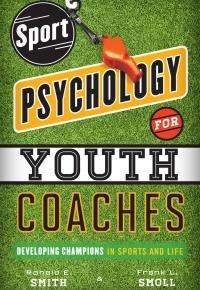
This is the book cover for "Sport Psychology for Youth Coaches," by Frank Smoll and Ron Smith, psychology professors at the University of Washington. Credit: Rowman & Littlefield Publishing Group Inc.
"If an athlete makes a mistake, give encouragement and demonstrate how to make it right," Smith said. "What doesn't work is promoting the mentality of winning at all costs."He added that "winning takes care of itself when you create kids who feel good about themselves, gain more skills, are engaged in the activity because they're having fun, and aren't shackled by fear of failure."
Smith and Smoll give tips to coaches on how to deal with "problem" parents and athletes, and the authors also provide an overview of coaches' legal responsibilities.
"Parenting Young Athletes" is directed at all parents, regardless of athletic experience, and offers advice on how to be productively involved in their child's sport activities.
"We emphasize to parents that the coach is in charge, and they can't undermine the coach's leadership authority," Smoll said. "But parents have a responsibility to oversee their children's welfare, and we give suggestions on how they can do that."
Their recommendations to parents include finding out what time and cost responsibilities the parents take on when enrolling their child in a sport. The psychologists also advise parents on issues related to sports medicine, including how to take care of injuries, recommending water for rehydration, and suggesting other food needs for athletes.
Smoll encourages parents to volunteer to coach their kids' teams − even those who may be unsure about doing so.
"Sport programs are always looking for more head and assistant coaches. Parents don't need to have been superstar athletes, they should just be motivated to provide growth-promoting experiences for the kids."
In the end, sports aren't just a way to keep kids busy and entertained, Smoll and Smith say, but rather they provide a training ground for other life skills, like bouncing back after setbacks and cooperating with peers.
Mental toughness, or ability to perform under pressure, is one of the most valued qualities in athletes. In both books, Smoll and Smith provide tips on how to help kids learn to be mentally tough through a combination of stress management, coping with the fear of failure and developing "winning" attitudes.
More information: The books were published Sept. 15 by Rowman & Littlefield Publishing Group Inc. and are based on research funded by the National Institutes of Health and the William T. Grant Foundation.
Provided by
University of Washington
-
Spring training for Parents? Youth sport programs would benefit
Mar 18, 2008 |
not rated yet |
0
-
Coaches can shape young athletes' definition of success
Nov 17, 2009 |
not rated yet |
0
-
For kids, it's more than just a game
Jul 20, 2011 |
not rated yet |
0
-
Disabled athletes face segregation in coaching researchers say
Sep 03, 2012 |
not rated yet |
0
-
Focus on self-improvement, rather than winning, benefits young athletes
Feb 09, 2012 |
not rated yet |
0
-
Motion perception revisited: High Phi effect challenges established motion perception assumptions
Apr 23, 2013 |
3 / 5 (2) |
2
-
Anything you can do I can do better: Neuromolecular foundations of the superiority illusion (Update)
Apr 02, 2013 |
4.5 / 5 (11) |
5
-
The visual system as economist: Neural resource allocation in visual adaptation
Mar 30, 2013 |
5 / 5 (2) |
9
-
Separate lives: Neuronal and organismal lifespans decoupled
Mar 27, 2013 |
4.9 / 5 (8) |
0
-
Sizing things up: The evolutionary neurobiology of scale invariance
Feb 28, 2013 |
4.8 / 5 (10) |
14
-
Classical and Quantum Mechanics via Lie algebras
Apr 15, 2011
- More from Physics Forums - Independent Research
More news stories
Do doctors understand the individualisation of treatments?
The individualisation of drug treatments to support patients to self-manage their conditions is a concept that sits at the heart of policy, but a recent study in BMJ Open shows that there is no concrete defini ...
Health
1 hour ago |
not rated yet |
0
Keep summer water fun safe with training and supervision
Fun in the summer often means kids spending time in the water, whether at a pool, the beach, a lake or river. A pediatric safety expert at the University of Alabama at Birmingham (UAB) stresses proper training ...
Health
1 hour ago |
not rated yet |
0
Pregnant bellies: Updating the tape measure technique
A new way of interpreting information from a low-tech, age-old method used in pregnancy care is expected to more accurately identify potential health issues for mothers and babies.
Health
2 hours ago |
not rated yet |
0
Obesity weighs down on top soda guzzler Mexico
Artemio Martinez balanced his corpulent frame on a stool in a Mexico City street taco stand, downing a sweet soda and eating a final pork-filled corn tortilla.
Health
4 hours ago |
not rated yet |
0
Consumers largely underestimating calorie content of fast food
People eating at fast food restaurants largely underestimate the calorie content of meals, especially large ones, according to a paper published today in BMJ.
Health
15 hours ago |
not rated yet |
0
Scientists put bowel cancer under the microscope
Researchers from London's Kingston University have begun a two-year study which could help prolong the lives of people with colorectal tumours.
New neuron formation could increase capacity for new learning, at the expense of old memories
New research presented today shows that formation of new neurons in the hippocampus - a brain region known for its importance in learning and remembering - could cause forgetting of old memories by causing a reorganization ...
Are there atheists in foxholes? Study says they're the minority
Ernie Pyle – an iconic war correspondent in World War II – reportedly said "There are no atheists in foxholes." A new joint study between two brothers at Cornell and Virginia Wesleyan found that only ...
Saudi to send animal samples to US in coronavirus probe
Saudi Arabia said Friday it would send samples taken from animals possibly infected with a deadly SARS-like virus to the United States for testing in a bid to find the source of disease.
Engineered cytomegalovirus protects monkeys from HIV equivalent
(Medical Xpress)—A new study by researchers in the US has shown that an ancient virus can be modified to help in the fight against the simian immunodeficiency virus SIV, which is the equivalent in monkeys ...
Help at hand for people with schizophrenia
How can healthy people who hear voices help schizophrenics? Finding the answer for this is at the centre of research conducted at the University of Bergen.
