Comparing animal and human cancers for mutual benefit
October 16, 2012 in Cancer

Comparing animal and human cancers for mutual benefit

Enlarge

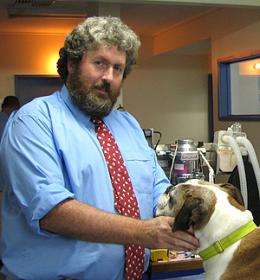
Dr Peter Bennett: "We want to improve and maintain the quality of life of both human and animal cancer patients."

(Medical Xpress)—A diagnosis of cancer once spelled the end for our animal companions but the launch today of a specialty cancer clinic, led by one of Australia's leading veterinary oncologists at the University of Sydney, offers new hope.

"Our clinic is one of the first specialist oncology services to be established in a veterinary teaching hospital in Australia," said Dr Peter Bennett from the University's Faculty of Veterinary Science and the newly appointed head of the cancer service. Dr Bennett's position is a joint appointment with the NHMRC Clinical Trials Centre to drive comparative research.

Both dogs and cats have a range of cancers, and many of these are similar to the diseases seen in humans including lymphoma, melanomas, skin cancer and bone tumours.

"My ambition is to identify cutting edge treatment options developed for people that may benefit veterinary patients, as well as use information gained from animal cases to help our understanding of how cancers occur and how we manage them in people. Most importantly we want to improve and maintain the quality of life of both human and animal cancer patients," Dr Bennett said.

sufferers will also benefit from the University's recent establishment of a research group to compare human and animal cancer. Dr Bennett will contribute to the recently established Comparative Oncology Special Interest Group (CO-SIG) chaired by Dr Beata Ujvari, which promotes collaboration between human and animal cancer researchers for mutual benefit.

Comparative oncology is a multidisciplinary approach that connects clinicians, oncologists, pathologists, epidemiologists and molecular researchers who study naturally occurring animal tumours.

"Comparative oncology has been a major contributor to better pet care in America in the last five years but this diverse, multidisciplinary group is new for Australia, where veterinary oncology is only a recent development," Dr Bennett said.

Animal are essential to improving our understanding of what is happening at the molecular level in cancer development.

One research area being focused on by the University is viruses that increase the risk of cancer in cats. "We are looking at the role of viruses in cat lymphoma. Cats are now the most popular choice of pet in the world and lymphoma is the most common cancer they suffer. It is also common in humans," said Associate Professor Julia Beatty, who is leading the research.

Knowing that the Epstein-Barr virus can cause cancer in people with immunodeficiency problems, such as transplant recipients or AIDS patients, Associate Professor Beatty is studying if a similar virus causes lymphoma and other cancers in cats.

"Our aim is to design treatments and vaccines to improve cancer treatment outcomes in cats and people," Associate Professor Beatty said.

Members of CO-SIG are also investigating molecules that influence the clinical outcome of canine mast cell tumours in dogs; the high incidence of lymphoma in some dog breeds; and Tasmanian Devil Facial Tumour Disease, where a is transmitted by bites due to the devils' immune system failing to recognise the need to respond.

Provided by University of Sydney search and more info website

not rated yet  

Rank not rated yet
Relevant PhysicsForums posts

More news stories

New smartphone application improves colonoscopy preparation

The use of a smartphone application significantly improves patients' preparation for a colonoscopy, according to new research presented today at Digestive Disease Week (DDW). The preparation process, which begins days in ...

Cancer created 21 hours ago | popularity not rated yet | comments 0

Research examines new methods for managing digestive health

Research presented at Digestive Disease Week (DDW) explores new methods for managing digestive health through diet and lifestyle.

Cancer created 22 hours ago | popularity not rated yet | comments 1

New colonoscope provides ground-breaking view of colon

A ground-breaking advance in colonoscopy technology signals the future of colorectal care, according to research presented today at Digestive Disease Week(DDW). Additional research focuses on optimizing the minimal withdrawal ...

Cancer created May 18, 2013 | popularity 5 / 5 (2) | comments 0

ASCO: combo antibody therapy effective for melanoma

(HealthDay)—Concurrent use of two immune checkpoint antibodies—ipilimumab and nivolumab—may be effective for the treatment of advanced melanoma, according to a proof-of-principal study presented in ...

Cancer created May 17, 2013 | popularity not rated yet | comments 0

Risk factors ID'd for poor cutaneous cell CA outcomes

(HealthDay)—The risks of metastasis and death associated with cutaneous squamous cell carcinoma (CSCC) are low, but significant, and risk factors for poor outcome include tumor diameter, invasion beyond ...

Cancer created May 17, 2013 | popularity not rated yet | comments 0 | with audio podcast


Researchers identify a potential new risk for sleep apnea: Asthma

Researchers at the University of Wisconsin have identified a potential new risk factor for obstructive sleep apnea: asthma. Using data from the National Institutes of Health (Heart, Lung, and Blood Institute)-funded Wisconsin ...

Computational tool translates complex data into simplified 2-dimensional images

In their quest to learn more about the variability of cells between and within tissues, biomedical scientists have devised tools capable of simultaneously measuring dozens of characteristics of individual ...

New theory on genesis of osteoarthritis comes with successful therapy in mice

Scientists at Johns Hopkins have turned their view of osteoarthritis (OA) inside out. Literally. Instead of seeing the painful degenerative disease as a problem primarily of the cartilage that cushions joints, ...

Study finds that sleep apnea and Alzheimer's are linked

A new study looking at sleep-disordered breathing (SDB) and markers for Alzheimer's disease (AD) risk in cerebrospinal fluid (CSF) and neuroimaging adds to the growing body of research linking the two.

'Gap' for HIV vaccine efforts after latest setback

The hunt for an HIV vaccine has gobbled up $8 billion in the past decade, and the failure of the most recent efficacy trial has delivered yet another setback to 26 years of efforts.

Ginger compounds may be effective in treating asthma symptoms

Gourmands and foodies everywhere have long recognized ginger as a great way to add a little peppery zing to both sweet and savory dishes; now, a study from researchers at Columbia University shows purified components of the ...