New study finds brain tumors can arise from neurons
October 19, 2012
by Lin Edwards
in Cancer
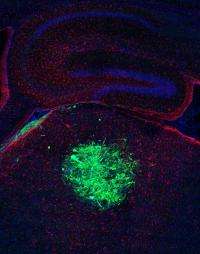
A mouse brain contains a glioma (green) three weeks after being injected with a virus that targeted mature astrocytes and altered the expression levels of two oncogenes, HRasV12 and p53. GFAP expression (red) reveals reactive astrocytes surrounding the tumor. Credit: Dr. Eric Bushong
(Medical Xpress)—Researchers from the US and Japan have shown that an aggressive type of brain tumor can arise from normal cells in the central nervous system such as neurons. The cells revert to an earlier, undifferentiated stem cell stage, which can then reproduce prolifically.
The international team of scientists, led by Professor Inder Verma and geneticist Dr Dinorah Friedmann Morvinski, both of the Salk Institute for Biological Studies at La Jolla in California, studied the development of malignant glioblastoma tumors in mice. They had earlier developed a new method of researching cancer by using viruses to introduce cancer-causing genes (oncogenes) into the mice brains, as reported in Phys.Org.
Many of the mouse studies on cancer revolve around transplanting human tissue or cancer cells into immune-compromised mice to begin the process of tumor formation, but this is not the way that real tumors develop in humans. The San Diego team therefore designed a new method, which aimed to imitate the appearance of random mutations by transferring novel oncogenes to healthy mouse cells via genetically modified viruses.
In the new study, they also introduced oncogenes via viruses, and when tumors began to form they then transferred some of the cells to the brains of healthy mice. They discovered that only as few as 10 cells were needed to produce a tumor in the healthy brain.
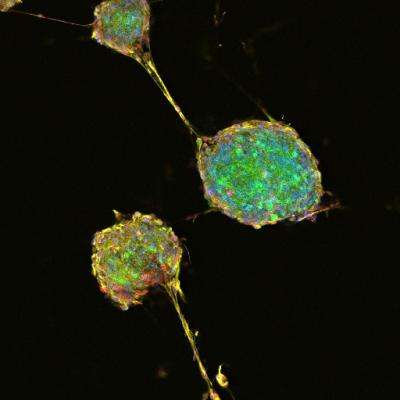
The blue, green, red and yellow in this image indicate that these neurons are producing proteins typical of immature nerve cells, evidence that they have reverted to a stem cell-like state. Salk scientists found that mature cortical neurons are capable of reverting to this immature state and developing into an aggressive type of brain tumor that was previously thought to only develop from neural stem cells or glia, another type of cell in the brain. Credit: Dinorah Friedmann-Morvinski
Scientists had earlier assumed glioblastoma tumors only arose from glial cells, which support and protect the neurons and supply them with nutrients and oxygen. When stem cells were discovered within the brain, they were also implicated as being capable of leading to cancer cells.The new research shows that tumors can in fact have their origins in several types of differentiated cells in the central nervous system, including neural stem cells, astrocytes (a sub-type of glial cell) and even neurons, when cancer-causing genes are introduced. Neurons do not divide, but when the genes were introduced they were found to transform into stem cells that could reproduce rapidly.
Tumors arising from astrocytes and neurons were similar to the most common and aggressive glioblastoma multiforme (GBM) brain tumors found in humans. The average length of survival after diagnosis of this type of tumor is around 14 months.
The research, reported in the journal Science, could explain why GBM tumors are so aggressive and difficult to treat, and why they can re-grow even after the tumor has been surgically removed or killed by chemotherapy drugs. In effect every cell left behind after the treatment can start the tumor-building process again.
The next phase of the research will be to learn more about the dedifferentiation process in which cells turn into reproducing stem cells, and then work out a way to block it.
More information: Dedifferentiation of Neurons and Astrocytes by Oncogenes Can Induce Gliomas in Mice, Science, DOI: 10.1126/science.1226929
ABSTRACT
Glioblastoma multiforme (GBM) is the most common and aggressive malignant primary brain tumor in humans. Here, we show that gliomas can originate from differentiated cells in the central nervous system (CNS), including cortical neurons. Transduction by oncogenic lentiviral vectors of neural stem cells (NSCs), astrocytes, or even mature neurons in the brain of mice can give rise to malignant gliomas. All the tumors, irrespective of the site of injection (initiating population), share common features of high expression of stem or progenitor markers and low expression of differentiation markers. Microarray analysis revealed that tumors of astrocytic and neuronal origin match the mesenchymal GBM subtype. We propose that most differentiated cells in the CNS upon defined genetic alterations undergo dedifferentiation to generate a NSC or progenitor state to initiate and maintain the tumor progression, as well as to give rise to the heterogeneous populations observed in malignant gliomas.
Journal reference:
Science
© 2012 Medical Xpress
-
Researchers develop novel glioblastoma mouse model
Jan 04, 2009 |
not rated yet |
0
-
How brain tumors invade
Dec 12, 2011 |
not rated yet |
0
-
Study suggests new treatment target for glioblastoma multiforme
Aug 01, 2012 |
not rated yet |
0
-
Brain tumors: Tissue stem cell turning into tumor stem cell
Apr 01, 2010 |
not rated yet |
0
-
Neural stem cells attack glioblastoma cells
Jul 06, 2010 |
not rated yet |
0
-
Motion perception revisited: High Phi effect challenges established motion perception assumptions
Apr 23, 2013 |
3 / 5 (2) |
2
-
Anything you can do I can do better: Neuromolecular foundations of the superiority illusion (Update)
Apr 02, 2013 |
4.5 / 5 (11) |
5
-
The visual system as economist: Neural resource allocation in visual adaptation
Mar 30, 2013 |
5 / 5 (2) |
9
-
Separate lives: Neuronal and organismal lifespans decoupled
Mar 27, 2013 |
4.9 / 5 (8) |
0
-
Sizing things up: The evolutionary neurobiology of scale invariance
Feb 28, 2013 |
4.8 / 5 (10) |
14
-
Pressure-volume curve: Elastic Recoil Pressure don't make sense
May 18, 2013
-
If you became brain-dead, would you want them to pull the plug?
May 17, 2013
-
MRI bill question
May 15, 2013
-
Ratio of Hydrogen of Oxygen in Dessicated Animal Protein
May 13, 2013
-
Alcohol and acetaminophen
May 13, 2013
-
Marie Curie's leukemia
May 13, 2013
- More from Physics Forums - Medical Sciences
More news stories
Older prostate cancer patients should think twice before undergoing treatment
Older prostate cancer patients with other underlying health conditions should think twice before committing to surgery or radiation therapy for their cancer, according to a multicenter study led by researchers in the UCLA ...
Cancer
10 hours ago |
not rated yet |
0
|
Two radiotherapy treatments show similar morbidity, cancer control after prostatectomy
Intensity-modulated radiation therapy has become the most commonly used type of radiation in prostate cancer, but research from the University of North Carolina suggests that the therapy may not be more effective than older, ...
Cancer
12 hours ago |
not rated yet |
0
The compound in the Mediterranean diet that makes cancer cells 'mortal'
New research suggests that a compound abundant in the Mediterranean diet takes away cancer cells' "superpower" to escape death. By altering a very specific step in gene regulation, this compound essentially re-educates cancer ...
Cancer
12 hours ago |
4.8 / 5 (11) |
2
|
CT radiation risk less than risk of examination indicator
(HealthDay)—For young adults needing either a chest or abdominopelvic computed tomography (CT), the short-term risk of death from underlying morbidity is greater than the long-term risk of radiation-induced ...
Cancer
13 hours ago |
not rated yet |
0
Team finds mechanism linking key inflammatory marker to cancer
In a new study described in the journal Oncogene, researchers reveal how a key player in cell growth, immunity and the inflammatory response can be transformed into a primary contributor to tumor growth.
Cancer
19 hours ago |
not rated yet |
0
|
Genetic predictors of postpartum depression uncovered
Johns Hopkins researchers say they have discovered specific chemical alterations in two genes that, when present during pregnancy, reliably predict whether a woman will develop postpartum depression.
Child maltreatment increases risk of adult obesity
Children who have suffered maltreatment are 36% more likely to be obese in adulthood compared to non-maltreated children, according to a new study by King's College London. The authors estimate that the prevention or effective ...
New immune system discovered
(Medical Xpress)—A research team, led by Jeremy Barr, a biology post-doctoral fellow, unveils a new immune system that protects humans and animals from infection.
Early-life traffic-related air pollution exposure linked to hyperactivity
Early-life exposure to traffic-related air pollution was significantly associated with higher hyperactivity scores at age 7, according to new research from the University of Cincinnati (UC) and Cincinnati Children's Hospital ...
Do salamanders hold the solution to regeneration?
Salamanders' immune systems are key to their remarkable ability to regrow limbs, and could also underpin their ability to regenerate spinal cords, brain tissue and even parts of their hearts, scientists have ...
Scientists identify molecular trigger for Alzheimer's disease
Researchers have pinpointed a catalytic trigger for the onset of Alzheimer's disease – when the fundamental structure of a protein molecule changes to cause a chain reaction that leads to the death of neurons ...
Oct 19, 2012
Rank: not rated yet