China passes law to curb abuse of mental hospitals
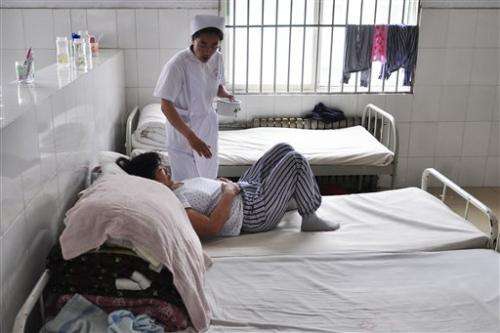
(AP)—China's legislature on Friday passed a long-awaited mental health law that aims to prevent people from being involuntarily held and unnecessarily treated in psychiatric facilities—abuses that have been used against government critics and triggered public outrage.
The law standardizes mental health care services, requiring general hospitals to set up special outpatient clinics or provide counseling, and calls for the training of more doctors.
Debated for years, the law attempts to address an imbalance in Chinese society—a lack of mental health care services for a population that has grown more prosperous but also more aware of modern-day stresses and the need for treatment. Psychiatrists who helped draft and improve the legislation welcomed its passage.
"The law will protect the rights of mental patients and prevent those who don't need treatment from being forced to receive it," said Dr. Liu Xiehe, an 85-year-old psychiatrist based in the southwestern city of Chengdu, who drafted the first version of the law in 1985.
"Our mental health law is in line with international standards. This shows the government pays attention to the development of mental health and the protection of people's rights in this area," Liu told The Associated Press by phone.
Pressure has grown on the government in recent years after state media and rights activists reported cases of people forced into mental hospitals when they did not require treatment. Some were placed there by employers with whom they had wage disputes, some by their family members in fights over money, and others—usually people with grievances against officials—by police who wanted to silence them.
Yang Yamei, of the Inner Mongolian city of Hulunbuir, has been locked up at a local mental hospital for the last eight months in what her daughter says is retaliation for her attempts to seek compensation from the government for a court ruling that unfairly sentenced her to three years in a labor camp.
This is the third time in four years that she has been forcibly committed, her daughter Guo Dandan said by phone.
"It's because my mother has been petitioning for help, but the authorities don't want to solve her problems, so they put her in there," Guo said. "I have tried many times to persuade her doctors to release her, but they refuse."
Guo's claim could not be independently verified. Local government offices and the mental hospital could not immediately be reached for comment.
"I only hope that the law will be stricter," Guo said. "In the cases of petitioners, when the authorities can use their personal relationships with doctors to fake medical records, hospitals should not be allowed to accept such cases."
The law states for the first time that mental health examinations and treatment must be conducted on a voluntary basis, unless a person is considered a danger to himself or others. Only psychiatrists have the authority to commit people to hospitals for treatment, and treatment may be compulsory for patients diagnosed with a severe mental illness, according to the law.
Significantly, the law gives people who feel they have been unnecessarily admitted into mental health facilities the right to appeal.
But it will likely be a challenge for people to exercise that right once they are in the system, said Huang Xuetao, a lawyer who runs an organization in the southern city of Shenzhen that assists people who have been committed against their will.
Though questions remain over how the law will be enforced and whether sufficient government funding will be provided to enable the expansion of services, psychiatrists said the passage of the legislation marked a milestone.
"It's very exciting. I honestly believe this will start a new trajectory," said Dr. Michael Phillips, a Canadian psychiatrist who has worked in China for nearly three decades and now heads a suicide research center in Shanghai.
Phillips said the biggest change for the psychiatric system is the curb on involuntary admissions. At least 80 percent of hospital admissions are compulsory, he said.
___
Associated Press researcher Flora Ji contributed to this report.
Follow Gillian Wong on Twitter: twitter.com/gillianwong
Copyright 2012 The Associated Press. All rights reserved. This material may not be published, broadcast, rewritten or redistributed.


