Study finds diabetes raises levels of proteins linked to Alzheimer's features
October 26, 2012 in Alzheimer's disease & dementia
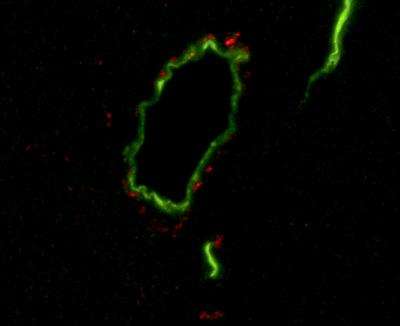
This microscope image shows blood vessels in the brain of mouse (green) surrounded by amyloid beta peptides (red), a component of the amyloid plaques found in the brains of Alzheimer's patients. Salk researchers found that these peptides accumulate in the brains of diabetic and aged mice, a finding that may help explain the connection between diabetes and Alzheimer's. Credit: Image: Courtesy of the Salk Institute for Biological Studies
Growing evidence suggests that there may be a link between diabetes and Alzheimer's disease, but the physiological mechanisms by which diabetes impacts brain function and cognition are not fully understood. In a new study published in Aging Cell, researchers at the Salk Institute for Biological Studies show, for the first time, that diabetes enhances the development of aging features that may underlie early pathological events in Alzheimer's.
Specifically, the Salk team found increases in two hallmarks of Alzheimer's-accumulations of amyloid beta (Abeta) and tau protein-in the brains of diabetic mice, especially in cells surrounding blood vessels. Abeta, the misfolded peptide that is thought in part to cause Alzheimer's disease, aggregated inside astrocytes, star-shaped brain cells that, upon interaction with Abeta, release inflammatory molecules that can destroy neurons. Previously, this had not been shown in mouse models of type 1 diabetes (T1D).
"Our study supports and extends the links between diabetes, aging and Alzheimer's," says senior author Pamela Maher, a senior staff scientist in Salk's Laboratory of Cellular Neurobiology. "We show that type 1 diabetes increases vascular-associated amyloid beta buildup in the brain and causes accelerated brain aging."
The findings suggest that the neurovascular system may be a good candidate for new therapeutic targets to treat Alzheimer's in the early stages of the disease.
Alzheimer's and diabetes are two diseases that are increasing at an alarming rate within the U.S. population. Alzheimer's affects one in 10 Americans over 65 years of age and nearly 50 percent of those over 85. Similarly, more than 8 percent of Americans (approximately 26 million people) have diabetes, with the vast majority of those individuals being over 60.
Maher says her team is uncertain of the precise mechanism behind the increase in Abeta and tau in the mouse brain, but their data suggest that changes in astrocytes, as well as other pro-inflammatory processes and the bonding of proteins with sugar molecules (called non-enzymatic glycation), may contribute.
"Astrocytes play a key role in maintaining nerve cells in the brain," says lead study author Antonio Currais, a postdoctoral researcher at Salk. "Both chronic peripheral inflammation and increased non-enzymatic glycation are associated with diabetes, and these changes may act on the brain to alter astrocyte function, which eventually leads to Alzheimer's-like changes."
All nerve cells are closely connected to blood vessels, as they need nutrients—— especially glucose (sugar) and oxygen—— provided by the blood in order to function. Astrocytes facilitate the transfer of nutrients between blood vessels and cells. The buildup of Abeta at sites where astrocytes interact with blood vessels suggest that this could impair the transfer of nutrients. The type of Abeta localization seen in Maher's mouse models is also found in human Alzheimer's patients
To examine the contributions of diabetes to Alzheimer's-related pathology in the aged brain, the Salk researchers induced T1D in two sets of mouse models. One set, known as SAMP8 mice, undergo accelerated aging and develop early deterioration in learning and memory, as well as a number of brain alterations similar to those found in Alzheimer's. The other set, SAMR1 mice, which in this study came from the same gene pool as the SAMP8 mice, age normally.
Using these mice, Maher and her colleagues addressed how T1D interacts with age to contribute to Alzheimer's-related pathology. They showed that T1D elicits a wide range of pathological changes in the brains of both strains of mice, which are exacerbated by premature aging.
The Salk study is the first to show that these modifications are similar to those seen in old nondiabetic SAMP8 mice and to identify unique pathological changes, such as increases in markers for inflammation, in aged, T1D SAMP8 mice. Unlike most mouse studies of Alzheimer's, Maher's mice were not engineered to produce high levels of human Abeta or tau,so all of their observations came from naturally occurringAbeta and tau.
Provided by
Salk Institute
-
Study links diabetes and Alzheimer's disease
Apr 30, 2008 |
not rated yet |
0
-
Naturally occurring enzyme can break down key part of Alzheimer's plaques
Oct 24, 2006 |
not rated yet |
0
-
Researchers identify how a gene linked to both Alzheimer's disease and type 2 diabetes works
Jul 18, 2011 |
not rated yet |
0
-
Key action of a gene linked to both Alzheimer's disease and type 2 diabetes identified
Sep 28, 2010 |
not rated yet |
0
-
Peripheral induction of Alzheimer's-like brain pathology in mice
Oct 21, 2010 |
not rated yet |
0
-
Motion perception revisited: High Phi effect challenges established motion perception assumptions
Apr 23, 2013 |
3 / 5 (2) |
2
-
Anything you can do I can do better: Neuromolecular foundations of the superiority illusion (Update)
Apr 02, 2013 |
4.5 / 5 (11) |
5
-
The visual system as economist: Neural resource allocation in visual adaptation
Mar 30, 2013 |
5 / 5 (2) |
9
-
Separate lives: Neuronal and organismal lifespans decoupled
Mar 27, 2013 |
4.9 / 5 (8) |
0
-
Sizing things up: The evolutionary neurobiology of scale invariance
Feb 28, 2013 |
4.8 / 5 (10) |
14
-
Question about perception of colors around light sources
2 hours ago
-
Does a charged particle rotate when traveling through a static Bf?
4 hours ago
-
Find a link between physics and assignment problems
5 hours ago
-
Light as a source of electricity
5 hours ago
-
A question about the energy stored in a capacitor.
5 hours ago
-
Electric field-Charge inside a metallic shell
8 hours ago
- More from Physics Forums - Classical Physics
More news stories
Study finds that sleep apnea and Alzheimer's are linked
A new study looking at sleep-disordered breathing (SDB) and markers for Alzheimer's disease (AD) risk in cerebrospinal fluid (CSF) and neuroimaging adds to the growing body of research linking the two.
Alzheimer's disease & dementia
5 hours ago |
5 / 5 (1) |
0
|
Alzheimer's leaves bilingual victims stranded in Canada
The devastating effect of Alzheimer's disease on bilingual people has been thrown into focus in Canada, where the sudden loss of a second language can leave sufferers feeling like strangers in their own country.
Alzheimer's disease & dementia
8 hours ago |
not rated yet |
0
Study identifies new approach to improving treatment for MS and other conditions
(Medical Xpress)—Working with lab mice models of multiple sclerosis (MS), UC Davis scientists have detected a novel molecular target for the design of drugs that could be safer and more effective than current FDA-approved ...
Alzheimer's disease & dementia
May 17, 2013 |
5 / 5 (2) |
0
|
Nonmelanoma skin cancer tied to lower Alzheimer's risk
(HealthDay)—Older individuals with nonmelanoma skin cancer (NMSC) seem to have a significantly reduced risk of developing Alzheimer's disease (AD), according to a study published online May 15 in Neurology.
Alzheimer's disease & dementia
May 16, 2013 |
5 / 5 (1) |
0
Skin cancer may be linked to lower risk of Alzheimer's disease
People who have skin cancer may be less likely to develop Alzheimer's disease, according to new research published in the May 15, 2013, online issue of Neurology®, the medical journal of the American Academy of Neurology. The li ...
Alzheimer's disease & dementia
May 15, 2013 |
5 / 5 (1) |
0
|
Researchers identify a potential new risk for sleep apnea: Asthma
Researchers at the University of Wisconsin have identified a potential new risk factor for obstructive sleep apnea: asthma. Using data from the National Institutes of Health (Heart, Lung, and Blood Institute)-funded Wisconsin ...
Computational tool translates complex data into simplified 2-dimensional images
In their quest to learn more about the variability of cells between and within tissues, biomedical scientists have devised tools capable of simultaneously measuring dozens of characteristics of individual ...
New theory on genesis of osteoarthritis comes with successful therapy in mice
Scientists at Johns Hopkins have turned their view of osteoarthritis (OA) inside out. Literally. Instead of seeing the painful degenerative disease as a problem primarily of the cartilage that cushions joints, ...
Ginger compounds may be effective in treating asthma symptoms
Gourmands and foodies everywhere have long recognized ginger as a great way to add a little peppery zing to both sweet and savory dishes; now, a study from researchers at Columbia University shows purified components of the ...
'Gap' for HIV vaccine efforts after latest setback
The hunt for an HIV vaccine has gobbled up $8 billion in the past decade, and the failure of the most recent efficacy trial has delivered yet another setback to 26 years of efforts.
Ketamine shows significant therapeutic benefit in people with treatment-resistant depression
Patients with treatment-resistant major depression saw dramatic improvement in their illness after treatment with ketamine, an anesthetic, according to the largest ketamine clinical trial to-date led by researchers from the ...