Researchers identify novel genes that may drive rare, aggressive form of uterine cancer
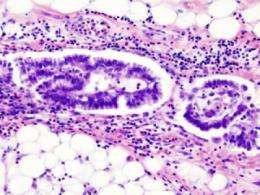
Researchers have identified several genes that are linked to one of the most lethal forms of uterine cancer, serous endometrial cancer. The researchers describe how three of the genes found in the study are frequently altered in the disease, suggesting that the genes drive the development of tumors. The findings appear in the Oct. 28, 2012, advance online issue of Nature Genetics. The team was led by researchers from the National Human Genome Research Institute (NHGRI), part of the National Institutes of Health.
Cancer of the uterine lining, or endometrium, is the most commonly diagnosed gynecological malignancy in the United States. Also called endometrial cancer, it is diagnosed in about 47,000 American women and leads to about 8,000 deaths each year.
Each of its three major subtypes—endometrioid, serous and clear-cell —is caused by a different constellation of genetic alterations and has a different prognosis. Endometrioid tumors make up about 80 percent of diagnosed tumors. Surgery often is a complete cure for women with the endometrioid subtype, since doctors usually diagnose these cases at an early stage.
Compared to other subtypes, the 2 to 10 percent of uterine cancers that comprise the serous subtype do not respond well to therapies. The five-year survival rate for serous endometrial cancer is 45 percent, compared to 65 percent for clear-cell and 91 percent for endometrioid subtypes. Serous and clear-cell endometrial tumor subtypes are clinically aggressive and quickly advance beyond the uterus.
"Serous endometrial tumors can account for as much as 39 percent of deaths from endometrial cancer," said Daphne W. Bell, Ph.D., an NHGRI investigator and the paper's senior author. Dr. Bell heads the Reproductive Cancer Genetics Section of NHGRI's Cancer Genetics Branch.
To determine which genes are altered in serous endometrial cancer, Dr. Bell and her team undertook a comprehensive genomic study of tumors by sequencing their exomes, the critical 1 to 2 percent of the genome that codes for proteins.
"Exome sequencing is a powerful tool for revealing important insights about this form of cancer that exacts such a high toll for thousands of women," said NHGRI Scientific Director Dan Kastner, M.D., Ph.D. "This study pinpoints genetic alterations that may be essential for onset and progression of uterine cancers and may eventually lead to new therapeutic targets."
Dr. Bell's team focused on the rarer, more aggressive forms of endometrial cancer. They began their study by examining serous tumor tissue and matched normal tissue from 13 patients. National Cancer Institute and Massachusetts General Hospital pathologists processed the 26 tissue samples, which subsequently underwent whole-exome sequencing at the NIH Intramural Sequencing Center.
With the exome data in hand, the researchers filtered through millions of data points to locate alterations, or mutations. They disqualified from the analysis any mutation found in a tumor and its matched healthy tissue, looking expressly for mutations that occurred exclusively in the tumor cells. They also eliminated one of the 13 tumors from analysis because its exome had hundreds more unique mutations than any other tumor.
The researchers detected more than 500 somatic mutations within the remaining 12 tumors. They next looked for genes that were mutated in more than one of the tumors. An alteration that occurs in more than one tumor is more likely to be relevant to the development of the cancer than a unique alteration.
"When you identify a set of mutations, they could either be drivers that have caused the cancer or incidental passengers that are of no consequence; our goal is to identify the drivers," Dr. Bell explained. "One way to do this is to home in on genes that are mutated in more than one tumor, because we know from experience that frequently mutated genes are often driver genes."
The team felt confident that alterations in nine genes could be driver genes in serous endometrial cancer. Three of the nine genes had previously been recognized by researchers in the cancer genetics field as a cause of serous endometrial cancer. To get a clearer picture of driver gene status among the other six genes, the researchers sequenced each gene in 40 additional serous endometrial tumors. They discovered that three of the six genes—CHD4, FBXW7 and SPOP—are altered at a statistically high frequency in serous endometrial cancer.
The team also found that this set of three genes is mutated in 40 percent of the serous endometrial cancer tumors and in 15 to 26 percent of the other endometrial cancer subtypes.
Probing still further, the researchers looked for the same genes highlighted by their exome sequencing study within databases that organize genes according to their biological function. They found an enrichment of genes involved in chromatin remodeling, the dynamic process by which the contents of the cell nucleus, including DNA, are packaged and modified. Chromatin remodeling enables tightly packaged DNA to be accessed for the expression of genes. Intriguingly, CHD4 was one of the genes that formed the chromatin-remodeling cluster.
"We sequenced the other genes that make up this cluster and, as a set, these genes are frequently mutated in both serous and clear-cell endometrial tumors," said Dr. Bell.
They also noted frequent mutations in genes that regulate a process known as ubiquitin-mediated protein degradation. The process targets unneeded proteins for destruction, and thus prevents them from accumulating within the cell. Left to accumulate, some of the target proteins are known to drive cancer formation. FBXW7 and SPOP are both known to play a role in binding to the unneeded proteins and targeting them for destruction.
Many of the FBXW7 gene mutations that Dr. Bell's team identified are known in other cancers to be driver mutations that prevent the FBXW7 protein from binding to its target protein. Dr. Bell believes that altered SPOP may behave the same way. "All the mutations we found in SPOP are in the region that binds the target proteins" she said. "We suspect the mutations in SPOP might lead to the accumulation of the unneeded proteins within the cell. But that has to be tested."
The current findings build on the team's 2011 study that showed for the first time that alterations in the PIK3R1 gene occur in all subtypes of endometrial cancer and are most frequent in the more common endometrioid subtype.
"This discovery really changes our understanding of some of the genetic alterations that may contribute to this disease," Dr. Bell said, acknowledging that the findings are limited by the small number of tumors subjected to exome sequencing.
She noted that it is too early to make a direct connection between their findings and prospects for treatments for this aggressive form of uterine cancer.


