'Grassroots' neurons wire and fire together for dominance in the brain
October 24, 2012 in Neuroscience
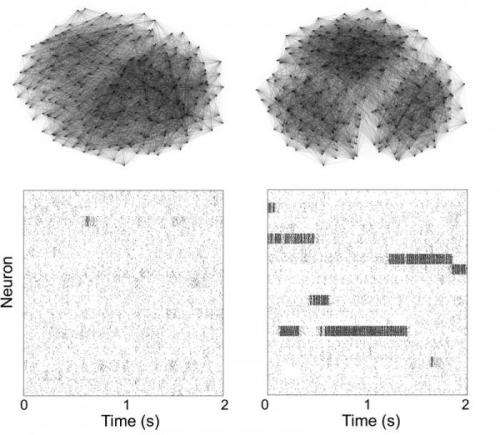
Every time a neuron in the network fires, a dot is placed indicating the time (x-axis) and neuron (y-axis). The collection of dots show the overall dynamics in the network. This model shows how clustering provides more competitive dynamics, where clusters are winning and losing randomly in time. Credit: University of Pittsburgh
(Medical Xpress)—Inside the brain, an unpredictable race—like a political campaign—is being run. Multiple candidates, each with a network of supporters, have organized themselves into various left- and right-wing clusters—like grassroots political teams working feverishly to reinforce a vision that bands them together. While scientists know that neurons in the brain anatomically organize themselves into these network camps, or clusters, the implications of such groupings on neural dynamics have remained unclear until now.
Using mathematical modeling, two researchers from the University of Pittsburgh have found that neurons team up together to sway particular outcomes in the brain and take over the nervous system in the name of their preferred action or behavior. The findings will be published in the November print issue of Nature Neuroscience.
"Through complex mathematical equations, we organized neurons into clustered networks and immediately saw that our model produced a rich dynamic wherein neurons in the same groups were active together," said Brent Doiron, assistant professor of mathematics.
Together with Ashok Litwin-Kumar, a PhD student in neural computation in Pitt and Carnegie Mellons's Center for the Neural Basis of Cognition, Doiron found that, like a political race, the brain's neurons divide into a collection of candidates (clusters) with various preferences, each with its own network of supporters (neurons) interacting on a competitive playing field (the cortex). The Pitt researchers' mathematical models show that few neural teams can be highly active and "in the lead" at any given time, advocating for their stimulus or response preference and suppressing the preferences of the other teams.
However, when Doiron and Litwin-Kumar introduced a stimulus to select only a few groups in the network, the competition quickly became unbalanced. Similar to selective funding during a campaign, the parties with "more campaign money" (neurons influenced by their preferred stimulus) had a higher probability of "winning the race" (or taking over the nervous system).
"We found that stimulation actually reduces the firing rate variability among neurons, an observation that is consistent with recent cortical readings," said Doiron. "Our results show that even weak stimuli can substantially change our balanced network dynamics, making brain dynamics much more predictable."
When there was no stimulus, Doiron and Litwin-Kumar saw that the landscape of winners and losers was very random in time, with clusters randomly transitioning from the lead position to secondary positions and vice versa, much like a contentious political primary race trying to decide the leader of a party.
These significant fluctuations over long periods of time mimicked recorded activity in the spontaneously active brain. While past models of unclustered brains could not capture this key dynamic, this new model gives a plausible explanation for how spontaneous neural activity arises and is maintained.
These results explore for the first time how the wiring of the nervous system can influence stochastic (or unpredictable) brain dynamics, especially when the brain is spontaneously active. Doiron said there has been significant research on how the brain responds to input—such as during tasks like remembering a phone number or grasping a cup. However, the neuroscience community has only just begun to think about what is happening in the brain when there are no inputs and the brain is seemingly idle.
"Unlike the quiet states of your computer between processing jobs, the brain has a highly variable and random political fight going on when there are no immediate tasks," said Doiron. "This fight likely consolidates factions and keeps specific networks well linked, a feature that can be crucial for proper brain functioning in driven states."
With their new models, Doiron and Litwin-Kumar plan to investigate how the spontaneous neural dynamics caused by these clustered neurons impact the processing of a stimulus, helping them possibly understand new forms of biological-inspired computation. He said that neural computation is a new field with significant challenges ahead.
"A good start is to understand what is happening in the brain's default spontaneous state, and from there a more comprehensive theory of neural cognition can be made," said Doiron.
Journal reference:
Nature Neuroscience
Provided by
University of Pittsburgh
-
Researchers link neural variability to short-term memory and decision making
Apr 02, 2012 |
not rated yet |
0
-
When neurons fire up: Study sheds light on rhythms of the brain
Aug 05, 2008 |
not rated yet |
0
-
Researchers connect neurons to computers to decipher the enigmatic code of neuronal circuits
Jul 12, 2011 |
not rated yet |
0
-
Brain cell networks recreated with new view of activity behind memory formation
May 25, 2011 |
not rated yet |
0
-
Interaction with neighbors: Neuronal field simulates brain activity
Sep 27, 2010 |
not rated yet |
0
-
Motion perception revisited: High Phi effect challenges established motion perception assumptions
Apr 23, 2013 |
3 / 5 (2) |
2
-
Anything you can do I can do better: Neuromolecular foundations of the superiority illusion (Update)
Apr 02, 2013 |
4.5 / 5 (11) |
5
-
The visual system as economist: Neural resource allocation in visual adaptation
Mar 30, 2013 |
5 / 5 (2) |
9
-
Separate lives: Neuronal and organismal lifespans decoupled
Mar 27, 2013 |
4.9 / 5 (8) |
0
-
Sizing things up: The evolutionary neurobiology of scale invariance
Feb 28, 2013 |
4.8 / 5 (10) |
14
-
How can there be villous adenoma in colon, if there are no villi there
7 hours ago
-
How can there be a term called "intestinal metaplasia" of stomach
May 21, 2013
-
Pressure-volume curve: Elastic Recoil Pressure don't make sense
May 18, 2013
-
If you became brain-dead, would you want them to pull the plug?
May 17, 2013
-
MRI bill question
May 15, 2013
-
Ratio of Hydrogen of Oxygen in Dessicated Animal Protein
May 13, 2013
- More from Physics Forums - Medical Sciences
More news stories
Researchers analyse hunting behaviour of fish larvae in virtual reality
Moving objects attract greater attention – a fact exploited by video screens in public spaces and animated advertising banners on the Internet. For most animal species, moving objects also play a major ...
Neuroscience
1 hour ago |
not rated yet |
0
|
Signs of motor disorders can appear years before disease manifestation
It is known that signs of neurological disorders such as Alzheimer's and Huntington's disease can appear years before the disease becomes manifest; these signs take the form of subtle changes in the brain and behavior of ...
Neuroscience
1 hour ago |
not rated yet |
0
Taming suspect gene reverses schizophrenia-like abnormalities in mice
Scientists have reversed behavioral and brain abnormalities in adult mice that resemble some features of schizophrenia by restoring normal expression to a suspect gene that is over-expressed in humans with ...
Neuroscience
3 hours ago |
5 / 5 (1) |
0
|
Scientists uncover molecular roots of cocaine addiction in the brain
Researchers at Johns Hopkins have unraveled the molecular foundations of cocaine's effects on the brain, and identified a compound that blocks cravings for the drug in cocaine-addicted mice. The compound, already proven safe ...
Neuroscience
3 hours ago |
not rated yet |
0
|
Addiction as a disorder of decision-making
New research shows that craving drugs such as nicotine can be visualized in specific regions of the brain that are implicated in determining the value of actions, in planning actions and in motivation. Dr. Alain Dagher, from ...
Neuroscience
5 hours ago |
not rated yet |
0
Enzyme-activating antibodies revealed as marker for most severe form of rheumatoid arthritis
In a series of lab experiments designed to unravel the workings of a key enzyme widely considered a possible trigger of rheumatoid arthritis, researchers at Johns Hopkins have found that in the most severe ...
Researchers complete largest genetic sequencing study of human disease
Researchers from Queen Mary, University of London have led the largest sequencing study of human disease to date, investigating the genetic basis of six autoimmune diseases.
Slowing the aging process—only with antibiotics
Swiss scientists reveal the mechanism responsible for aging hidden deep within mitochondria—and dramatically slow it down in worms by administering antibiotics to the young.
Research offers promising new approach to treatment of lung cancer
Researchers have developed a new drug delivery system that allows inhalation of chemotherapeutic drugs to help treat lung cancer, and in laboratory and animal tests it appears to reduce the systemic damage ...
Overeating learned in infancy, study suggests
In the long run, encouraging a baby to finish the last ounce in their bottle might be doing more harm than good.
Study details genes that control whether tumors adapt or die when faced with p53 activating drugs
When turned on, the gene p53 turns off cancer. However, when existing drugs boost p53, only a few tumors die – the rest resist the challenge. A study published in the journal Cell Reports shows how: tumors that live even i ...