Study shows group-based weight loss treatment effective whether led by health professionals or by peer counselors
October 9, 2012 in Overweight and Obesity

Baruch College professor leads NIH study on weight loss interventions

Enlarge

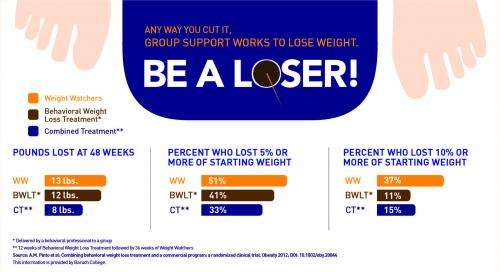
Study shows that group-based weight loss treatment is effective whether led by health professionals or by peer counselors. Credit: Baruch College

A new National Institutes of Health (NIH)-funded study conducted at Baruch College and published in Obesity found that overweight and obese adults who participated in three different weight loss treatments, all involving intensive, multi-component counseling delivered in groups, lost significant weight after 48 weeks whether the treatment was led by a health professional or by someone who had previous weight loss success.

This led by Angela Marinilli Pinto, PhD Assistant Professor of Psychology at Baruch College, is the first to compare professionally delivered group-based behavioral weight loss treatment– considered the "gold standard" for treating moderate - to Weight Watchers, which is led by trained peer counselors who have achieved their own successful weight loss. The findings open up the possibility of offering effective, affordable weight loss options to more Americans.

In this study, 141 overweight and and women were randomly assigned to:

  • 48 weeks of behavioral weight loss treatment delivered by a health professional,
  • 48 weeks of Weight Watchers, where group support is led by Weight Watchers members who have successfully achieved and maintained a healthy goal weight,
  • Or a combined treatment consisting of 12 weeks of behavioral weight loss treatment delivered by a health professional followed by 36 weeks of Weight Watchers.
Weight Watchers was chosen because it is the largest commercial program in the United States and is behaviorally oriented and focuses on modifying diet and increasing to produce weight loss. The hypothesized that the combined treatment would produce better weight losses than Weight Watchers alone. Assessments were conducted at baseline and weeks 12, 24, and 48, with weight change as the primary outcome.

All groups lost weight, but contrary to expectations, Weight Watchers participants lost more weight, on average, at the end of treatment compared to participants in the combination approach (mean weight loss in the professionally led program was not significantly different from either group). In fact, 37% of Weight Watchers participants lost 10% or more of their starting weight compared to 15% of combined group participants and 11% of participants in the professionally led group.

Results of the study also showed that better meeting attendance was associated with greater weight losses during the first 24 weeks in all treatments. In the Weight Watchers group, this relationship was maintained even in the second half of treatment, suggesting that individuals who continue to stay involved in the Weight Watchers program do better.

"This study is important because, with almost 70% of American adults classified as overweight or obese, there is a need to provide practical treatment solutions that are effective, accessible, and affordable," Dr. Pinto explained. "Results of this study demonstrate that the Weight Watchers program can produce clinically meaningful losses." The cost of joining is approximately $10 per week, which includes member registration, weekly meetings, and access to online resources.

More information: A.M. Pinto et al: Combining behavioral weight loss treatment and a commercial program: a randomized clinical trial. Obesity 2012; DOI: 10.1002/oby.20044

Journal reference: Obesity search and more info website

Provided by Baruch College

not rated yet  

Rank not rated yet
Relevant PhysicsForums posts

More news stories

Genetic risk for obesity found in many Mexican young adults

As many as 35 percent of Mexican young adults may have a genetic predisposition for obesity, said a University of Illinois scientist who conducted a study at the Universidad Autónoma de San Luis Potosί.

Overweight and Obesity created 9 hours ago | popularity not rated yet | comments 0

'Doctor shopping' by obese patients negatively affects health

Overweight and obese patients are significantly more likely than their normal-weight counterparts to repeatedly switch primary care doctors, a practice that disrupts continuity of care and leads to more emergency room visits, ...

Overweight and Obesity created 11 hours ago | popularity not rated yet | comments 0

Child maltreatment increases risk of adult obesity

Children who have suffered maltreatment are 36% more likely to be obese in adulthood compared to non-maltreated children, according to a new study by King's College London. The authors estimate that the prevention or effective ...

Overweight and Obesity created 20 hours ago | popularity not rated yet | comments 0

Young children appear to reject story characters who are obese

(Medical Xpress)—Research by the University of Leeds has shown that very young children appear to reject story book characters who are overweight, but not those who are disabled.

Overweight and Obesity created May 16, 2013 | popularity 3 / 5 (1) | comments 4

Gene variations may explain weight gain among men, women

(HealthDay)—Weight gain in men and women is predicted by two different genetic variations—so-called polymorphisms, according to a new study from the Netherlands.

Overweight and Obesity created May 15, 2013 | popularity 5 / 5 (1) | comments 0 | with audio podcast


If you can remember it, you can remember it wrong

(Medical Xpress)—Native peoples in regions where cameras are uncommon sometimes react with caution when their picture is taken. The fear that something must have been stolen from them to create the photo ...

B vitamins could delay dementia

(Medical Xpress)—Despite spending billions of dollars on research and development, drug companies have been unable to come up with effective treatments for dementia and Alzheimer's Disease (AD). Now, A. ...

New sleeping pill poised to hit US markets

An experimental sleeping pill from US drug company Merck is effective at helping people fall and stay asleep, according to reviewers at the US Food and Drug Administration, which could soon approve the new drug.

Reducing caloric intake delays nerve cell loss

Activating an enzyme known to play a role in the anti-aging benefits of calorie restriction delays the loss of brain cells and preserves cognitive function in mice, according to a study published in the May ...

Insight into the dazzling impact of insulin in cells

Australian scientists have charted the path of insulin action in cells in precise detail like never before. This provides a comprehensive blueprint for understanding what goes wrong in diabetes.

Antidepressant reduces stress-induced heart condition

A drug commonly used to treat depression and anxiety may improve a stress-related heart condition in people with stable coronary heart disease, according to researchers at Duke Medicine.