Computational intelligence opens up new avenues in Alzheimer's research
October 9, 2012 in Alzheimer's disease & dementia

Computational intelligence opens up new avenues in Alzheimer's researc

Enlarge

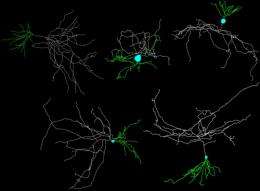
Reconstruction of granule neurons (left). Granule neurons are estimated to account for 80% of dentate gyrus neurons. By contrast, pyramidal neurons are the most common neurons in the entorhinal cortex. Pyramidal neurons are the group most at risk from lesion in Alzheimer's disease. Credit: Facultad de Informática, UPM.

Researchers from the Computational Intelligence Group based at the Universidad Politécnica de Madrid's Facultad de Informática have used machine learning and data mining techniques to compare gene expresssion levels in Alzheimer's disease (AD) patients in two key regions of the hippocampus: the dentate gyrus, where the disease appears to have little or no effect, and the entorhinal cortex, where Alzheimer's disease produces major neuronal damage.

The results, published in Computer Methods and Programs in Biomedicine, corroborate previous findings by other studies and set forth new working hypotheses for AD research.

Dentate gyrus and entorhinal cortex

The hippocampal formation is a complex structure situated in the medial temporal lobe of the brain. It plays a key role in memory, attention and . It is composed of six regions: presubiculum, subiculum, parasubiculum, , hippocampus and entorhinal cortex. A noteworthy part of this formation is the dentate gyrus, one of the few regions of the brain where new neurons continue to be born (neurogenesis) throughout adulthood. It is known that neurogenesis plays a key role in the generation of . Postmortem histopathological studies have provided evidence that the dentate gyrus is the least affected by AD.

The entorhinal cortex is the primary interface between the hippocampus and the neocortex. This region plays a key role in and consolidation, as well as the retrieval of autobiographical, declarative and . Today, we know that the entorhinal cortex is not only one of the first areas to be affected by AD but also where its progression produces most lesions.

Data analysis using an ensemble of Bayesian classifiers

The data mining technique used is part of the computational intelligence discipline. Thanks to the computational power available today, vast amounts of complex data can be analysed holistically to identify new findings or set forth new hypotheses. This study has used ensemble statistical techniques applied to mathematical models to search for relevant genes and gene dependency networks. In both cases, the mathematical paradigm used is called Bayesian classifier.

Results

The results identify relevant genes in different neurological diseases, as well as key metabolic mechanisms that corroborate earlier molecular research in AD. One of these findings is the deregulation of the DEC1 and BTRC genes that help to regulate the molecular clock controlling the body's circadian rhythm.

One of the most common symptoms of AD is sleep disorder, an effect of the loss of the circadian reference. Patients' brains do not correctly identify when they should sleep or be awake. Sleepless periods increase amyloid beta levels, causing the disease to progress.

Another noteworthy result is the deregulation of the S100A10 gene. This gene plays a key role in serotonin receptors, whose activity is linked to neuropsychiatric symptoms in AD patients.

Similarly, it is known to be involved in the pathogenesis and deregulation of depressive disorders. The level of this gene's differential activity between the dentate gyrus and corroborates both these associations and recent findings identifying it as a new early biomarker of AD.

More information: Armañanzas, R., Larrañaga, P. & Bielza, C. (2012). Ensemble transcript interaction networks: A case study on Alzheimer's disease. Computer Methods and Programs in Biomedicine, 108(1), 442-450.

Provided by Universidad Politécnica de Madrid search and more info website

not rated yet  

Rank not rated yet
Relevant PhysicsForums posts

More news stories

A new strategy required in the search for Alzheimer's drugs?

In the search for medication against Alzheimer's disease, scientists have focused – among other factors – on drugs that can break down Amyloid beta (A-beta). After all, it is the accumulation of A-beta that causes the ...

Alzheimer's disease & dementia created 22 hours ago | popularity not rated yet | comments 0

Alzheimer's disease, the soft target of the euthanasia debate

(Medical Xpress)—The way Alzheimer's disease is portrayed by advocacy groups and the media is having undue influence on the euthanasia debate, according to a Deakin University nursing ethics professor.

Alzheimer's disease & dementia created 23 hours ago | popularity not rated yet | comments 2

Scientists discover cinnamon compounds' potential ability to prevent Alzheimer's

Cinnamon: Can the red-brown spice with the unmistakable fragrance and variety of uses offer an important benefit? The common baking spice might hold the key to delaying the onset of –– or warding off ...

Alzheimer's disease & dementia created May 23, 2013 | popularity 5 / 5 (5) | comments 0 | with audio podcast

Drug reverses Alzheimer's disease deficits in mice, research confirms

An anti-cancer drug reverses memory deficits in an Alzheimer's disease mouse model, University of Pittsburgh Graduate School of Public Health researchers confirm in the journal Science.

Alzheimer's disease & dementia created May 23, 2013 | popularity not rated yet | comments 0 | with audio podcast

Multiple research teams unable to confirm high-profile Alzheimer's study

Teams of highly respected Alzheimer's researchers failed to replicate what appeared to be breakthrough results for the treatment of this brain disease when they were published last year in the journal Science.

Alzheimer's disease & dementia created May 23, 2013 | popularity 3 / 5 (2) | comments 3 | with audio podcast


Heart failure accelerates male 'menopause'

Heart failure accelerates the aging process and brings on early andropausal syndrome (AS), according to research presented today at the Heart Failure Congress 2013. AS, also referred to as male 'menopause', was four times ...

First drug to improve heart failure mortality in over a decade

Coenzyme Q10 decreases all cause mortality by half, according to the results of a multicentre randomised double blind trial presented today at Heart Failure 2013 congress. It is the first drug to improve heart failure mortality ...

Feds fight morning-after pill age ruling in NY

(AP)—Department of Justice lawyers have again asked a federal appeals court in New York to delay lifting age restrictions and prescription requirements on an emergency contraceptive popularly known as the morning-after ...

Death highest in heart failure patients admitted in January, on Friday, and overnight

Mortality and length of stay are highest in heart failure patients admitted in January, on Friday, and overnight, according to research presented today at the Heart Failure Congress 2013. The analysis of nearly 1 million ...

Engineered cytomegalovirus protects monkeys from HIV equivalent

(Medical Xpress)—A new study by researchers in the US has shown that an ancient virus can be modified to help in the fight against the simian immunodeficiency virus SIV, which is the equivalent in monkeys ...

Researchers identify first drug targets in childhood genetic tumor disorder

Two mutations central to the development of infantile myofibromatosis (IM)—a disorder characterized by multiple tumors involving the skin, bone, and soft tissue—may provide new therapeutic targets, according to researchers ...