Study to examine methods to reduce damage of radiotherapy to normal tissue
October 1, 2012 in Cancer

Study to reduce radiotherapy toxicity

Enlarge

A new research programme at the University of Cambridge hopes to improve cancer cure rates by reducing toxicity from radiotherapy.

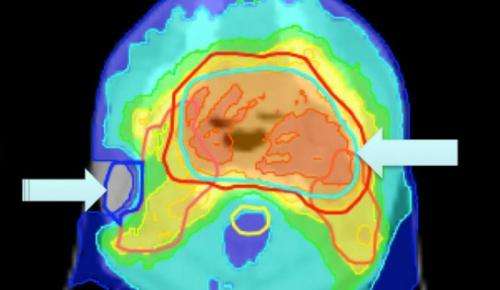
About half of all people with cancer receive a course of radiotherapy, a form of treatment in which X-rays are used to shrink or destroy the tumour. With the benefit of advanced systems, it is now possible to aim radiation beams at tumours more effectively than ever before, allowing increasing doses of radiotherapy with increased cancer cure rates, and also reducing side effects.

However, although clinicians use planning software to define the target area for treatment and deliver the , any dose that falls outside the target area – for instance due to the positioning of the patient and their internal organs during treatment – can cause permanent and severe damage to normal tissues.

Now, a new research programme at the University of Cambridge aims to reduce levels of toxicity from , enabling doses of the treatment to be escalated. By examining to what extent the dose of radiation planned by the clinician for a patient differs from that which the patient actually receives – and how this damages normal, healthy tissues – the programme will develop a set of tools that can be used to provide patients with the for their condition.

"We are breaking new ground thanks to the marshalling of forces from several fields," said Professor Neil Burnet, who leads the research. Expertise is being pooled from a cross-disciplinary group of clinicians and scientists from the University of Cambridge Departments of Oncology, Physics, Engineering, and Applied Mathematics and , the NHS Oncology Centre, and the Cancer Research UK (CRUK) Cambridge Research Institute.

"The aim will always be to safely deliver radiation to the tumour and so kill the ," he added. "Although modern technology has improved side effects, 29% of patients are still left with significant dry mouth after head and neck radiotherapy because of damage to the salivary glands, and 10% of men experience severe toxicity after prostate radiotherapy because of rectal damage. Hormonal dysfunction after radiotherapy damage to the hypothalamus and pituitary gland can result in a patient needing lifelong hormone replacement therapy."

The VoxTox Research Programme, a five-year study funded by CRUK, focuses on reducing radiation toxicity. After quantifying the differences between planned dose and the dose actually delivered during the whole course of radiotherapy, the programme will link these data to differences between expected and observed toxicity. It will look into the physical factors behind dose variation such as movement of , as well as suspected biological factors, such as a patient's genetic make-up.

"In Cambridge there is a unique archive of daily computed tomography (CT) scans – imaging data acquired during the course of a patient's high-precision image-guided radiotherapy on our TomoTherapy treatment machines," said Burnet. "Systems will be developed to map the location of each point, or voxel, within the patient outline, and then to re-compute the dose at that point each day during treatment."

The study will develop a suite of integrated software tools for dose review during the treatment course, with the objective of individualising based on predicted toxicity, and make these tools available to the world cancer community.

Provided by University of Cambridge search and more info website

not rated yet  

Rank not rated yet
Relevant PhysicsForums posts

More news stories

New colonoscope provides ground-breaking view of colon

A ground-breaking advance in colonoscopy technology signals the future of colorectal care, according to research presented today at Digestive Disease Week(DDW). Additional research focuses on optimizing the minimal withdrawal ...

Cancer created 8 hours ago | popularity 5 / 5 (1) | comments 0

ASCO: combo antibody therapy effective for melanoma

(HealthDay)—Concurrent use of two immune checkpoint antibodies—ipilimumab and nivolumab—may be effective for the treatment of advanced melanoma, according to a proof-of-principal study presented in ...

Cancer created May 17, 2013 | popularity not rated yet | comments 0

Risk factors ID'd for poor cutaneous cell CA outcomes

(HealthDay)—The risks of metastasis and death associated with cutaneous squamous cell carcinoma (CSCC) are low, but significant, and risk factors for poor outcome include tumor diameter, invasion beyond ...

Cancer created May 17, 2013 | popularity not rated yet | comments 0 | with audio podcast

Physical & emotional impairments common, often untreated in people with cancer

A new review finds cancer survivors suffer a diverse and complex set of impairments, affecting virtually every organ system. Writing in CA: A Cancer Journal for Clinicians, Julie Silver, M.D., associate professor at Harvar ...

Cancer created May 17, 2013 | popularity not rated yet | comments 0

Calif. doc with 'cancer cure' gets 14 years prison (Update)

(AP)—A California doctor has been sentenced to 14 years in federal prison for bilking her patients out of more than $1 million by promising that an herbal supplement could cure late-stage cancer and other diseases.

Cancer created May 17, 2013 | popularity not rated yet | comments 0


New research identifies risks, interventions for children's GI health

An increasing number of U.S. children are experiencing gastrointestinal issues that require interventions to resolve, according to research presented at Digestive Disease Week (DDW).

US psychiatry gets makeover in new manual

The latest makeover to a massive psychiatric tome honored by some, reviled by others and even called the "Bible" of mental disorders is being released Saturday with a host of new changes.

New case of SARS-like virus in Saudi: ministry

A new case of the deadly coronavirus has been detected in Saudi Arabia where 15 people have already died after contracting it, the health ministry announced on Saturday on its Internet website.

AIDS science at 30: 'Cure' now part of lexicon

Big names in medicine are set to give an upbeat assessment of the war on AIDS on Tuesday, 30 years after French researchers identified the virus that causes the disease.

For combat veterans suffering from post-traumatic stress disorder, 'fear circuitry' in the brain never rests

Chronic trauma can inflict lasting damage to brain regions associated with fear and anxiety. Previous imaging studies of people with post-traumatic stress disorder, or PTSD, have shown that these brain regions can over-or ...

Flesh-eating disease victim gets prosthetic hands

(AP)—A woman who lost both hands, her left leg and right foot after contracting a flesh-eating disease has been fitted with prosthetic hands.