Movement breaks help learning, well-being
October 4, 2012 by Lanna Crucefix in Psychology & Psychiatry
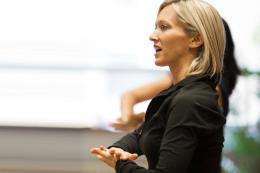
U of T Student Life's Jill Cressy demonstrates a stress relief exercise.
Jill Cressy was three hours into a six-hour class when she realized that her shoulders were tense, her back was aching and she was beginning to lose her focus. The issue wasn't the subject – Educational Finance and Economics. It was the sitting.
"I approached the professor, Dan Lang, and asked if I could lead a movement break," she says. "Something to get our muscles moving and our circulation flowing."
After a quick five minutes of shoulder rolls, balancing exercises, simple stretches and arm circles, Cressy and her fellow students in the Masters of Education, Higher Education program at OISE returned to work, re-energized and ready to concentrate.
"Movement breaks are a superb way to integrate physical activity and mental well-being into the classroom experience," says Janine Robb, Executive Director of Health and Wellness. "It's quick, simple and can be done by anyone."
Dan Lang, a professor in the OISE Leadership, Higher & Adult Education program and former head coach for the Varsity Blues baseball team, can attest to the change the movement breaks have on his class. Lang says that although students were encouraged to take conventional breaks to eat or drink, it didn't seem to make a difference.
"Movement breaks are a useful alternative to keeping attention focused, especially during the longer classes that are part of a compressed curriculum," he says. "The breaks are fun. After, students seem to be more alert and concentration improves. Since we all do them, including me, the class has more cohesion and the gap between teacher and student narrows."
The breaks are part of a larger movement on campus to ensure that the academic experience incorporates health and wellness. For instance, through MoveU, a partnership between U of T and ParticipACTION, student leaders are inspiring fellow students to keep active, and providing tips and news via their twitter feed and Facebook page.
Cressy points out that students, with their busy schedules, can often feel overwhelmed by competing pressures. The movement breaks provide easy, calming techniques that can be applied anywhere.
"One exercise is to press the palm of one hand into the other while paying attention to the breath. This simple activity can help to manage stress and can be done in a variety of settings from the library to the TTC."
So far, Cressy, who is also a Community Health Coordinator in Student Life, has led movement breaks in U of T's Summer Leadership Institute (sponsored by the Institute for Leadership Education in Engineering and the Centre for Teaching Support and Innovation) and the Exploring Leadership Workshop (Office of Student Life, Leadership Programs). However, she says the breaks can be adapted for any classroom experience and are beneficial to both instructors and students.
U of T will be promoting other mental health and wellbeing strategies during Mental Health Awareness Month in October. One of the events will be an Oct. 22 screening at Victoria College of the movie Happy, which combines research on happiness with real-life stories to explore what happiness is.
"What's so attractive about movement breaks is that they reinforce healthy habits that are useful now and in the future when students begin their careers," says Robb. "A short break to stand and move around doesn't take a huge time commitment, but the benefits to student success and mental well-being can be significant."
Provided by
University of Toronto
-
Active and healthy schools get kids moving
May 19, 2010 |
not rated yet |
0
-
University of Missouri program helps teachers prevent teen suicides
Oct 25, 2011 |
not rated yet |
0
-
On the move for repair
Apr 17, 2012 |
not rated yet |
0
-
Movement + academics = success
May 01, 2011 |
not rated yet |
0
-
Alternative teacher certification programs do not meet expectations
Mar 25, 2009 |
not rated yet |
0
-
Motion perception revisited: High Phi effect challenges established motion perception assumptions
Apr 23, 2013 |
3 / 5 (2) |
2
-
Anything you can do I can do better: Neuromolecular foundations of the superiority illusion (Update)
Apr 02, 2013 |
4.5 / 5 (11) |
5
-
The visual system as economist: Neural resource allocation in visual adaptation
Mar 30, 2013 |
5 / 5 (2) |
9
-
Separate lives: Neuronal and organismal lifespans decoupled
Mar 27, 2013 |
4.9 / 5 (8) |
0
-
Sizing things up: The evolutionary neurobiology of scale invariance
Feb 28, 2013 |
4.8 / 5 (10) |
14
-
Why is zone 1 in liver more prone to ischemic injury?
May 23, 2013
-
How can there be villous adenoma in colon, if there are no villi there
May 22, 2013
-
How can there be a term called "intestinal metaplasia" of stomach
May 21, 2013
-
Pressure-volume curve: Elastic Recoil Pressure don't make sense
May 18, 2013
-
If you became brain-dead, would you want them to pull the plug?
May 17, 2013
-
MRI bill question
May 15, 2013
- More from Physics Forums - Medical Sciences
More news stories
Are there atheists in foxholes? Study says they're the minority
Ernie Pyle – an iconic war correspondent in World War II – reportedly said "There are no atheists in foxholes." A new joint study between two brothers at Cornell and Virginia Wesleyan found that only ...
Psychology & Psychiatry
8 minutes ago |
not rated yet |
0
Breathing exercises help veterans find peace after war, scholar says
(Medical Xpress)—Research by Stanford scholar Emma Seppala at the Center for Compassion and Altruism Research and Education found that post-traumatic stress disorder decreased in veterans who participated ...
Psychology & Psychiatry
35 minutes ago |
not rated yet |
0
Depression raises diabetics' risk of severe low blood sugar episodes
(Medical Xpress)—Patients with diabetes who are depressed are much more likely to develop episodes of dangerously low blood sugars, or hypoglycemia, than are those who are not depressed, a new study has ...
Psychology & Psychiatry
1 hour ago |
not rated yet |
0
|
Motion quotient: IQ predicted by ability to filter motion (w/ video)
A brief visual task can predict IQ, according to a new study. This surprisingly simple exercise measures the brain's unconscious ability to filter out visual movement. The study shows that individuals whose ...
Psychology & Psychiatry
21 hours ago |
4.5 / 5 (10) |
1
|
Anxious men fare worse during job interviews, study finds
Nervous about that upcoming job interview? You might want to take steps to reduce your jitters, especially if you are a man.
Psychology & Psychiatry
22 hours ago |
5 / 5 (1) |
0
Engineered cytomegalovirus protects monkeys from HIV equivalent
(Medical Xpress)—A new study by researchers in the US has shown that an ancient virus can be modified to help in the fight against the simian immunodeficiency virus SIV, which is the equivalent in monkeys ...
Help at hand for people with schizophrenia
How can healthy people who hear voices help schizophrenics? Finding the answer for this is at the centre of research conducted at the University of Bergen.
Scientists put bowel cancer under the microscope
Researchers from London's Kingston University have begun a two-year study which could help prolong the lives of people with colorectal tumours.
New neuron formation could increase capacity for new learning, at the expense of old memories
New research presented today shows that formation of new neurons in the hippocampus - a brain region known for its importance in learning and remembering - could cause forgetting of old memories by causing a reorganization ...
Do doctors understand the individualisation of treatments?
The individualisation of drug treatments to support patients to self-manage their conditions is a concept that sits at the heart of policy, but a recent study in BMJ Open shows that there is no concrete defini ...
Reducing experimental inflammatory arthritis
(Medical Xpress)—UCD researchers led by Conway Fellow, Professor David Brayden in UCD School of Veterinary Medicine have successfully reduced inflammation in the swollen arthritic knees of a murine model using a novel nanoparticle.