Online learning initiative reinventing medical school courses
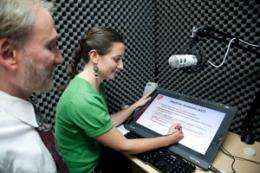
(Medical Xpress)—Andrew Patterson, MD, associate professor of anesthesia, is convinced that the only way forward in medical education is what he calls a revolutionary path. No more of the old way—professors lecture, students listen.
Instead, the time for online learning for medical students has arrived, said Patterson, and a core group of Stanford medical professors, education technology specialists and collaborators from the Khan Academy who are working toward that future.
Charles Prober, MD, the senior associate dean for medical education at the School of Medicine, is onboard. Prober, who oversees the school's new educational technologies, leapt to national visibility in May with the publication of an article in the New England Journal of Medicine titled "Lecture halls without lectures: A proposal for medical education." Co-written with Chip Heath, PhD, a professor of organizational behavior at the Stanford Graduate School of Business, the article stated flatly, "It's time to change the way we educate doctors."
Charles Prober, MD, the senior associate dean for medical education at the School of Medicine, is onboard. Prober, who oversees the school's new educational technologies, leapt to national visibility in May with the publication of an article in the New England Journal of Medicine titled "Lecture halls without lectures: A proposal for medical education." Co-written with Chip Heath, PhD, a professor of organizational behavior at the Stanford Graduate School of Business, the article stated flatly, "It's time to change the way we educate doctors."
Prober is one of the driving forces behind the Stanford Medicine Interactive Learning Initiatives, otherwise known as SMILI. The idea is to combine the Internet with something very old—the Socratic method—and ensure that the knowledge being taken in by medical students actually means something to them.
Prober believes that meaning derives from interaction, and that flipping classrooms—using videos to impart basic knowledge and reserving class time for more engaging activities—is the first step.
"The videos are not the endgame; they're a way of creating a product that's useful for students," he said. "We're packaging knowledge, but that's not the real learning part. Pushing facts at people isn't learning. The learning is the embedding of the facts to create rich, interactive sessions."
That's where SMILI comes in. The idea is to provide what Prober calls a "seamless concierge service for faculty" to help them overcome their skepticism and then produce class materials online with the aid of the school's education technology staff.
"Faculty reaction has been variable," he said. "Some have been very enthusiastic; they say it's the natural thing, the way of the future, and they're out there creating courses in the image of this idea. But others—and it's not a matter of age or field—think it's a bad idea. They say, 'We don't know if the new methods will be effective.' They say, 'Show me the data.'"
It is too early for reliable data, but several medical classes and programs nonetheless are moving forward this year. Portions of classes in cardiovascular physiology and endocrinology are being made more interactive by going online.
The endocrinology and women's health tutorial, part of the Human Health and Disease course, brings together people from pathology, endocrinology, gerontology, and obstetrics and gynecology. Before going to class, students will watch videotaped lectures. The clear advantage, Patterson said, is that students who don't follow a particular point can pause and replay the video, or pause and consult another source.
"That's what an on-site culture can't do," he said. "Unprepared students zone out or don't even come to class." But now, using the online pilots, when they come to class they will meet with patients (live or on video), debate with their peers and do immersive group exercises, putting into practice what they've learned beforehand.
Part of Prober's vision is that video instruction could be shared by the country's leading medical schools—they all teach essentially the same material to first- and second-year students. Representatives of those schools are discussing shared curriculum, he said, and they are all reconsidering how they deliver knowledge.
Griff Harsh, MD, a professor of neurosurgery and associate dean of postgraduate medical education, said at a recent SMILI meeting that as many as nine online pilots will be produced this year for practitioners enrolled in continuing medical education. They include units on critical care ultrasound, clinical trials, antibiotics, sepsis, dermatitis and cardiac crisis management.
The benefits of online learning also could extend far beyond the School of Medicine; the videos for Patterson's course on cardiovascular physiology will be watched by students in Rwanda, a project made possible thanks to Patterson's longtime collaboration with medical professionals in that battered country who have, nearly miraculously, established a medical school.
The videos for the cardiovascular physiology unit will be made by the professors with the assistance of Khan Academy, a nonprofit organization that since 2006 has been producing free videos about a variety of academic (and medical) topics. Khan Academy is involved with Stanford in other areas as well—for example, problem sets on Stanford's open-source course-hosting platform, Class2Go, use the Khan exercise framework—but it has been particularly active with the School of Medicine.
"I'm very attracted to what they're doing, very impressed by Sal Khan," Prober said, referring to the organization's founder. "Their mission really resonates, the mission to educate anyone, everywhere, at no cost. When we create medical education, I want to share it as broadly as possible, at no profit. If it helps raise the level of education, that's great. That's our mission."
Rishi Desai, MD, a pediatric infectious disease physician and a medical fellow at the Khan Academy, is working with the medical faculty to generate content in short videos. "It's been an honor to work with medical students and faculty here to help them make medical education more interactive and fun," Desai said after the first of what will be a series of open houses to attract potential faculty converts and hold discussions about the mechanics and virtues of online education.
One of the people at that meeting. Don Regula, MD, a professor of pathology involved in the online endocrinology pilot, said he remains skeptical, though he's teaching online. He insisted that class time would have to be used wisely to ensure that the knowledge sticks.
But the professors themselves say that an estimated 70 percent of medical students do not attend lectures. Clearly, the traditional approach is not working. Prober, Patterson, Regula and a growing number of medical professors are convinced that online learning is a large part of the solution.


