Swimming pools don't help Indigenous children's hearing, contradiction of previous study
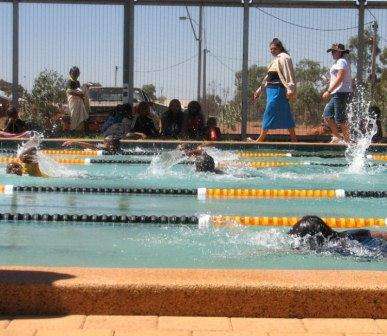
Swimming carnival day at Mimili Community Pool.
(Medical Xpress)—Swimming pools are not the answer to solving the horrific prevalence of middle ear disease afflicting Indigenous children in remote communities, a ground-breaking report from Flinders University reveals.
The Federally-funded study, conducted in South Australia's Aṉangu Pitjantjatjara Yankunytjatjara (APY) Lands and Yalata from 2009-2011, found chlorinated saltwater pools have no direct benefit on the ear health and hearing of school-aged Indigenous children.
The findings contradict an influential and widely-publicised 2003 Australian study which showed swimming pools in two Indigenous communities in remote Western Australia significantly reduced some ear disease in children.
Flinders University Associate Professor in Audiology Linnett Sanchez, the study's chief investigator, said while swimming pools were "an incredibly important social and recreational asset", they had no effect in reducing middle ear disease – a serious, long-term condition that affects alarmingly high numbers of remote Indigenous children.
"Otitis media (middle ear disease) is a disease of poverty in Indigenous children," Associate Professor Sanchez said.
"It's a serious and complex problem that in remote Indigenous children typically persists throughout childhood and is very difficult to treat so it's not surprising that a single intervention such as a swimming pool wouldn't make a difference," she said.
The Flinders study assessed the ear health of 813 different children aged between 5 and 17 years, with a total of 2100 audiological and medical assessments conducted across 11 remote Indigenous communities, both with and without pools, twice a year during the three-year research.
The "whole of population" study included every child who was at school on the day the researchers visited, and was undertaken both at the end of the swimming season and at the end of winter to gauge any seasonal variations.
The study did not measure other indices of health, such as skin infections, that might be improved by access to swimming pools.
"We found ear health was actually worse at the end of summer – there's no straightforward explanation for that but it has nothing to do with pools," Associate Professor Sanchez said.
"So when they conducted the WA study and saw an improvement after winter, the change was attributed to a swimming pool effect."
Aside from ascertaining any effects on ear health and hearing, Associate Professor Sanchez said the Flinders study was able to determine the influence of swimming pools on school attendance.
"The communities initiated a 'no school, no pool' policy when the pools were first put in but we found no difference in school attendance rates in pool and non-pool communities, which average 74 per cent.
"School attendance issues, just like ear health, have many contributing social, cultural and health factors so again there's no single solution."
Associate Professor Sanchez said Indigenous ear health required urgent action on many fronts in Anangu communities, and more generally in remote Australia.
"Among five-year old Anangu children starting school with English as a second language, 13 per cent have hearing levels in both ears which meet standard audiological criteria for a hearing aid fitting, while 36 per cent of all school age children have a perforation in one or both eardrums.
"The awful persistence of eardrum perforations is seen right through the oldest secondary students which means many adolescents are trying to find jobs as young adults with the significant social and health effects of hearing loss, as well as generally reduced educational attainment, contributed to by years of poor hearing."
Provided by
Flinders University
-
Remote pools boost aboriginal child health
May 19, 2008 |
not rated yet |
0
-
Evidence of a relationship between swimming babies and infections
Oct 04, 2007 |
not rated yet |
0
-
Ear infections linked to passive smoking
May 19, 2008 |
not rated yet |
0
-
CDC: 1 in 8 swimming pools closed, many too dirty
May 20, 2010 |
not rated yet |
0
-
Drowning is leading cause of kids' accidental death: CDC
May 17, 2012 |
not rated yet |
0
-
Motion perception revisited: High Phi effect challenges established motion perception assumptions
Apr 23, 2013 |
3 / 5 (2) |
2
-
Anything you can do I can do better: Neuromolecular foundations of the superiority illusion (Update)
Apr 02, 2013 |
4.5 / 5 (11) |
5
-
The visual system as economist: Neural resource allocation in visual adaptation
Mar 30, 2013 |
5 / 5 (2) |
9
-
Separate lives: Neuronal and organismal lifespans decoupled
Mar 27, 2013 |
4.9 / 5 (8) |
0
-
Sizing things up: The evolutionary neurobiology of scale invariance
Feb 28, 2013 |
4.8 / 5 (10) |
14
-
Classical and Quantum Mechanics via Lie algebras
Apr 15, 2011
- More from Physics Forums - Independent Research
More news stories
CDC presents recent trends in health behaviors of US adults
(HealthDay)—In 2008 to 2010, the prevalence of key health behaviors among U.S. adults varied, with about one in five adults current smokers and 62.1 percent overweight or obese, according to a report presented ...
Health
26 minutes ago |
not rated yet |
0
Americans still making unhealthy choices, CDC reports
(HealthDay)—The overall health of Americans isn't improving much, with about six in 10 people either overweight or obese and large numbers engaging in unhealthy behaviors like smoking, heavy drinking or ...
Health
36 minutes ago |
not rated yet |
0
US court strikes down Arizona 20-week abortion ban
A federal court in San Francisco Tuesday struck down Arizona's ban on abortions after 20 weeks of pregnancy.
Health
36 minutes ago |
not rated yet |
0
Aggressive behavior linked specifically to secondhand smoke exposure in childhood
Children who are exposed to secondhand smoke in early childhood are more likely to grow up to physically aggressive and antisocial, regardless of whether they were exposed during pregnancy or their parents have a history ...
Health
3 hours ago |
1 / 5 (1) |
0
Most elite athletes believe doping substances are effective in improving performance
Most elite athletes consider doping substances "are effective" in improving performance, while recognising that they constitute cheating, can endanger health and entail the obvious risk of sanction. At the same time, the ...
Health
4 hours ago |
not rated yet |
0
Antidepressant reduces stress-induced heart condition
A drug commonly used to treat depression and anxiety may improve a stress-related heart condition in people with stable coronary heart disease, according to researchers at Duke Medicine.
Study examines outbreak of spinal infections in Michigan
(HealthDay)—Factors such as increased case finding may explain why Michigan had half of the total spinal infections associated with contaminated methylprednisolone acetate in the recent fungal meningitis ...
Early use of tracheostomy for mechanically ventilated patients not associated with improved survival
For critically ill patients receiving mechanical ventilation, early tracheostomy (within the first 4 days after admission) was not associated with an improvement in the risk of death within 30 days compared to patients who ...
CDC says high number of public pools contain microbes
(HealthDay)—Three-quarters of public schools in the metro Atlanta area contain microbes, including bacteria indicating the presence of fecal matter, according to research published in the May 17 issue of ...
Weather worries can threaten a child's mental health
(HealthDay)—The monstrous tornado that devastated Moore, Okla., on Monday, killing dozens of adults and children, is a stunning example of violent weather that can affect a child's mental well-being.
World not ready if flu outbreak strikes, WHO says
The globe remains unprepared to deal with the risk of a massive virus outbreak, the deputy chief of the World Health Organization warned Tuesday, amid fears that H7N9 bird flu striking China could morph into a form that spreads ...