Scientists build 'mechanically active' DNA material
October 23, 2012 in Medical research
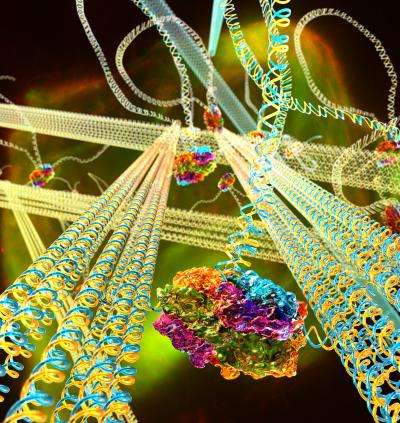
The DNA gel is composed of stiff DNA nanotubes connected to each other via long, flexible DNA linkers. A motor protein, FtsK50C, binds to special sites on the linkers. When ATP, a biochemical fuel, is allowed to permeate the gel, the motor molecules reel in the linkers to which they are bound, drawing nanotubes together, and stiffening the gel. Credit: Peter Allen, UCSB
Artificial muscles and self-propelled goo may be the stuff of Hollywood fiction, but for UC Santa Barbara scientists Omar Saleh and Deborah Fygenson, the reality of it is not that far away. By blending their areas of expertise, the pair have created a dynamic gel made of DNA that mechanically responds to stimuli in much the same way that cells do. The results of their research were published online in the Proceedings of the National Academy of Sciences.
"This is a whole new kind of responsive gel, or what some might call a 'smart' material," said Saleh, associate professor of materials, affiliated with UCSB's Biomolecular Science and Engineering program. "The gel has active mechanical capabilities in that it generates forces independently, leading to changes in elasticity or shape, when fed ATP molecules for energy—much like a living cell."
Their DNA gel, at only 10 microns in width, is roughly the size of a eukaryotic cell, the type of cell of which humans are made. The miniscule gel contains within it stiff DNA nanotubes linked together by longer, flexible DNA strands that serve as the substrate for molecular motors.
"DNA gives you a lot more design control," said Fygenson, associate professor of physics and also affiliated with UCSB's BMSE program. "This system is exciting because we can build nano-scale filaments to specifications." Using DNA design, she said, they can control the stiffness of the nanotubes and the manner and extent of their cross-linking, which will determine how the gel responds to stimuli.
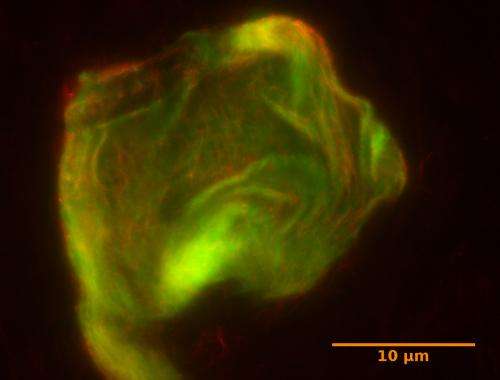
A typical DNA gel used for the active mechanics study. In this fluorescent micrograph, the stiff DNA nanotubes are visible as glowing green and red fibers. Credit: UCSB
Using a bacterial motor protein called FtsK50C, the scientists can cause the gel to react in the same way cytoskeletons react to the motor protein myosin—by contracting and stiffening. The protein binds to predetermined surfaces on the long linking filaments, and reels them in, shortening them and bringing the stiffer nanotubes closer together. To determine the gel's movement the scientists attached a tiny bead to its surface and measured its position before and after activation with the motor protein.The breakthrough, said Saleh, is that this gel "quantitatively shows similar active fluctuations and mechanics to cells."
"This new material could provide a means for controllably testing active gel mechanics in a way that will tell us more about how the cytoskeleton works," Saleh said. Like a cell, which consumes adenosine triphosphate (ATP) for energy, the DNA gel's movement runs on ATP, allowing for faster, stronger mechanics than other smart gels based on synthetic polymers.
"The development of active gels represents a water-shed event for the broader materials community," commented Craig Hawker, director of the Materials Research Laboratory at UCSB: an NSF MRSEC, which provided seed money for their research. "By exploiting cellular building blocks, it offers unique design parameters when compared to existing gel systems that can be used in a wide range of both established biomedical applications as well as totally new applications."
The project has potential applications for a variety of fields, including smart materials, artificial muscle, understanding cytoskeletal mechanics and research into nonequilibrium physics, as well as DNA nanotechnology. Long-term implications of this research are significant, Hawker added, with the final result being "a fundamental breakthrough in soft-materials science and engineering."
Having created a gel that can replicate contractions, Saleh and Fygenson are now looking to refine their technique and enable distinct movements, such as twisting and crawling, or using other motor proteins that would allow the gel to mimic other cell behaviors, such as shape-shifting and dividing.
"Biology provides a wide range of motors that we have only begun to explore," Saleh said.
"And the suite of nanostructure designs and geometries at our disposal is nearly limitless," echoed Fygenson.
Journal reference:
Proceedings of the National Academy of Sciences
Provided by
University of California - Santa Barbara
-
Oscillating gel acts like artificial skin, giving robots potential ability to 'feel'
Mar 29, 2012 |
not rated yet |
0
-
DNA-based gel produces proteins without live cells
Apr 01, 2009 |
not rated yet |
0
-
Tough hydrogel stretches to 21 times its length, recoils, and heals itself
Sep 05, 2012 |
not rated yet |
0
-
Light but stable: novel cellulose-silica gel composite aerogels
Jan 27, 2012 |
not rated yet |
0
-
C60 could form a new kind of gel
Feb 17, 2011 |
not rated yet |
0
-
Motion perception revisited: High Phi effect challenges established motion perception assumptions
Apr 23, 2013 |
3 / 5 (2) |
2
-
Anything you can do I can do better: Neuromolecular foundations of the superiority illusion (Update)
Apr 02, 2013 |
4.5 / 5 (11) |
5
-
The visual system as economist: Neural resource allocation in visual adaptation
Mar 30, 2013 |
5 / 5 (2) |
9
-
Separate lives: Neuronal and organismal lifespans decoupled
Mar 27, 2013 |
4.9 / 5 (8) |
0
-
Sizing things up: The evolutionary neurobiology of scale invariance
Feb 28, 2013 |
4.8 / 5 (10) |
14
-
Pressure-volume curve: Elastic Recoil Pressure don't make sense
May 18, 2013
-
If you became brain-dead, would you want them to pull the plug?
May 17, 2013
-
MRI bill question
May 15, 2013
-
Ratio of Hydrogen of Oxygen in Dessicated Animal Protein
May 13, 2013
-
Alcohol and acetaminophen
May 13, 2013
-
Marie Curie's leukemia
May 13, 2013
- More from Physics Forums - Medical Sciences
More news stories
Now we know why old scizophrenia medicine works on antibiotics-resistant bacteria
In 2008 researchers from the University of Southern Denmark showed that the drug thioridazine, which has previously been used to treat schizophrenia, is also a powerful weapon against antibiotic-resistant bacteria such as ...
Medical research
May 17, 2013 |
3.7 / 5 (3) |
0
|
SUMO wrestling cells reveal new protective mechanism target for stroke
Scientists investigating the interaction of a group of proteins in the brain responsible for protecting nerve cells from damage have identified a new target that could increase cell survival.
Medical research
May 17, 2013 |
5 / 5 (1) |
0
How serotonin receptors can shape drug effects, from LSD to migraine medication
New findings by researchers carrying out experiments at the U.S. Department of Energy Office of Science's Advanced Photon Source (APS) help explain why some drugs that interact with two kinds of human serotonin ...
Medical research
May 17, 2013 |
4 / 5 (1) |
0
|
Preventing blood poisoning
Peptide molecules derived from the body's natural immune system can help boost the body's defence against life-threatening blood poisoning, joint University research has uncovered.
Medical research
May 17, 2013 |
4 / 5 (1) |
0
|
New mechanism to prevent type 2 diabetes in obese individuals
A new Montréal study conducted by Dr. May Faraj, associate research professor at the Université de Montréal and invited scientist at the IRCM, along with her research team and medical collaborators, shows ...
Medical research
May 17, 2013 |
not rated yet |
0
|
Consuming coffee linked to lower risk of detrimental liver disease, study finds
Regular consumption of coffee is associated with a reduced risk of primary sclerosing cholangitis (PSC), an autoimmune liver disease, Mayo Clinic research shows. The findings were being presented at the Digestive Disease ...
Ketamine shows significant therapeutic benefit in people with treatment-resistant depression
Patients with treatment-resistant major depression saw dramatic improvement in their illness after treatment with ketamine, an anesthetic, according to the largest ketamine clinical trial to-date led by researchers from the ...
Research examines new methods for managing digestive health
Research presented at Digestive Disease Week (DDW) explores new methods for managing digestive health through diet and lifestyle.
New smartphone application improves colonoscopy preparation
The use of a smartphone application significantly improves patients' preparation for a colonoscopy, according to new research presented today at Digestive Disease Week (DDW). The preparation process, which begins days in ...
New research identifies practice changes to improve value and quality of GI procedures
There are significant cost and risk factors associated with two procedures commonly used to diagnose or treat gastrointestinal problems, according to research presented at Digestive Disease Week (DDW).
New research identifies risks, interventions for children's GI health
An increasing number of U.S. children are experiencing gastrointestinal issues that require interventions to resolve, according to research presented at Digestive Disease Week (DDW).
