Scientists probe how some HIV patients resist AIDS
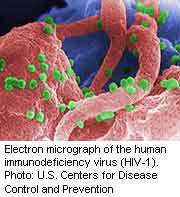
Understanding immune response in these 'elite controllers' might help pave way to vaccine.
(HealthDay)—Researchers who discovered an immune system mechanism that seems to provide some people with a natural defense against HIV say their finding could help efforts to develop a vaccine for HIV/AIDS.
In most people, HIV infection without treatment almost always progresses to AIDS. But about one in 300 HIV-infected people remain AIDS-free without having to take medications. These people are called "elite controllers."
After conducting experiments with laboratory animals, the researchers concluded that elite controllers suppress HIV by generating a powerful CD8+ T killer cell response against just two or three small regions of the virus.
"By focusing on these selected regions, the immune response successfully controls the virus," David Watkins, a professor of pathology at the University of Miami Miller School of Medicine, said in a university news release.
"Understanding this mechanism may shed light on how to develop an effective vaccine to eradicate the global HIV/AIDS crisis," he added.
Scientists, however, note that research with animals often fails to provide similar results in humans.
The study was published Sept. 30 in the journal Nature.
The next step is to determine why these particular killer cells are so effective, Watkins said.
Watkins and his colleagues recently received a $10 million grant from the U.S. National Institute of Allergy and Infectious Diseases to develop an HIV vaccine from the yellow fever vaccine.
More information: The U.S. Centers for Disease Control and Prevention has questions and answers about HIV/AIDS.
Abstract
Full Text (subscription or payment may be required)
Journal reference:
Nature
Copyright © 2012 HealthDay. All rights reserved.
-
Revealed: Secret of HIV's natural born killers
Jun 10, 2012 |
not rated yet |
0
-
HIV isolate from Kenya provides clues for vaccine design
Jan 02, 2008 |
not rated yet |
0
-
AIDS vaccine trial exceeds expectations
Sep 23, 2005 |
not rated yet |
0
-
AIDS experts go back to basics
Mar 27, 2008 |
not rated yet |
0
-
AIDS: No vaccine after 25 years
Jul 17, 2006 |
not rated yet |
0
-
Motion perception revisited: High Phi effect challenges established motion perception assumptions
Apr 23, 2013 |
3 / 5 (2) |
2
-
Anything you can do I can do better: Neuromolecular foundations of the superiority illusion (Update)
Apr 02, 2013 |
4.5 / 5 (11) |
5
-
The visual system as economist: Neural resource allocation in visual adaptation
Mar 30, 2013 |
5 / 5 (2) |
9
-
Separate lives: Neuronal and organismal lifespans decoupled
Mar 27, 2013 |
4.9 / 5 (8) |
0
-
Sizing things up: The evolutionary neurobiology of scale invariance
Feb 28, 2013 |
4.8 / 5 (10) |
14
-
Classical and Quantum Mechanics via Lie algebras
Apr 15, 2011
- More from Physics Forums - Independent Research
More news stories
After a decade, global AIDS program looks ahead
(AP)—The decade-old law that transformed the battle against HIV and AIDS in developing countries is at a crossroads. The dream of future generations freed from the epidemic is running up against an era ...
HIV & AIDS
9 hours ago |
not rated yet |
0
'Gap' for HIV vaccine efforts after latest setback
The hunt for an HIV vaccine has gobbled up $8 billion in the past decade, and the failure of the most recent efficacy trial has delivered yet another setback to 26 years of efforts.
HIV & AIDS
May 19, 2013 |
5 / 5 (1) |
0
AIDS science at 30: 'Cure' now part of lexicon
Big names in medicine are set to give an upbeat assessment of the war on AIDS on Tuesday, 30 years after French researchers identified the virus that causes the disease.
HIV & AIDS
May 18, 2013 |
5 / 5 (2) |
0
Peer-referral programs can increase HIV-testing in emergency departments
Researchers at the University of Cincinnati (UC) have found that incorporating a peer-referral program for HIV testing into emergency departments can reach new groups of high-risk patients and brings more patients into the ...
HIV & AIDS
May 17, 2013 |
not rated yet |
0
HIV no barrier to getting liver transplant, study finds
(HealthDay)—Liver transplants to treat a common type of liver cancer are a viable option for people infected with HIV, according to new research.
HIV & AIDS
May 17, 2013 |
not rated yet |
0
B vitamins could delay dementia
(Medical Xpress)—Despite spending billions of dollars on research and development, drug companies have been unable to come up with effective treatments for dementia and Alzheimer's Disease (AD). Now, A. ...
Enrichment therapy effective among children with autism, study finds
Children with autism showed significant improvement after six months of simple sensory exercises at home using everyday items such as scents, spoons and sponges, according to UC Irvine neurobiologists.
Waiting for a sign? Researchers find potential brain 'switch' for new behavior
You're standing near an airport luggage carousel and your bag emerges on the conveyor belt, prompting you to spring into action. How does your brain make the shift from passively waiting to taking action when ...
Poliovirus vaccine trial shows early promise for recurrent glioblastoma
An attack on glioblastoma brain tumor cells that uses a modified poliovirus is showing encouraging results in an early study to establish the proper dose level, researchers at Duke Cancer Institute report.
'Doctor shopping' by obese patients negatively affects health
Overweight and obese patients are significantly more likely than their normal-weight counterparts to repeatedly switch primary care doctors, a practice that disrupts continuity of care and leads to more emergency room visits, ...
Aggressive behavior linked specifically to secondhand smoke exposure in childhood
Children who are exposed to secondhand smoke in early childhood are more likely to grow up to physically aggressive and antisocial, regardless of whether they were exposed during pregnancy or their parents have a history ...