Unlocking the secrets of DNA repair
October 31, 2012 in Cancer

Unlocking the secrets of DNA repair

Enlarge

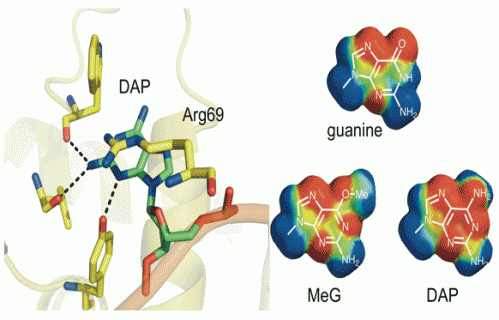
The figure shows a zoomed in structure (derived by X-ray crystallography) of a complex between Atl1 and DNA containing 2,6-diaminopurine, an analogue that has the same electrostatic charge characteristics as O6-alkylguanine

Scientists from the University of Sheffield have unlocked one of the secrets to DNA repair—helping doctors identify DNA base damage and a patient's susceptibility to certain types of cancer.

Groundbreaking research led by Dr David Williams from the University of Sheffield's Department of Chemistry and an of expert researchers has discovered how some proteins recognise damaged bases within DNA which, if untreated, could lead to cancer.

Dr Williams said: "Proteins carry out all the day-to-day processes needed for survival. If the DNA bases become damaged the associated protein may not function or in some cases, too much of a certain protein can be produced – which might lead to cancer.

"Everyday humans are exposed to chemicals known as alkylating agents which may be derived from environmental sources or from dietary sources such as a high intake of red or or exposure to . can chemically modify the bases in DNA which can, in turn, lead to non- being produced or indeed cancer.

"Fortunately humans have a large number of different DNA repair proteins whose task it is to find and repair damaged bases in DNA. However damage, although highly problematic, is rare and often only one or two bases per million or even fewer. The task of locating a damaged base is similar to finding a needle in a haystack."

DNA contains all the information needed for life within the sequence of its four bases; adenine, cytosine, guanine and thymine. Specific sequences of bases in DNA known as genes instruct what proteins are made and furthermore genes may be switched on or off to control how much of each protein is made.

The pioneering research, published in the journal: Proceeding of the National Academy of Sciences (PNAS), was conducted by scientists from the University of Sheffield, University of Manchester and the Scripps Research Institute in California and focuses on damage to the guanine base to form O6-alkylguanine, a type of damage that is particularly prevalent in colon or bowel cancer.

"In humans this is repaired by alkyltransferase proteins that simply reverse the damage of these modified bases, converting them back to guanine," said Dr Williams.

"We have uncovered an exquisite mechanism whereby a positively charged side chain of the amino acid arginine found in the Alt1 protein is used to check the electronic charge distribution across the DNA base, which is altered by alkylation damage.

"This method of recognition, we believe, may also be used by many other DNA repair proteins to recognise damaged bases within DNA. A further exciting discovery we have made is to show that the alkyltransferase-like Alt1 can detect all known types of O6-alkylguanine modification.

"Consequently, Alt1 has potential for use in identifying and quantifying levels of certain O6- alkylguanines in human tissue biopsies. This would be informative to clinicians about individual susceptibility to certain cancers, particularly colorectal."

Journal reference: Proceedings of the National Academy of Sciences search and more info website

Provided by University of Sheffield search and more info website

5 /5 (1 vote)  

Rank 5 /5 (1 vote)
Related Stories
Relevant PhysicsForums posts

More news stories

ASCO: combo antibody therapy effective for melanoma

(HealthDay)—Concurrent use of two immune checkpoint antibodies—ipilimumab and nivolumab—may be effective for the treatment of advanced melanoma, according to a proof-of-principal study presented in ...

Cancer created 9 hours ago | popularity not rated yet | comments 0

Risk factors ID'd for poor cutaneous cell CA outcomes

(HealthDay)—The risks of metastasis and death associated with cutaneous squamous cell carcinoma (CSCC) are low, but significant, and risk factors for poor outcome include tumor diameter, invasion beyond ...

Cancer created 10 hours ago | popularity not rated yet | comments 0 | with audio podcast

Physical & emotional impairments common, often untreated in people with cancer

A new review finds cancer survivors suffer a diverse and complex set of impairments, affecting virtually every organ system. Writing in CA: A Cancer Journal for Clinicians, Julie Silver, M.D., associate professor at Harvar ...

Cancer created 14 hours ago | popularity not rated yet | comments 0

Doctor who promised cancer cure faces sentencing

(AP)—At the age of three, Brianica Kirsch was diagnosed with brain cancer.

Cancer created 15 hours ago | popularity not rated yet | comments 0

New protein-targeting drug shows promise in early trial for patients with high-risk CLL

A new oral targeted drug, idelalisib (GS-1101), has the potential to stave off the need for additional treatments for relapsed or treatment-resistant chronic lymphocytic leukemia (CLL), according to a study led in part by ...

Cancer created 16 hours ago | popularity not rated yet | comments 0 | with audio podcast


Temporal processing in the olfactory system

The neural machinery underlying our olfactory sense continues to be an enigma for neuroscience. A recent review in Neuron seeks to expand traditional ideas about how neurons in the olfactory bulb might encode information about ...

Melon focus headband turns to Kickstarter for rollout plans

(Medical Xpress)—What if the quality of your work depends more on your focus on the piano keys or canvas or laptop than your musical or painting or computing skills? If target users can be convinced, they ...

Now we know why old scizophrenia medicine works on antibiotics-resistant bacteria

In 2008 researchers from the University of Southern Denmark showed that the drug thioridazine, which has previously been used to treat schizophrenia, is also a powerful weapon against antibiotic-resistant bacteria such as ...

College women exceed NIAAA drinking guidelines more frequently than college men

In order to avoid harms associated with alcohol consumption, in 2009 the National Institute on Alcohol Abuse and Alcoholism issued guidelines that define low-risk drinking. These guidelines differ for men and women: no more ...

Study identifies new approach to improving treatment for MS and other conditions

(Medical Xpress)—Working with lab mice models of multiple sclerosis (MS), UC Davis scientists have detected a novel molecular target for the design of drugs that could be safer and more effective than current FDA-approved ...

Individuals who drink heavily and smoke may show 'early aging' of the brain

Treatment for alcohol use disorders works best if the patient actively understands and incorporates the interventions provided in the clinic. Multiple factors can influence both the type and degree of neurocognitive abnormalities ...