Stay-at-home transcription factor prevents neurodegeneration
October 29, 2012 in Medical research
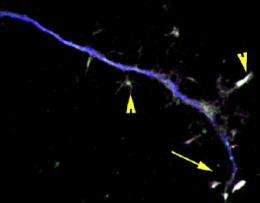
A JCB study shows how the protein CNTF activates the transcription factor STAT3 (green), which lingers in the axon (blue) and helps stabilize microtubules by inhibiting a protein called stathmin (magenta). STAT3 and stathmin colocalize in axonal branch points (arrowheads) and growth cones (arrow). Credit: Selvaraj, B.T.
A study in The Journal of Cell Biology shows how a transcription factor called STAT3 remains in the axon of nerve cells to help prevent neurodegeneration. The findings could pave the way for future drug therapies to slow nerve damage in patients with neurodegenerative diseases.
In Lou Gehrig's Disease (ALS) and other neurodegenerative diseases, nerve cells usually die in stages, with axons deteriorating first and the cells themselves perishing later. Axon degeneration may represent a turning point for patients, after which so much nerve damage has accumulated that treatments won't work. Researchers have tested several proteins for their ability to save axons. One of these molecules, CNTF, rescues axons in rodents and extends their lives. But it caused severe side effects in patients during clinical trials. "Acting on the same pathway but farther downstream could be an ideal way to improve the situation for motor neuron disease" and possibly for other neurodegenerative diseases, says senior author Michael Sendtner from the University of Wuerzburg in Germany.
To discover how CNTF works, Sendtner and his colleagues studied mice with a mutation that mimics ALS. The researchers found that CNTF not only prevented shrinkage of the rodents' motor neurons, it also reduced the number of swellings along the axon that are markers of degeneration. It is known that CNTF indirectly turns on the transcription factor STAT3, so the researchers wanted to determine if STAT3 is behind CNTF's protective powers. They tested whether CNTF helps motor neurons that lack STAT3 and discovered that, in the mutant mice, axons lacking STAT3 were half as long as those from a control group after CNTF treatment
Once it has been activated, STAT3 typically travels to the nucleus of the neuron to switch on genes. But the researchers were surprised to find that most of the axonal STAT3 did not move to the nucleus and instead had a local effect in the axon. Specifically, the team found that activated STAT3 inhibited stathmin, a protein that normally destabilizes microtubules. When the team removed stathmin in motor neurons from the mutant mice, the axons grew at the same rate as axons from normal mice but didn't elongate any faster after doses of CNTF. These results indicate that CNTF mainly stimulates axon growth by thwarting stathmin and suggests that drugs to block stathmin could slow neuron breakdown in patients with neurodegenerative diseases.
More information: J. Cell Biol. doi:10.1083/jcb.201203109
Provided by
Rockefeller University
-
Coaxing injured nerve fibers to regenerate by disabling 'brakes' in the system
Dec 09, 2009 |
not rated yet |
0
-
Nerve pathway for combating axon injury and stress may hold benefits for individuals with neurodegenerative disorders
Jun 27, 2012 |
not rated yet |
0
-
New Pathway is a Common Thread in Age-Related Neurodegenerative Diseases
Jan 29, 2009 |
not rated yet |
0
-
What makes an axon an axon?
Nov 10, 2008 |
not rated yet |
0
-
Scientists find survival factor for keeping nerve cells healthy
Jan 26, 2010 |
not rated yet |
0
-
Motion perception revisited: High Phi effect challenges established motion perception assumptions
Apr 23, 2013 |
3 / 5 (2) |
2
-
Anything you can do I can do better: Neuromolecular foundations of the superiority illusion (Update)
Apr 02, 2013 |
4.5 / 5 (11) |
5
-
The visual system as economist: Neural resource allocation in visual adaptation
Mar 30, 2013 |
5 / 5 (2) |
9
-
Separate lives: Neuronal and organismal lifespans decoupled
Mar 27, 2013 |
4.9 / 5 (8) |
0
-
Sizing things up: The evolutionary neurobiology of scale invariance
Feb 28, 2013 |
4.8 / 5 (10) |
14
-
How can there be a term called "intestinal metaplasia" of stomach
11 hours ago
-
Pressure-volume curve: Elastic Recoil Pressure don't make sense
May 18, 2013
-
If you became brain-dead, would you want them to pull the plug?
May 17, 2013
-
MRI bill question
May 15, 2013
-
Ratio of Hydrogen of Oxygen in Dessicated Animal Protein
May 13, 2013
-
Alcohol and acetaminophen
May 13, 2013
- More from Physics Forums - Medical Sciences
More news stories
H. pylori, smoking trends, and gastric cancer in US men
Trends in Helicobacter pylori (H. pylori) and smoking explain a significant proportion of the decline of intestinal-type noncardia gastric adenocarcinoma (NCGA) incidence in US men between 1978 and 2008, and are estimated ...
Medical research
57 minutes ago |
not rated yet |
0
Common food supplement fights degenerative brain disorders
Widely available in pharmacies and health stores, phosphatidylserine is a natural food supplement produced from beef, oysters, and soy. Proven to improve cognition and slow memory loss, it's a popular treatment for older ...
Medical research
5 hours ago |
5 / 5 (1) |
0
|
Finding a family for a pair of orphan receptors in the brain
Researchers at Emory University have identified a protein that stimulates a pair of "orphan receptors" found in the brain, solving a long-standing biological puzzle and possibly leading to future treatments for neurological ...
Medical research
6 hours ago |
not rated yet |
0
|
Insight into the dazzling impact of insulin in cells
Australian scientists have charted the path of insulin action in cells in precise detail like never before. This provides a comprehensive blueprint for understanding what goes wrong in diabetes.
Medical research
6 hours ago |
4.7 / 5 (3) |
0
|
Do men's and women's hearts burn fuel differently?
Researchers at the University of Illinois at Chicago College of Medicine will study gender differences in how the heart uses and stores fat—its main energy source—and how changes in fat metabolism play ...
Medical research
9 hours ago |
not rated yet |
0
Reducing caloric intake delays nerve cell loss
Activating an enzyme known to play a role in the anti-aging benefits of calorie restriction delays the loss of brain cells and preserves cognitive function in mice, according to a study published in the May ...
New sleeping pill poised to hit US markets
An experimental sleeping pill from US drug company Merck is effective at helping people fall and stay asleep, according to reviewers at the US Food and Drug Administration, which could soon approve the new drug.
Researchers find genetic risk factor for pulmonary fibrosis
A paper recently published in the New England Journal of Medicine and co-written by physicians and scientists at the University of Colorado School of Medicine finds that an important genetic risk factor for pulmonary fibros ...
Biomarkers discovered for inflammatory bowel disease
Using the Department of Defense Serum Repository (DoDSR), University of Cincinnati (UC) researchers have identified a number of biomarkers for inflammatory bowel disease (IBD), which could help with earlier diagnosis and ...
Changing cancer's environment to halt its spread
By studying the roles two proteins, thrombospondin-1 and prosaposin, play in discouraging cancer metastasis, a trans-Atlantic research team has identified a five-amino acid fragment of prosaposin that significantly reduces ...
Global recommendations on child medicine
Transparent information on the evidence supporting global recommendations on paediatric medicines should be easily accessible in order to help policy makers decides on what drugs to include in their national drug lists, according ...