Smoking affects allergy-relevant stem cells, study finds
November 14, 2012 by Daniela Weber in Immunology
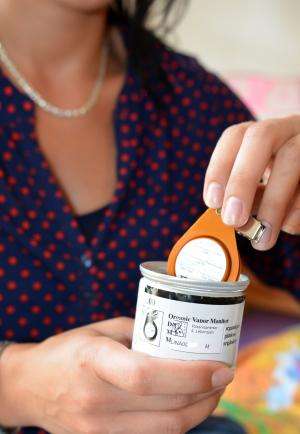
With the help of passive samplers it is examined in the LiNA-cohort study that environmental contaminants such as volatile organic compounds (VOCs) have an impact on human health. Credit: Dr. Kristin Weiße/UFZ
Environmental contaminants, such as smoking, are harmful to the human organism in relation to the occurrence of allergies. This is known. Until now, researchers had never investigated whether and to what extent environmental contaminants also affect allergy-relevant stem cells. For the first time a team at the Helmholtz Centre for Environmental Research (UFZ) has found evidence for this: Smoking affects the development of peripheral allergy-relevant stem cells in the blood. In order to present this result Dr. Irina Lehmann and Dr. Kristin Weiße chose a new scientific path: The combination of exposure analysis and stem cell research.
Stem cells are not specialised, propagate without limit and can develop to different cell types. From these the different cell and tissue types of the human organism, including the allergy-promoting eosinophil granulocytes, are differentiated. Progenitor cells, e.g. eosinophil/basophilic progenitors, which mature in the bone marrow and are then washed out into the bloodstream – the so-called periphery - function as a link between unspecialised stem cells and specialised tissue and organ cells. Until now, whether and to what extent environmental contaminants affect this maturation and release has not been investigated.
The UFZ team of Dr. Irina Lehmann and Dr. Kristin Weiße undertook their investigations from this point. Two facts were already known from a number of earlier studies: Firstly that the blood of allergy sufferers – whether children or adults – shows evidence of increased eosinophil/basophil progenitor levels. Secondly, that the occurrence of such peripheral progenitors in the blood of the umbilical cord indicates a higher risk for subsequent allergies. For the first time, the hypothesis which Dr. Kristin Weiße and Dr. Irina Lehmann developed on this basis combined this knowledge from stem cell research with the results of many years of exposure research at the UFZ. The researchers characterise their approach in the following way: "We wanted to clarify the relationship between environmental influences and the maturation and differentiation of the progenitor cells on the one hand and its contribution to the occurrence of allergies on the other hand. Specifically, we wanted to know whether the occurrence of allergy-relevant progenitor cells in the blood of infants can be changed by environmental influences".
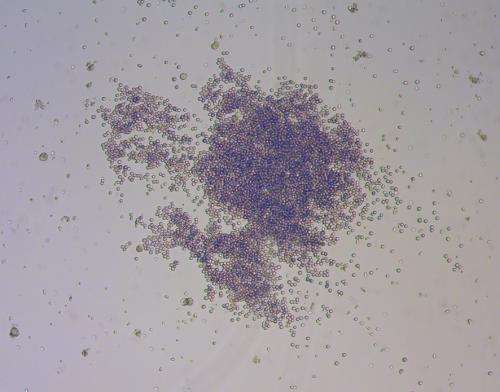
Stem cells are not specialised, propagate without limit and can develop to different cell types. From these the different cell and tissue types of the human organism, including the allergy-promoting eosinophil granulocytes, are differentiated. Progenitor cells, e.g. eosinophil/basophilic progenitors shown in the picture, which mature in the bone marrow and are then washed out into the bloodstream – the so-called periphery - function as a link between unspecialised stem cells and specialised tissue and organ cells. Credit: Dr. Kristin Weiße/UFZ
The results of the study, based on the data collected from 60 children aged one year, were recently published in the British medical journal Clinical & Experimental Allergy: It was found that children with skin manifestations, such as atopic dermatitis or cradle cap, have increased levels of eosinophil progenitors in their blood. In this connection, it was shown for the first time that children already afflicted show particularly sensitive reactions when exposed to environmental contaminants: The offspring of families exposed to significant levels of volatile organic compounds (VOC) at home were found to have considerably higher allergy-relevant eosinophilic/basophilic progenitor cell levels. "That VOCs, large amounts of which are released with cigarette smoke, have the greatest effect on stem cells was not entirely unexpected", explains Dr. Irina Lehmann. "Just as important, however", adds Dr. Kristin Weiße, is "that we can show that alterations in the number of stem cells as a result of harmful substances take place only in children who have already been afflicted with skin manifestations." This leads to the conclusion: There is a relationship between the genetic predisposition for a disease and environmental influences – there are environmental and life style factors which determine whether a genetic predisposition is in fact realised or not.Considerable logistical effort underlies this knowledge: On the one hand there is the long-term study "LiNA – Life Style and Environmental Factors and their Influence on The Risk of Allergy" in Newborn Children, a joint project of the Helmholtz Centre for Environmental Research and the Städtisches Klinikum St. Georg in Leipzig. 622 mothers, with a total of 629 children born, were recruited for the study between 2006 and 2008. In order to also take prenatal environmental influences into account - in contrast with earlier comparable studies of newborn children – mothers were already included in the investigations during pregnancy and the children from the time of birth. At the same time, it was necessary to become familiar with the methods required for stem cell analysis at the laboratory of the Canadian cooperation partner, Professor Judah Denburg of the McMaster University in Hamilton and to transfer this knowledge to Germany. Dr. Kristin Weiße spent six months in Canada working in the group of Professor Denburg in order to acquire the necessary know-how and profit from the experience of the Canadian partners. Dr. Lehmann and Dr. Weiße agree that "with the subject of environmental contamination and stem cells we have established an exciting new field of research". The UFZ team is currently the only one in the world investigating this relationship with analytical precision and methodical patience. The LiNA study, in the course of which mothers and their children can be observed over several years, represents a unique basis.
More information: K. Weisse, I. Lehmann, D. Heroux, T. Kohajda, G. Herberth, S. Röder, M. von Bergen, M. Borte and J. Denburg (2012): The LINA cohort: indoor chemical exposure, circulating eosinophil/basophil (Eo/B) progenitors and early life skin manifestations (pages 1337–1346). Clinical & Experimental Allergy. 09/2012; 42(9):1337-46. DOI:10.1111/j.1365-2222.2012.04024.x
Provided by
Helmholtz Association of German Research Centres
-
Environmental factors instruct lineage choice of blood progenitor cells
Jul 15, 2009 |
not rated yet |
0
-
New research sheds light on how stem cells turn into blood cells
Mar 05, 2009 |
not rated yet |
0
-
Stress during childhood increases the risk of allergies
Jun 18, 2008 |
not rated yet |
0
-
Smoke exposure late in pregnancy might boost baby's eczema risk
Mar 03, 2012 |
not rated yet |
0
-
Mature liver cells may be better than stem cells for liver cell transplantation therapy
Jun 04, 2012 |
not rated yet |
0
-
Motion perception revisited: High Phi effect challenges established motion perception assumptions
Apr 23, 2013 |
3 / 5 (2) |
2
-
Anything you can do I can do better: Neuromolecular foundations of the superiority illusion (Update)
Apr 02, 2013 |
4.5 / 5 (11) |
5
-
The visual system as economist: Neural resource allocation in visual adaptation
Mar 30, 2013 |
5 / 5 (2) |
9
-
Separate lives: Neuronal and organismal lifespans decoupled
Mar 27, 2013 |
4.9 / 5 (8) |
0
-
Sizing things up: The evolutionary neurobiology of scale invariance
Feb 28, 2013 |
4.8 / 5 (10) |
14
-
Sphygmomonometers energy...storage?
3 hours ago
-
How does momentum, inertia and drag affect the motion of an object?
5 hours ago
-
What is Time-Varying Voltage?
7 hours ago
-
Contextual Relationships Between Momentum, Energy, and Force.
8 hours ago
-
Barometric pressure and the math behind it. Very interesting, I think.
10 hours ago
-
Doubts in electrostatics
15 hours ago
- More from Physics Forums - Classical Physics
More news stories
Stem-cell-based strategy boosts immune system in mice
Raising hopes for cell-based therapies, UC San Francisco researchers have created the first functioning human thymus tissue from embryonic stem cells in the laboratory. The researchers showed that, in mice, ...
Immunology
May 16, 2013 |
4.8 / 5 (5) |
0
|
Resistance to visceral leishmaniasis: New mechanisms involved
Researchers from CNRS, Université Toulouse III - Paul Sabatier and IRD have elucidated new molecular mechanisms involved in resistance to visceral leishmaniasis, a serious parasitic infection. They have shown that dectin-1 ...
Immunology
May 16, 2013 |
not rated yet |
0
Women's immune systems remain younger for longer
Women's immune systems age more slowly than men's, suggests research in BioMed Central's open access journal Immunity & Ageing. The slower decline in a woman's immune system may contribute to women living longer than men. ...
Immunology
May 14, 2013 |
not rated yet |
0
Newly described type of immune cell and T cells share similar path to maturity, according to new study
(Medical Xpress)—Labs around the world, and a core group at Penn, have been studying recently described populations of immune cells called innate lymphoid cells (ILCs). Some researchers liken them to foot soldiers that ...
Immunology
May 14, 2013 |
5 / 5 (3) |
0
|
Not all cytokine-producing cells start out the same way, study finds
(Medical Xpress)—Cytokines are molecules produced by immune cells that induce the migration of other cells to sites of infection or injury, promote the production of anti-microbial agents, and signal the production of inflammatory ...
Immunology
May 13, 2013 |
5 / 5 (1) |
0
|
AIDS science at 30: 'Cure' now part of lexicon
Big names in medicine are set to give an upbeat assessment of the war on AIDS on Tuesday, 30 years after French researchers identified the virus that causes the disease.
For combat veterans suffering from post-traumatic stress disorder, 'fear circuitry' in the brain never rests
Chronic trauma can inflict lasting damage to brain regions associated with fear and anxiety. Previous imaging studies of people with post-traumatic stress disorder, or PTSD, have shown that these brain regions can over-or ...
Temporal processing in the olfactory system
The neural machinery underlying our olfactory sense continues to be an enigma for neuroscience. A recent review in Neuron seeks to expand traditional ideas about how neurons in the olfactory bulb might encode information about ...
Melon focus headband turns to Kickstarter for rollout plans
(Medical Xpress)—What if the quality of your work depends more on your focus on the piano keys or canvas or laptop than your musical or painting or computing skills? If target users can be convinced, they ...
Now we know why old scizophrenia medicine works on antibiotics-resistant bacteria
In 2008 researchers from the University of Southern Denmark showed that the drug thioridazine, which has previously been used to treat schizophrenia, is also a powerful weapon against antibiotic-resistant bacteria such as ...
Study identifies new approach to improving treatment for MS and other conditions
(Medical Xpress)—Working with lab mice models of multiple sclerosis (MS), UC Davis scientists have detected a novel molecular target for the design of drugs that could be safer and more effective than current FDA-approved ...
