Detection, analysis of 'cell dust' may allow diagnosis, monitoring of brain cancer
November 11, 2012 in Medical research
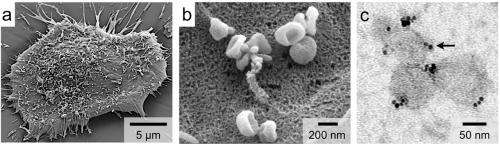
Glioblastoma cells (a) release abundant microvesicles (b), which can be labeled (c) with magnetic nanoparticles (black dots). Credit: MGH Center for Systems Biology
A novel miniature diagnostic platform using nuclear magnetic resonance (NMR) technology is capable of detecting minuscule cell particles known as microvesicles in a drop of blood. Microvesicles shed by cancer cells are even more numerous than those released by normal cells, so detecting them could prove a simple means for diagnosing cancer.
In a study published in Nature Medicine, investigators at the Massachusetts General Hospital (MGH) Center for Systems Biology (CSB) demonstrate that microvesicles shed by brain cancer cells can be reliably detected in human blood through a combination of nanotechnology and their new NMR-based device.
"About 30 or 40 years ago, people noticed something in the bloodstream that they initially thought was some kind of debris or 'cell dust',"explains Hakho Lee, PhD, of the CSB, and co-senior author of the study with Ralph Weissleder, MD, PhD, director of the CSB. "But it has recently become apparent that these vesicles shed by cells actually harbor the same biomarkers as their parent cells."
Circulating tumor cells (CTCs) have been regarded as a potential key to improved cancer diagnosis, but Lee explains, "The problem with CTCs is that they are extremely rare, so finding them in the blood is like trying to find a needle in a haystack." Microvesicles on the other hand are abundant in the circulation and, unlike CTCs, are small enough to cross the blood/brain barrier, which means that they could be used to detect and monitor brain cancers, he adds.
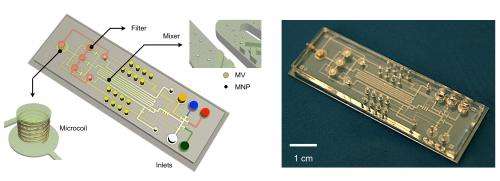
This is a Microfluidic NMR system for the detection of microvesicles (MV) in blood. Labeling with magnetic nanoparticles (MNP) enables detection with a miniature NMR coil. Credit: MGH Center for Systems Biology
Glioblastoma multiforme (GBM) is the most common and most aggressive brain cancer in humans. By the time it is diagnosed, patients typically have less than 15 months to live. One of the biggest challenges with this condition is accurate disease monitoring to establish whether patients are responding to treatment. Currently, the only way to diagnose and monitor GBM is with biopsies and imaging tests, making long-term treatment monitoring difficult, invasive and impractical. To address this need, the CSB team sought to develop a simple blood test that could be used to easily monitor disease progression.
"The issue with microvesicles, however, is that they are very small, so there are not many technologies out there that can detect and molecularly profile them," explains Lee. "That is where our new technology comes in." By using nanotechnology to magnetically label microvesicles, and by adapting and improving equipment they developed last year to detect cancer cells with a miniature, hand-held NMR, the MGH researchers were able to reliably detect the tumor microvesicles in blood samples from mice bearing human GBM tumors and eventually in samples from human GBM patients.
Compared with other gold-standard techniques, this new technology demonstrated excellent detection accuracy. However, unlike other methods – which can be time-consuming and require much greater sample volumes as well as expertise to perform – NMR detection is quick and simple, potentially providing almost instant results from a small blood sample right in a doctor's office, the authors note. The MGH CSB team is currently extending this platform to other types of cancer and to other diseases such as bacterial infection. A number of clinical studies are currently ongoing, and others are in the planning stages, with the goal of eventually commercializing the technology.
"These microvesicles were found to be remarkably reliable biomarkers," confirms Weissleder. "They are very stable and abundant and appear to be extremely sensitive to treatment effects. In both animals and human patients, we were able to monitor how the number of cancer-related microvesicles in the bloodstream changed with treatment," explains Weissleder. "Even before an appreciable change in tumor size could be seen with imaging, we saw fewer microvesicles. It's like they are a harbinger of treatment response." Weissleder is a professor of Radiology and Lee an assistant professor at Harvard Medical School.
More information: DOI: 10.1038/nm.2994
Journal reference:
Nature Medicine
Provided by
Massachusetts General Hospital
-
Tumor microvesicles reveal detailed genetic information
Feb 10, 2011 |
not rated yet |
0
-
Study examines the biology of tumor-derived microvesicles
Jun 21, 2012 |
not rated yet |
0
-
Hand-held NMR instrument yields rapid analysis of human tumors
Mar 28, 2011 |
not rated yet |
0
-
Study provides insights into the molecular basis of tumor cell behavior
Nov 05, 2009 |
not rated yet |
0
-
Offering hope for tissue regeneration
Feb 26, 2010 |
not rated yet |
0
-
Motion perception revisited: High Phi effect challenges established motion perception assumptions
Apr 23, 2013 |
3 / 5 (2) |
2
-
Anything you can do I can do better: Neuromolecular foundations of the superiority illusion (Update)
Apr 02, 2013 |
4.5 / 5 (11) |
5
-
The visual system as economist: Neural resource allocation in visual adaptation
Mar 30, 2013 |
5 / 5 (2) |
9
-
Separate lives: Neuronal and organismal lifespans decoupled
Mar 27, 2013 |
4.9 / 5 (8) |
0
-
Sizing things up: The evolutionary neurobiology of scale invariance
Feb 28, 2013 |
4.8 / 5 (10) |
14
-
Why is zone 1 in liver more prone to ischemic injury?
May 23, 2013
-
How can there be villous adenoma in colon, if there are no villi there
May 22, 2013
-
How can there be a term called "intestinal metaplasia" of stomach
May 21, 2013
-
Pressure-volume curve: Elastic Recoil Pressure don't make sense
May 18, 2013
-
If you became brain-dead, would you want them to pull the plug?
May 17, 2013
-
MRI bill question
May 15, 2013
- More from Physics Forums - Medical Sciences
More news stories
Study reveals new mechanism for estrogen suppression of liver lipid synthesis
By discovering the new mechanism by which estrogen suppresses lipid synthesis in the liver, UC Irvine endocrinologists have revealed a potential new approach toward treating certain liver diseases.
Medical research
16 hours ago |
not rated yet |
0
|
MRI-based measurement helps predict vascular disease in the brain
Aortic arch pulse wave velocity, a measure of arterial stiffness, is a strong independent predictor of disease of the vessels that supply blood to the brain, according to a new study published in the June issue the journal ...
Medical research
16 hours ago |
not rated yet |
0
Antibiotics: A new understanding of sulfonamide nervous system side effects
Since the discovery of Prontosil in 1932, sulfonamide antibiotics have been used to combat a wide spectrum of bacterial infections, from acne to chlamydia and pneumonia. However, their side effects can include serious neurological ...
Medical research
17 hours ago |
not rated yet |
0
|
Scientists discover molecule triggers sensation of itch
Scientists at the National Institutes of Health report they have discovered in mouse studies that a small molecule released in the spinal cord triggers a process that is later experienced in the brain as ...
Medical research
17 hours ago |
5 / 5 (2) |
0
|
Discarded immune cells induce the relocation of stem cells
Spanish researchers have discovered that the daily clearance of neutrophils from the body stimulates the release of hematopoietic stem cells from the bone marrow into the bloodstream, according to a report published today ...
Medical research
19 hours ago |
5 / 5 (2) |
0
Patenting the human genome
Can human genes be patented? That was the question posed by Alan J. Snyder, vice president and associate provost for research and graduate studies at Lehigh, and Lee Kaplan, scientific director of cellular and molecular genetics ...
How the EU could help more children survive cancer
A leading expert in childhood cancer at The University of Nottingham is spearheading a Europe-wide lobby of the European Parliament to try to make it easier for doctors to develop and test new treatments on children and young ...
Controlling mood through the motions of mitochondria
(Medical Xpress)—Regulating the distribution of power in neurons is done by a system that makes the national electric grid look simple by comparison. Each neuron has several thousand mitochondria confined ...
Obesity weighs down on top soda guzzler Mexico
Artemio Martinez balanced his corpulent frame on a stool in a Mexico City street taco stand, downing a sweet soda and eating a final pork-filled corn tortilla.
Study: No higher cancer rate at Conn. Pratt plant
(AP)—Researchers examining the incidence of brain cancer at jet engine manufacturer Pratt & Whitney in Connecticut say they have found no statistically significant elevations in the rate of cancer among workers.
WHO voices deep concern over spread of SARS-like virus
The World Health Organization voiced deep concern Thursday over the SARS-like virus that has killed 22 people in less than a year, saying it might potentially spread more widely between humans.
