Research shows brain hub activity different in coma patients
November 27, 2012
by Bob Yirka
in Neuroscience
Credit: National Institute of Mental Health
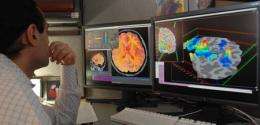
(Medical Xpress)—A team of French and British researchers has found that brain region activity for coma patients is markedly different than for healthy people. In their paper published in the Proceedings of the National Academy of Sciences, the group describes the differences found when comparing fMRI scans of people in a coma with healthy volunteers.
To gain a better understanding of what goes on in the brain when a person is in a coma, and perhaps the nature of consciousness, the researchers performed fMRI brain scans on 17 people who had recently become comatose due to medical conditions that led to blockage of oxygen to the brain. They then compared those scans to those taken of 20 healthy volunteers.
In analyzing the results the team found that global comparisons between the two groups revealed very few if any differences. Blood continued to flow to all of the parts of the brain. When focusing on the brain as a network however, they found very large differences.
To look at the brain as a network requires looking at its different parts as regions that communicate with one another, forming hubs. In healthy people, certain regions or hubs are busier than others as evidenced by more blood flow. But for the people in a coma, the team found, the normally busy hubs grew less busy, while other hubs grew busier, indicating a major change in the flow of information.
The researchers suggest that the brain scans reveal that the normally busy hubs in healthy people are centers of consciousness and their reduced role in communications in comatose patients suggests that they are most likely not conscious of their existence. They point to prior research that has suggested that being in a coma is more likely closer to the experience of being under anesthesia than being asleep. They add that the their research indicates that regions of the brain that are responsible for conscience thought likely require more oxygen rich blood, and are thus likely to be more sensitive to oxygen deprivation than other areas of the brain, which might explain why people go into a coma when those regions are harmed.
More information: Hubs of brain functional networks are radically reorganized in comatose patients, PNAS, Published online before print November 26, 2012, doi: 10.1073/pnas.1208933109
Abstract
Human brain networks have topological properties in common with many other complex systems, prompting the following question: what aspects of brain network organization are critical for distinctive functional properties of the brain, such as consciousness? To address this question, we used graph theoretical methods to explore brain network topology in resting state functional MRI data acquired from 17 patients with severely impaired consciousness and 20 healthy volunteers. We found that many global network properties were conserved in comatose patients. Specifically, there was no significant abnormality of global efficiency, clustering, small-worldness, modularity, or degree distribution in the patient group. However, in every patient, we found evidence for a radical reorganization of high degree or highly efficient "hub" nodes. Cortical regions that were hubs of healthy brain networks had typically become nonhubs of comatose brain networks and vice versa. These results indicate that global topological properties of complex brain networks may be homeostatically conserved under extremely different clinical conditions and that consciousness likely depends on the anatomical location of hub nodes in human brain networks.
Journal reference:
Proceedings of the National Academy of Sciences
© 2012 Medical Xpress
-
Imaging the network traffic in our brains
Sep 18, 2012 |
not rated yet |
0
-
The network in our heads: What our brains have in common with the internet
May 27, 2010 |
not rated yet |
0
-
fMRI brain imaging illuminates magic mushrooms' psychedelic effects
Jan 23, 2012 |
not rated yet |
0
-
Brain scans used to predict behavior
Nov 30, 2005 |
not rated yet |
0
-
Experiment shows visual cortex in women quiets when viewing porn
Apr 20, 2012 |
not rated yet |
0
-
Motion perception revisited: High Phi effect challenges established motion perception assumptions
Apr 23, 2013 |
3 / 5 (2) |
2
-
Anything you can do I can do better: Neuromolecular foundations of the superiority illusion (Update)
Apr 02, 2013 |
4.5 / 5 (11) |
5
-
The visual system as economist: Neural resource allocation in visual adaptation
Mar 30, 2013 |
5 / 5 (2) |
9
-
Separate lives: Neuronal and organismal lifespans decoupled
Mar 27, 2013 |
4.9 / 5 (8) |
0
-
Sizing things up: The evolutionary neurobiology of scale invariance
Feb 28, 2013 |
4.8 / 5 (10) |
14
-
How can there be a term called "intestinal metaplasia" of stomach
21 hours ago
-
Pressure-volume curve: Elastic Recoil Pressure don't make sense
May 18, 2013
-
If you became brain-dead, would you want them to pull the plug?
May 17, 2013
-
MRI bill question
May 15, 2013
-
Ratio of Hydrogen of Oxygen in Dessicated Animal Protein
May 13, 2013
-
Alcohol and acetaminophen
May 13, 2013
- More from Physics Forums - Medical Sciences
More news stories
Reducing caloric intake delays nerve cell loss
Activating an enzyme known to play a role in the anti-aging benefits of calorie restriction delays the loss of brain cells and preserves cognitive function in mice, according to a study published in the May ...
Neuroscience
11 hours ago |
5 / 5 (4) |
0
|
B vitamins could delay dementia
(Medical Xpress)—Despite spending billions of dollars on research and development, drug companies have been unable to come up with effective treatments for dementia and Alzheimer's Disease (AD). Now, A. ...
Neuroscience
14 hours ago |
4.9 / 5 (13) |
0
|
Waiting for a sign? Researchers find potential brain 'switch' for new behavior
You're standing near an airport luggage carousel and your bag emerges on the conveyor belt, prompting you to spring into action. How does your brain make the shift from passively waiting to taking action when ...
Neuroscience
15 hours ago |
5 / 5 (1) |
0
|
If you can remember it, you can remember it wrong
(Medical Xpress)—Native peoples in regions where cameras are uncommon sometimes react with caution when their picture is taken. The fear that something must have been stolen from them to create the photo ...
Neuroscience
16 hours ago |
4.2 / 5 (5) |
0
|
Study shows where scene context happens in our brain
In a remote fishing community in Venezuela, a lone fisherman sits on a cliff overlooking the southern Caribbean Sea. This man –– the lookout –– is responsible for directing his comrades on the water, ...
Neuroscience
18 hours ago |
4 / 5 (1) |
0
|
Phthalates: Study links chemicals widely found in plastics, processed food to elevated blood pressure in children, teens
Plastic additives known as phthalates (pronounced THAL-ates) are odorless, colorless and just about everywhere: They turn up in flooring, plastic cups, beach balls, plastic wrap, intravenous tubing and—according to the ...
Insight into the dazzling impact of insulin in cells
Australian scientists have charted the path of insulin action in cells in precise detail like never before. This provides a comprehensive blueprint for understanding what goes wrong in diabetes.
New sleeping pill poised to hit US markets
An experimental sleeping pill from US drug company Merck is effective at helping people fall and stay asleep, according to reviewers at the US Food and Drug Administration, which could soon approve the new drug.
Antidepressant reduces stress-induced heart condition
A drug commonly used to treat depression and anxiety may improve a stress-related heart condition in people with stable coronary heart disease, according to researchers at Duke Medicine.
Drugs found to both prevent and treat Alzheimer's disease in mice
Researchers at USC have found that a class of pharmaceuticals can both prevent and treat Alzheimer's Disease in mice.
Enrichment therapy effective among children with autism, study finds
Children with autism showed significant improvement after six months of simple sensory exercises at home using everyday items such as scents, spoons and sponges, according to UC Irvine neurobiologists.
Nov 27, 2012
Rank: not rated yet
Equally fascinating is the suggestion consciousness is a particularly energy-hungry process, which throws up its own raft of questions: is the process fundamentally different from other modes of network activity - perhaps akin to a higher-level language 'wrapping around' the underlying language base? Or is it just a denser, more intensive form of the same type of global processing protocols? After all, it might reasonably be anticipated that a 'master network' would be doing less work than the net throng of disparate nuclei it corrals. Is it perhaps higher frequency activity, higher voltage, or what?
Nov 27, 2012
Rank: not rated yet
You're posing a lot of pertinent questions to a discipline that's by its very nature incapable of answering. Consciousness is too elusive for science because of the requirement of reproducibility. It's impossible to measure, photograph, or record with scientific instruments. All we have is our own awareness of it and its unique profile to each and every living entity. It is massless, not even the size of a pinpoint, and is unbridled at times like the neutrino. There are some subjects that science can get information from ancient knowledge, or what was then ancient science.
Nov 28, 2012
Rank: 5 / 5 (1)
We can switch it on or off in a variety of ways, and increasingly, measure corresponding activity of the wetware in real-time. Likewise we can influence and modify its behaviour with drugs, electrical and magnetic simulation, and exploits like subconscious priming. Then there's all manner of optical illusions, cognitive sleight-of-hand phenomenon like change blindness, somatosensory ones like phantom appendages, and a whole smorgasbord of different aphasias. Even music, that can speak to our souls, cut us down or leave us ascendant, depends on rigorous mathematical relationships - how, and in what sense, are all factors of two of a fundamental frequency perceived as equivalent? It's a rigidly mechanical valuation, wholly objective, yet innate to the depths of our psyche...
Can it be digitised, created, transplanted?
Nov 28, 2012
Rank: 5 / 5 (1)
This is the fire. Understanding, even mastering, the chemistry, won't make the dance of the flame any less mesmerising...
Nov 28, 2012
Rank: not rated yet
You ought to be published with writing like that. I've had the privilege of investigating the subject with first hand experience- not with drugs, but through meditation. A few sessions resulted in the "separation" of my "consciousness" from my physical body, also known as an "out-of-body experience." When it happens, there is little doubt that it's the most profound of all experiences. I suggest you read some first-hand accounts from people in all cultures and time periods. Then pursue the experience yourself if you're so inclined.
Nov 29, 2012
Rank: not rated yet
Cheers for the nod, however the type of 'out of body experience' i've been considering lately is mind imaging - the fruits of endeavours like the Human Connectome Project and developments in autonomous networks - the possibility of rendering mind in software...
..as for writing, with mind-software transplants as a starting point you quickly end up with a universe that makes The Matrix look tame - real and virtual worlds in parallel, both populated by organics, ex-organics & synthetics alike, inter-dependent, yet with vastly different & often conflicting restrictions and needs... recipe for a plot line from hell eh? If only i had the time..