Cell proliferation is a key factor in degenerative diseases and cancers
November 28, 2012 in Medical research

Cell proliferation is a key factor in degenerative diseases and cancers

Enlarge

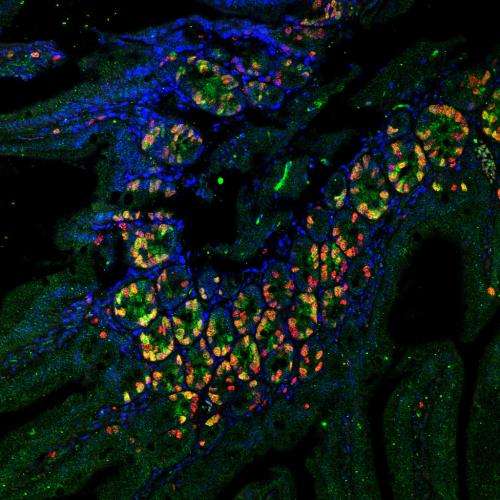
Fluorescence microscopy section of the intestine. Green/yellow areas mark sites of cell proliferation. Cell nuclei marked in blue and nuclei with DNA replication marked in red. Credit: Agnes Klochendler

(Medical Xpress)—A newly-engineered strain of mice whose dividing cells express a fluorescent protein could open the door to new methods of regulating cell proliferation in humans. Cell proliferation plays a key role in degenerative diseases, in which specific cells do not replicate enough, and in cancers, in which cells replicate too much.

Cells in the human body grow and multiply during body growth or during after damage. However most mature tissues require only rare cell divisions. Scientists who wish to study these rare populations of replicating cells face a serious obstacle: most current methods for labeling and identifying replicating cells involve procedures that kill the cells and destroy sensitive . This limits the ability of scientists to examine important functions of these cells, for example the genes active in such cells.
 
To address this problem, two Hebrew University of Jerusalem researchers—Prof. Yuval Dor from the Institute for Medical Research Israel-Canada (IMRIC) and Dr. Amir Eden from the Alexander Silberman Institute of Life Sciences—together with colleagues in Denmark and the U.S., created a mouse strain in which replicating cells express a fluorescent protein which is destroyed once is completed. In all tissues of these mice, replicating cells are labeled by green fluorescence, which allows identification and isolation of live, replicating cells directly from healthy or .
 
Using this system, research associate Dr. Agnes Klochendler and PhD student Noa Weinberg-Corem at the Hebrew University were able to isolate a rare population of replicating cells from the livers of mice, and study the genes that they express compared with resting . Interestingly, they found that in replicating liver cells there is a significant decrease in the expression of genes responsible for key liver functions such as fatty acid and amino acid metabolism.
 
The research results indicate that when differentiated cells divide, they temporarily shift to a less differentiated state. This finding is important to our understanding of the difference between the two fundamental states of differentiation and proliferation in normal cells. It is also relevant for the situation in cancer, where cells are proliferating and often less differentiated.
 
In the future, the researchers hope to develop methods for regulating . For example, isolation and study of the rare replicating cells in the pancreas could lead to development of approaches to promote the proliferation and expansion of insulin-producing cells, whose loss is the hallmark of diabetes.
 
This could also be useful in other areas such as cancer and regenerative biology. By distinguishing between abnormally expressed genes in tumors and the genes associated with normal cell divisions, researchers may be able to identify cancer-specific replication markers with a potential to become new drug targets. Similarly, scientists could analyze the effects of specific drugs on the biology of replicating cells, providing important clues for regenerative medicine.
 
The study, A Transgenic Mouse Marking Live Replicating Cells Reveals In Vivo Transcriptional Program of Proliferation,  was funded by the European Union and is published in the October issue of Developmental Cell.

More information: bit.ly/T8qGY4

Journal reference: Developmental Cell search and more info website

Provided by Hebrew University of Jerusalem search and more info website

5 /5 (1 vote)  

Rank 5 /5 (1 vote)
Relevant PhysicsForums posts

More news stories

Study suggests new source of kidneys for transplant

Nearly 20 percent of kidneys that are recovered from deceased donors in the U.S. are refused for transplant due to factors ranging from scarring in small blood vessels of the kidney's filtering units to the organ going too ...

Medical research created 1 hour ago | popularity not rated yet | comments 0 | with audio podcast

Discovery of circadian clock in mice hair reveals period of time when damage from radiotherapy can be quickly repaired

Discovering that mouse hair has a circadian clock - a 24-hour cycle of growth followed by restorative repair - researchers suspect that hair loss in humans from toxic cancer radiotherapy and chemotherapy ...

Medical research created 1 hour ago | popularity 5 / 5 (1) | comments 1 | with audio podcast

Do salamanders hold the solution to regeneration?

Salamanders' immune systems are key to their remarkable ability to regrow limbs, and could also underpin their ability to regenerate spinal cords, brain tissue and even parts of their hearts, scientists have ...

Medical research created 2 hours ago | popularity not rated yet | comments 0 | with audio podcast

New study finds blind people have the potential to use their 'inner bat' to locate objects

New research from the University of Southampton has shown that blind and visually impaired people have the potential to use echolocation, similar to that used by bats and dolphins, to determine the location of an object.

Medical research created 5 hours ago | popularity not rated yet | comments 1 | with audio podcast

Germ-fighting vaccine system makes great strides in delivery

A novel vaccine study from South Dakota State University (SDSU) will headline the groundbreaking research that will be unveiled at the American Association of Pharmaceutical Scientists' (AAPS) National Biotechnology Conference ...

Medical research created 5 hours ago | popularity not rated yet | comments 0


Practice makes perfect? Not so much

Turns out, that old "practice makes perfect" adage may be overblown. New research led by Michigan State University's Zach Hambrick finds that a copious amount of practice is not enough to explain why people ...

The compound in the Mediterranean diet that makes cancer cells 'mortal'

New research suggests that a compound abundant in the Mediterranean diet takes away cancer cells' "superpower" to escape death. By altering a very specific step in gene regulation, this compound essentially re-educates cancer ...

Study shows how bilinguals switch between languages

(Medical Xpress)—Individuals who learn two languages at an early age seem to switch back and forth between separate "sound systems" for each language, according to new research conducted at the University of Arizona.

Scientists identify molecular trigger for Alzheimer's disease

Researchers have pinpointed a catalytic trigger for the onset of Alzheimer's disease – when the fundamental structure of a protein molecule changes to cause a chain reaction that leads to the death of neurons ...

Neurons that can multitask greatly enhance the brain's computational power, study finds

Over the past few decades, neuroscientists have made much progress in mapping the brain by deciphering the functions of individual neurons that perform very specific tasks, such as recognizing the location ...

SARS-like virus claims new life in Saudi

A Saudi man who had contracted the coronavirus has died, raising the death toll in the kingdom from the SARS-like virus to 16, the health ministry announced on Monday on its Internet website.