Unlocking the destiny of a cell
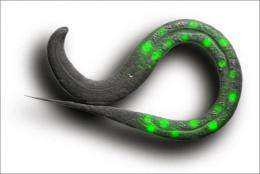
Juvenile C. elegans.
(Medical Xpress)— Scientists have discovered that breaking a biological signaling system in an embryo allows them to change the destiny of a cell. The findings could lead to new ways of making replacement organs.
The discovery was made in the laboratory of Joel H. Rothman, a professor in the Department of Molecular, Cellular, and Developmental Biology at UC Santa Barbara. The studies were reported in the interdisciplinary journal Genes and Development, and were carried out by Ph.D student Nareg Djabrayan, in collaboration with Rothman and two other members of the laboratory, Ph.D student Erica Sommermann and postdoctoral fellow Nathaniel Dudley.
"At some point along the way toward becoming part of a complete individual, cells become destined to choose a particular identity and long-term profession," Rothman noted. "Once a cell chooses who it will be, it locks onto that identity for the remainder of its life."
A cell that is destined to become a heart cell functions exclusively in the heart until it dies, and never chooses later to change jobs by becoming, for example, a brain cell. "If Oz's wizard possessed the powers he claimed, and had a spare brain lying around, he could switch it to a heart as a gift for the Tin Man. And he could reverse the trick for the Scarecrow," Rothman said.
Similarly, the researchers have found a way to unlock cells' destinies and lead them to take on a new profession.
The scientists found that a widely used cell signaling system, known as "Notch" signaling, causes cells to commit to a particular occupation, such as a skin or brain cell. When they blocked the signal by genetic manipulation, the researchers discovered that they could force a cell to change its destiny, such that they instead became cells of the intestine.
"We found that we could break the signal in such a way that cells would follow their usual destinies, but were somehow less committed to doing so: We could convince them to change professions long after they would normally refuse to do so," Rothman said.
The scientists made the discovery by harnessing the genetics of a tiny nematode worm known as C. elegans, a model animal that has become famed in fundamental studies in biomedicine, and has been the subject of six Nobel prizes.
The researchers discovered that shutting off the Notch signal in early embryos made it possible for them to change the destiny of cells much later on, at a stage when they normally could not. "The later cells seemed to remember what had happened to their great-grandparent cells," Rothman said. "Imagine if the experience of your great-grandparents predestined you to become a lawyer, dentist, or coal miner, and you could not choose to change your professional destiny. That is what is happening to cells whose cellular ancestors received the Notch signal."
The research was supported by the National Institute of Child Health and Human Development and the California Institute of Regenerative Medicine.
The discovery could someday help scientists develop new ways to produce tissues and organs in the laboratory that could be used to replace a patient's injured, diseased, or aged organs. By unlocking a cell's normal destiny, it may be possible to change it into an altogether different type of cell that could be used to grow a new organ for a patient—or perhaps, a Tin Man.
Journal reference:
Genes & Development
Provided by
University of California - Santa Barbara
-
Link between cellular glue and cancer growth
Aug 31, 2010 |
not rated yet |
0
-
Scientists Discover a Genetic Switch That Links Animal Growth and Cancer
Apr 17, 2006 |
not rated yet |
0
-
When is a stem cell not really a stem cell?
Aug 26, 2007 |
not rated yet |
0
-
We need to talk: How cells communicate to activate notch
May 31, 2012 |
not rated yet |
0
-
Signaling pathway is 'executive software' of airway stem cells
Jun 17, 2011 |
not rated yet |
0
-
Motion perception revisited: High Phi effect challenges established motion perception assumptions
Apr 23, 2013 |
3 / 5 (2) |
2
-
Anything you can do I can do better: Neuromolecular foundations of the superiority illusion (Update)
Apr 02, 2013 |
4.5 / 5 (11) |
5
-
The visual system as economist: Neural resource allocation in visual adaptation
Mar 30, 2013 |
5 / 5 (2) |
9
-
Separate lives: Neuronal and organismal lifespans decoupled
Mar 27, 2013 |
4.9 / 5 (8) |
0
-
Sizing things up: The evolutionary neurobiology of scale invariance
Feb 28, 2013 |
4.8 / 5 (10) |
14
-
Classical and Quantum Mechanics via Lie algebras
Apr 15, 2011
- More from Physics Forums - Independent Research
More news stories
Researchers develop model for better testing, targeting of malignant peripheral nerve sheath tumors
University of Minnesota Medical School researchers from the Masonic Cancer Center, University of Minnesota, in partnership with the University's Brain Tumor Program, have developed a new mouse model of malignant peripheral ...
Genetics
May 20, 2013 |
5 / 5 (1) |
0
|
Researchers identify new circadian clock component
Northwestern University scientists have shown a gene involved in neurodegenerative disease also plays a critical role in the proper function of the circadian clock.
Genetics
May 16, 2013 |
3 / 5 (1) |
1
|
Returning genetic incidental findings without patient consent violates basic rights, experts say
Informed consent is the backbone of patient care. Genetic testing has long required patient consent and patients have had a "right not to know" the results. However, as 21st century medicine now begins to use the tools of ...
Genetics
May 16, 2013 |
5 / 5 (1) |
3
|
Ethicists provide framework supporting new recommendations on reporting incidental findings in gene sequencing
In a paper published in Science Express, a group of experts led by bioethicists in the Center for Medical Ethics and Health Policy at Baylor College of Medicine provide a framework for the new American College of Medical Geneti ...
Genetics
May 16, 2013 |
not rated yet |
0
Experts urge caution over use of new genetic sequencing techniques
The use of genome-wide analysis (GWA), where the entirety of an individual's DNA is examined to look for the genomic mutations or variants which can cause health problems is a massively useful technology for diagnosing disease. ...
Genetics
May 16, 2013 |
not rated yet |
0
New sleeping pill poised to hit US markets
An experimental sleeping pill from US drug company Merck is effective at helping people fall and stay asleep, according to reviewers at the US Food and Drug Administration, which could soon approve the new drug.
Researchers find genetic risk factor for pulmonary fibrosis
A paper recently published in the New England Journal of Medicine and co-written by physicians and scientists at the University of Colorado School of Medicine finds that an important genetic risk factor for pulmonary fibros ...
Biomarkers discovered for inflammatory bowel disease
Using the Department of Defense Serum Repository (DoDSR), University of Cincinnati (UC) researchers have identified a number of biomarkers for inflammatory bowel disease (IBD), which could help with earlier diagnosis and ...
Changing cancer's environment to halt its spread
By studying the roles two proteins, thrombospondin-1 and prosaposin, play in discouraging cancer metastasis, a trans-Atlantic research team has identified a five-amino acid fragment of prosaposin that significantly reduces ...
Biodegradable stent proves non-inferior to drug-eluting stent
The Orsiro stent, which is a novel stent platform eluting sirolimus from a biodegradable polymer, demonstrated non-inferiority to the Xience Prime everolimus-eluting stent for the primary angiographic endpoint of in-stent ...
Reducing caloric intake delays nerve cell loss
Activating an enzyme known to play a role in the anti-aging benefits of calorie restriction delays the loss of brain cells and preserves cognitive function in mice, according to a study published in the May ...