New findings on gene regulation and bone development
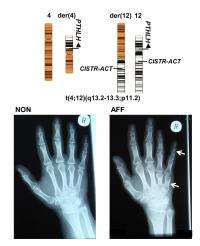
The patients have single short fingers (metacarpals) and toes (metatarsals) and can be restricted in growth due to a shortened skeleton. This hereditary disease is called brachydactyly type E (Greek for short fingers). Three years ago Dr. Philipp G. Maass from the research group of Professor Friedrich C. Luft at the Experimental and Clinical Research Center (ECRC), a joint cooperation between the Charité Medical Faculty and the Max Delbrück Center for Molecular Medicine (MDC) in Berlin-Buch, has discovered an epigenetic mechanism, which, when dysregulated, causes this condition. Now, together with Dr. Sylvia Bähring (ECRC) he was able to show how this epigenetic regulator functions and influences the development of the skeleton and the extremities. Also, he shed light on a new principle of gene regulation.
The gene causing brachydactyly type E (BDE) is PTHLH (the abbreviation stands for parathyroid hormone like hormone), and belongs to a group of genes that regulate the development of cartilage and determine subsequent skeletal structure. The researchers investigated two families with BDE. The patients exhibit shortened metacarpals, involved in forming the hands and feet, but had no other clinical symptoms.
Up to now, more than ten different forms of brachydactyly are known. The features of the hands and feet are variable depending upon which type of brachydactyly a patient has. Sometimes, the brachydactyly can be associated with hypertension, mental retardation, or other medical problems.
Several new findings
The gene PTHLH is located on chromosome 12, one of the 46 chromosomes of the human genome. The gene exerts considerably influence on cartilage during development and early life. However, little was known about the regulation of this gene. Now, Dr. Maass, Dr. Bähring and Professor Luft have detected an epigenetic regulator for the gene PTHLH on chromosome 12 and in the course of their research made several new findings.
First, they could show, that the gene regulator interacts with genes over very long distances on the same chromosome (cis) and that it also is able to regulate genes on other chromosomes (trans). Thus, the tongue-twister name for this regulator: cis and trans-chromosomal communicator acting through DNA and noncoding RNA (CISTR-ACT).
Second, the team showed that because of a balanced translocation, CISTR-ACT is misplaced, so that the regulator no longer can properly influence PTHLH function.
Third, CISTR-ACT encodes a so-called long noncoding RNA that participates in the regulatory functions. This finding encompasses a new principle in gene regulation. Epigenetics refers to inherited mechanisms that occur without alterations in the DNA gene sequence. In this form of BDE, no change in the DNA sequence of coding genes is responsible for the condition.
Back to the first finding, the epigenetic regulator CISTR-ACT on chromosome 12 manages to get in touch with the gene PTHLH over a distance of 24 million base pairs. "The largest ever measured distance between a gene regulator and a gene on the same chromosome was around one million base-pairs", explains Dr. Maass. Furthermore, CISTR-ACT regulates another developmental gene (SOX9) on chromosome 17. "This finding is extraordinary," comments Dr. Maass.
How is this regulation possible? The researchers found the solution at the chromatin level, in which the chromosomes are densely packed. "Just imagine a ball of wool in which different threads actually touch each other at special points. At one point you have the gene, the other point symbolizes the gene regulator. "It is through this physical contact that CISTR-ACT regulates certain genes such as PTHLH very precisely in a specific tissue," Dr. Maass and Dr. Bähring explain. The researchers could thus show that huge chromosomal loops build up on chromosome 12. Moreover, the epigenetic regulator, CISTR-ACT on chromosome 12 is somehow able to get in touch with its target SOX9 on chromosome 17.
Translocation on different chromosomes
Furthermore, Dr. Maass and Dr. Bähring could show that due to the balanced translocation involving chromosome 4, breakpoints result in patients with BDE so that the gene PTHLH is translocated far away to chromosome 4 in one family or to chromosome 8 in another. Such chromosomal rearrangments or translocations as geneticists say, can be inherited and are not that uncommon. They are often associated with cancer in which they are acquired (somatic mutations) or they can be a congenital (genomic) disorder. Translocations change the architecture of the genome. Genes can part from their regulator and be located at different places in the genome.
Translocations also influence gene expression, that is the production of proteins which built up and maintain the body`s tissues. Dr. Maass and Dr. Bähring found out that in their patients with BDE these translocations separate the gene PTHLH from its regulator CISTR-ACT, which reduces the expression of the gene during the development of cartilage. This state-of-affairs results in the premature maturation of the cartilage cells during the development of the extremities, leading to single shortened bones in the hands or feet of the patients with BDE.
New insights into the dogma of gene regulation
"We could also enlarge the dogma of gene regulation in monogenic diseases, that is in diseases which are caused by one single gene," Dr. Maass and Dr. Bähring explain. Up until recently, scientists believed that DNA regulators residing in close proximity to their targets regulate genes.
The researchers in Berlin also showed that CISTR-ACT not only functions as a DNA-regulator, but also encodes a long non-coding RNA (lncRNA). Recently, researchers have begun looking at these lncRNA, because they appear to play an important role in organ development. Contrary to protein-coding genes these lncRNA do not produce proteins but instead serve their function in an epigenetic fashion. lncRNAs are distinguished by their length (greater than 200 nucleotides). Often, lncRNAs are encoded in many exons spread over large, intergenic DNA regions. Various diverse functions have been proposed for lncRNAs, including roles in regulating DNA metabolism, chromatin structure, and gene expression.
More information: A misplaced lncRNA causes brachydactyly in humans, Journal of Clinical Investigation, doi: 10.1172/JCI65508


