Grandfathers play a more prominent role in grandchildren's lives, study finds

(Medical Xpress)—Europeans spend much time with their grandchildren. And past 70, the grandfather takes the lead.
Norwegian sociologist Knud Knudsen sets great store by his grandchildren. In that respect, he is typical of the grandparents in Europe who are the subjects of his recent research.
"Europeans with grandchildren generally opt to spend a good deal of time with them," says 67-year-old Knudsen, who is professor of sociology at the University of Stavanger (UiS).
"And grandfathers appear to be more involved than before," he adds. In a new study, he found that grandmothers are clearly more involved with their grandchildren when a couple is younger.
However, this gender disparity gradually changes with the years. Among the oldest age groups, grandfathers usually show greater solicitude.
At the same time, he has found that involvement with grandchildren naturally enough declines for both genders with advancing years.
Active grandfather of four
Knudsen himself has four grandchildren aged between one and 11 – one in Oslo and three in Stavanger – and he is together with them as often as possible for both play and more serious matters.
He and wife Gro collect grandchildren every Tuesday both from nursery school and day care facilities before the youngsters start homework, sports, dinner and play.
They often devote the weekend to their extended family and babysitting. "It provides new insights and instructive challenges, and gives more meaning to life," says Knudsen.
More than 5000 grandparents
His study embraces about 5 500 grandparents aged 60-85 in 11 European countries – Austria, Denmark, France, Greece, Germany, Italy, the Netherlands, Sweden, Switzerland, Spain and Belgium.
Called the survey of health, ageing and retirement in Europe (Share), this empirical dataset ranks as one of the largest in the continent.
"We're likely to see more grandparents spending time with their grandchildren," says Knudsen. "The basis for exercising this role can nevertheless differ between the genders".
"It's an advantage for both of them to have a life partner at their side. But grandfathers are more dependent on this than grandmothers when it comes to playing their grandparent role."
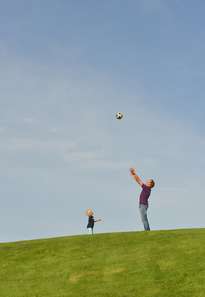
This is because a grandfather who still has his wife with him finds it easier to share in the life of his grandchildren.
"Grandmothers have traditionally had greater and more varied contact with the rest of the family, with responsibility for maintaining relationship," Knudsen observes.
"As a woman, mother and grandmother, norms for caring are clearer for her and she inspires the grandfather. A partner is accordingly important for contributing to the extended family.
"That applies particularly for men as they get older. In line with other studies of gender and partnership, we see here that men in particular benefit from marriage."
More shared lives
Both social and demographic changes underlie the substantial involvement by grandparents with their grandchildren. Three generations share more of their lives than before.
And new patterns are emerging, Knudsen reports: "We live longer and stay healthy for more of our lives. We're better off and communicate more closely".
"At the same time, today's parents are occupied with work and career. Unlike earlier generations, when children came before education and job, modern parents are often older and in full work when they become responsible for offspring."
Noting that this is where grandparents come in, he describes this as a win-win position. "Healthier and fitter grandparents who want to be with their grandchildren can be a big help to careerist parents in a hectic daily life".
"At the same time, little has changed where marriage and partnership are concerned. As before, men often marry women who are a few years younger than them".
"And women still live longer than men. Although this can vary greatly, a man of 70 has a partner beside him more often than a woman of the same age".
"So while grandmothers are usually alone, a grandfather is in a marriage. Having a younger and healthy partner seems to be crucial for a man's involvement with grandchildren."
Investment for later help?
Some would undoubtedly explain this phenomenon as a reflection of the grandparents' desire to invest time with their grandchildren in order to be helped later, Knudsen observes.
"But such arguments are only consistent with certain findings," he adds. "If they were correct, widowed grandmothers would be with the grandchildren most – and that's not the case."
Sociological role theory appears to provide a better explanation, he says. Grandfathers and grandmothers can have very different personal and social starting points.
"So although the latter spend more time with grandchildren than the former, the difference in participation shrinks steadily after 60. Past 70, the grandfather usually takes the lead."
It might be thought that older men still identify most with other interests, he says, and that women were accordingly better grandparents throughout their lives.
Men manage well
"In fact, however, men generally manage relatively well as grandparents. One important reason, as mentioned earlier, is that they usually still have their partner at their side."
But big differences nevertheless exist. "Many grandparents have other priorities or live a long way from the grandchildren. That naturally affects the time they spend together."
Norway is not one of the 11 countries in his study, but Knudsen says that its findings probably also apply to Norwegian conditions.
"After all, the research shows that demographic conditions have marked consequences later in life for grandparents more or less regardless of their country of residence".
"The differences between the European countries in the study are small - which represents an important finding in itself."
More information: Knudsen, K. European grandparents' solicitude: Why older men can be relatively good grand-fathers, Acta Sociologica, Sept. 2012 vol 55 no 3 231-250, doi: 10.1177/0001699312447962


