Immunobiological functioning of toll-receptors revealed
November 1, 2012 in Medical research
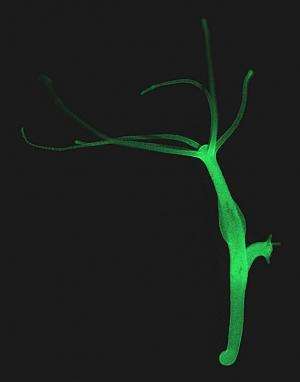
The polyp Hydra, together with corals and jellyfish, belongs to the phylum Cnidaria. The polyps in which the toll-receptor was now studied grow up to one centimeter. Microscopic photography. Credit: Kiel University
The puzzle about the ancestral function of toll-receptors has been solved. For more than 25 years, researchers from medicine and biology have been studying toll-receptors, revealing functions in immune defence on the one hand and developmental biology on the other. A research team from Kiel University (Germany) is now reporting that toll-receptors have primarily served to identify germs and to control bacterial colonisation of organisms – typical immune defence functions. The study was now published online in the Proceedings of the National Academy of Sciences (PNAS) and has implications for human medical research.
"Studying cnidarians, we were able to show that toll-receptors have been involved in immune defence already in this evolutionarily old phylum and that cnidarians can therefore serve as model organisms for human immunology research", says Thomas Bosch from the Zoological Institute of Kiel University who led the project. Toll receptors exist in many animal species as well as humans. Cnidarians are convenient research objects, because they live in plain aquaria, have a simple genome, and can be examined easily in experiments. Furthermore, they live in association with few types of bacteria compared to humans. As many fundamental research questions in medicine cannot be studied directly in humans, for ethical and practical reasons, fundamental toll-receptor research can now be carried out with cnidarians instead.
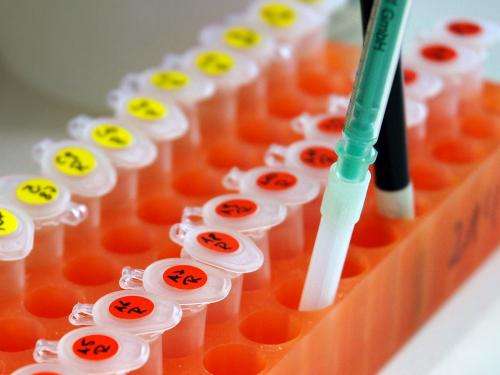
The cnidarians were studied using latest molecular biological methods at Kiel University and Max-Planck-Institute for Evolutionary Biology in Germany. Credit: Kiel University
With two Nobel Prizes dedicated to toll-receptor research in recent history, the topic has proven to be of major importance for science and society. In 1985, the so-called toll-receptors were first discovered as a key factor in embryonic development of the fruit fly (Drosophila melanogaster). For these findings, Christiane Nüsslein-Volhard, Edward Lewis und Eric Wieschaus were awarded the 1995 Nobel Prize for medicine. Toll-receptors again received much attention in science when researchers discovered a new function: in both the fruit fly as well vertebrate animals – evolutionarily much younger than insects – the toll-receptor helped to identify germs. Biologists Jules Hoffmann, Bruce Beutler and Ralph Steinmann received the Novel Prize for medicine for these astonishing results in 2011.Scientifically, the subsequent question was: Which function – regulation of embryonic development or immune defence – was first in evolution? In order to solve this puzzle, scientists of Kiel University in cooperation with Max-Planck-Institute of Evolutionary Biology Plön studied the function of toll receptors in an evolutionarily very old group, cnidarians, that have been existing for more than 600 million years. The scientists compared morbidity and bacterial colonisation of regular and genetically modified polyps of the genus Hydra. The study resulted in strong evidence for immunobiological functioning of the toll-receptors, implying that developmental functions of the toll-receptor are characteristic of insects, which are evolutionarily much younger.
More information: Sören Franzenburg,Sebastian Fraune, Sven Künzel, John F. Baines, Tomislav Domazet-Loso and Thomas C. G. Bosch (2012): " MyD88-deficient Hydra reveal an ancient function of TLR signaling in sensing bacterial colonizers", Proceedings of the National Academy of Sciences.
Journal reference:
Proceedings of the National Academy of Sciences
Provided by
Kiel University
-
Gene against bacterial attack unravelled
Oct 28, 2008 |
not rated yet |
0
-
Arteries from distinct regions of the body have unique immune functions
Sep 03, 2008 |
not rated yet |
0
-
Toll-like receptors play role in brain damage in newborns
Nov 23, 2011 |
not rated yet |
0
-
Alcohol-related behavior changes -- blame your immune system
Sep 29, 2011 |
not rated yet |
0
-
New therapeutic target identified for rheumatoid arthritis
Nov 05, 2008 |
not rated yet |
0
-
Motion perception revisited: High Phi effect challenges established motion perception assumptions
Apr 23, 2013 |
3 / 5 (2) |
2
-
Anything you can do I can do better: Neuromolecular foundations of the superiority illusion (Update)
Apr 02, 2013 |
4.5 / 5 (11) |
5
-
The visual system as economist: Neural resource allocation in visual adaptation
Mar 30, 2013 |
5 / 5 (2) |
9
-
Separate lives: Neuronal and organismal lifespans decoupled
Mar 27, 2013 |
4.9 / 5 (8) |
0
-
Sizing things up: The evolutionary neurobiology of scale invariance
Feb 28, 2013 |
4.8 / 5 (10) |
14
-
Why is zone 1 in liver more prone to ischemic injury?
May 23, 2013
-
How can there be villous adenoma in colon, if there are no villi there
May 22, 2013
-
How can there be a term called "intestinal metaplasia" of stomach
May 21, 2013
-
Pressure-volume curve: Elastic Recoil Pressure don't make sense
May 18, 2013
-
If you became brain-dead, would you want them to pull the plug?
May 17, 2013
-
MRI bill question
May 15, 2013
- More from Physics Forums - Medical Sciences
More news stories
Study reveals new mechanism for estrogen suppression of liver lipid synthesis
By discovering the new mechanism by which estrogen suppresses lipid synthesis in the liver, UC Irvine endocrinologists have revealed a potential new approach toward treating certain liver diseases.
Medical research
14 hours ago |
not rated yet |
0
|
MRI-based measurement helps predict vascular disease in the brain
Aortic arch pulse wave velocity, a measure of arterial stiffness, is a strong independent predictor of disease of the vessels that supply blood to the brain, according to a new study published in the June issue the journal ...
Medical research
15 hours ago |
not rated yet |
0
Antibiotics: A new understanding of sulfonamide nervous system side effects
Since the discovery of Prontosil in 1932, sulfonamide antibiotics have been used to combat a wide spectrum of bacterial infections, from acne to chlamydia and pneumonia. However, their side effects can include serious neurological ...
Medical research
16 hours ago |
not rated yet |
0
|
Scientists discover molecule triggers sensation of itch
Scientists at the National Institutes of Health report they have discovered in mouse studies that a small molecule released in the spinal cord triggers a process that is later experienced in the brain as ...
Medical research
16 hours ago |
5 / 5 (2) |
0
|
Discarded immune cells induce the relocation of stem cells
Spanish researchers have discovered that the daily clearance of neutrophils from the body stimulates the release of hematopoietic stem cells from the bone marrow into the bloodstream, according to a report published today ...
Medical research
18 hours ago |
5 / 5 (2) |
0
Obesity weighs down on top soda guzzler Mexico
Artemio Martinez balanced his corpulent frame on a stool in a Mexico City street taco stand, downing a sweet soda and eating a final pork-filled corn tortilla.
WHO voices deep concern over spread of SARS-like virus
The World Health Organization voiced deep concern Thursday over the SARS-like virus that has killed 22 people in less than a year, saying it might potentially spread more widely between humans.
Study: No higher cancer rate at Conn. Pratt plant
(AP)—Researchers examining the incidence of brain cancer at jet engine manufacturer Pratt & Whitney in Connecticut say they have found no statistically significant elevations in the rate of cancer among workers.
Controlling mood through the motions of mitochondria
(Medical Xpress)—Regulating the distribution of power in neurons is done by a system that makes the national electric grid look simple by comparison. Each neuron has several thousand mitochondria confined ...
Hormone replacement therapy—clarity at last
The British Menopause Society and Women's Health Concern have today released updated guidelines on Hormone Replacement Therapy (HRT) to provide clarity around the role of HRT, the benefits and the risks. The new guidelines ...
Motion quotient: IQ predicted by ability to filter motion (w/ video)
A brief visual task can predict IQ, according to a new study. This surprisingly simple exercise measures the brain's unconscious ability to filter out visual movement. The study shows that individuals whose ...
