It's not just what you eat, but when you eat it
November 11, 2012 in Medical research
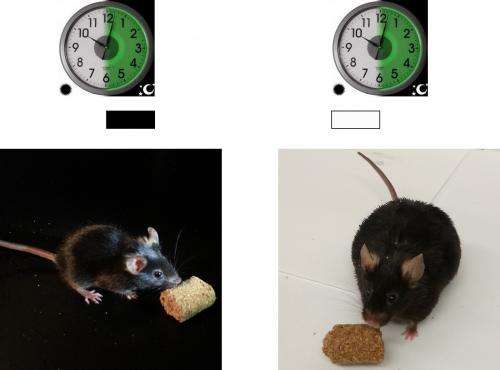
Mice with a broken clock in their fat get fat as they eat when they should be sleeping. Credit: Georgios Paschos PhD, Perelman School of Medicine, University of Pennsylvania
Fat cells store excess energy and signal these levels to the brain. In a new study this week in Nature Medicine, Georgios Paschos PhD, a research associate in the lab of Garret FitzGerald, MD, FRS director of the Institute for Translational Medicine and Therapeutics, Perelman School of Medicine, University of Pennsylvania, shows that deletion of the clock gene Arntl, also known as Bmal1, in fat cells, causes mice to become obese, with a shift in the timing of when this nocturnal species normally eats. These findings shed light on the complex causes of obesity in humans.
The Penn studies are surprising in two respects. "The first is that a relatively modest shift in food consumption into what is normally the rest period for mice can favor energy storage," says Paschos. "Our mice became obese without consuming more calories." Indeed, the Penn researchers could also cause obesity in normal mice by replicating the altered pattern of food consumption observed in mice with a broken clock in their fat cells.
This behavioral change in the mice is somewhat akin to night-eating syndrome in humans, also associated with obesity and originally described by Penn's Albert Stunkard in 1955.
The second surprising observation relates to the molecular clock itself. Traditionally, clocks in peripheral tissues are thought to follow the lead of the "master clock" in the SCN of the brain, a bit like members of an orchestra following a conductor. "While we have long known that peripheral clocks have some capacity for autonomy – the percussionist can bang the drum without instructions from the conductor – here we see that the orchestrated behavior of the percussionist can, itself, influence the conductor," explains FitzGerald.
Daily intake of food is driven by oscillating expression of genes that drive and suppress appetite in the hypothalamus. When the clock was broken in fat cells, the Penn investigators found that this hypothalamic rhythm was disrupted to favor food consumption at the time of inappropriate intake – daytime in mice, nighttime in humans.
When a species' typical daily rhythm is thrown off, changes in metabolism also happen. For example, in people, night shift workers have an increased prevalence of obesity and metabolic syndrome, and patients with sleep disorders have a higher risk for developing obesity. Also, less sleep means more weight gain in healthy men and women.
Balancing Act
Balancing energy levels in the body requires integrating mul¬tiple signals between the central nervous system and outlying tissues, such as the liver and heart. Fat cells not only store and release energy but also communicate with the brain about the amount of stored energy via the hormone leptin. When leptin is secreted, it causes more energy to be used and less eating via pathways in the hypothalamus.
The Penn team found that only a handful of genes were altered when the clock was broken in fat cells and these governed how unsaturated fatty acids, such as eicosapentaenoic acid (EPA) and docosahexaenoic acid (DHA) were released into the blood stream. Interestingly, these are the same fatty acids that are typically associated with fish oils. Sure enough, levels of EPA and DHA were low in both plasma and in the hypothalamus at the time of inappropriate feeding. "To our amazement, we were able to rescue the entire phenotype - inappropriate fatty acid oscillation and gene expression in the hypothalamus, feeding pattern and obesity - by supplementing EPA and DHA to the knock-out animals," notes Paschos.
The findings point to a role for the fat cell clock molecules in organizing energy regulation and the timing of eating by communicating with the hypothalamus, which ultimately affects stored energy and body weight.
Taken together, these studies emphasize the importance of the molecular clock as an orchestrator of metabolism and reflect a cen¬tral role for fat cells in the integration of food intake and energy expenditure.
"Our findings show that short-term changes have an immediate effect on the rhythms of eating," says FitzGerald. "Over time, these changes lead to an increase in body weight. The conductor is indeed influenced by the percussionist."
Journal reference:
Nature Medicine
Provided by
University of Pennsylvania School of Medicine
-
Liver fat gets a wake-up call that maintains blood sugar levels
May 06, 2012 |
not rated yet |
0
-
Scientists find high-fat diet disrupts body clock
Nov 06, 2007 |
not rated yet |
0
-
Carefully scheduled high-fat diet resets metabolism and prevents obesity
Sep 12, 2012 |
not rated yet |
0
-
High-fat diet may cause change in hypothalamus
Sep 11, 2012 |
not rated yet |
0
-
Another reason to avoid high-fat diet -- it can disrupt our biological clock
Dec 29, 2008 |
not rated yet |
0
-
Motion perception revisited: High Phi effect challenges established motion perception assumptions
Apr 23, 2013 |
3 / 5 (2) |
2
-
Anything you can do I can do better: Neuromolecular foundations of the superiority illusion (Update)
Apr 02, 2013 |
4.5 / 5 (11) |
5
-
The visual system as economist: Neural resource allocation in visual adaptation
Mar 30, 2013 |
5 / 5 (2) |
9
-
Separate lives: Neuronal and organismal lifespans decoupled
Mar 27, 2013 |
4.9 / 5 (8) |
0
-
Sizing things up: The evolutionary neurobiology of scale invariance
Feb 28, 2013 |
4.8 / 5 (10) |
14
-
How can there be a term called "intestinal metaplasia" of stomach
23 hours ago
-
Pressure-volume curve: Elastic Recoil Pressure don't make sense
May 18, 2013
-
If you became brain-dead, would you want them to pull the plug?
May 17, 2013
-
MRI bill question
May 15, 2013
-
Ratio of Hydrogen of Oxygen in Dessicated Animal Protein
May 13, 2013
-
Alcohol and acetaminophen
May 13, 2013
- More from Physics Forums - Medical Sciences
More news stories
H. pylori, smoking trends, and gastric cancer in US men
Trends in Helicobacter pylori (H. pylori) and smoking explain a significant proportion of the decline of intestinal-type noncardia gastric adenocarcinoma (NCGA) incidence in US men between 1978 and 2008, and are estimated ...
Medical research
13 hours ago |
not rated yet |
0
Common food supplement fights degenerative brain disorders
Widely available in pharmacies and health stores, phosphatidylserine is a natural food supplement produced from beef, oysters, and soy. Proven to improve cognition and slow memory loss, it's a popular treatment for older ...
Medical research
17 hours ago |
5 / 5 (3) |
0
|
Finding a family for a pair of orphan receptors in the brain
Researchers at Emory University have identified a protein that stimulates a pair of "orphan receptors" found in the brain, solving a long-standing biological puzzle and possibly leading to future treatments for neurological ...
Medical research
18 hours ago |
5 / 5 (1) |
0
|
Insight into the dazzling impact of insulin in cells
Australian scientists have charted the path of insulin action in cells in precise detail like never before. This provides a comprehensive blueprint for understanding what goes wrong in diabetes.
Medical research
18 hours ago |
4.6 / 5 (7) |
0
|
Do men's and women's hearts burn fuel differently?
Researchers at the University of Illinois at Chicago College of Medicine will study gender differences in how the heart uses and stores fat—its main energy source—and how changes in fat metabolism play ...
Medical research
21 hours ago |
not rated yet |
0
Study says empathy plays a key role in moral judgments
Is it permissible to harm one to save many? Those who tend to say "yes" when faced with this classic dilemma are likely to be deficient in a specific kind of empathy, according to a report published in the scientific journal ...
Phthalates: Study links chemicals widely found in plastics, processed food to elevated blood pressure in children, teens
Plastic additives known as phthalates (pronounced THAL-ates) are odorless, colorless and just about everywhere: They turn up in flooring, plastic cups, beach balls, plastic wrap, intravenous tubing and—according to the ...
If you can remember it, you can remember it wrong
(Medical Xpress)—Native peoples in regions where cameras are uncommon sometimes react with caution when their picture is taken. The fear that something must have been stolen from them to create the photo ...
B vitamins could delay dementia
(Medical Xpress)—Despite spending billions of dollars on research and development, drug companies have been unable to come up with effective treatments for dementia and Alzheimer's Disease (AD). Now, A. ...
Reducing caloric intake delays nerve cell loss
Activating an enzyme known to play a role in the anti-aging benefits of calorie restriction delays the loss of brain cells and preserves cognitive function in mice, according to a study published in the May ...
New sleeping pill poised to hit US markets
An experimental sleeping pill from US drug company Merck is effective at helping people fall and stay asleep, according to reviewers at the US Food and Drug Administration, which could soon approve the new drug.
Nov 11, 2012
Rank: not rated yet
Nov 12, 2012
Rank: not rated yet