Magnet ingestion injuries on the rise among children
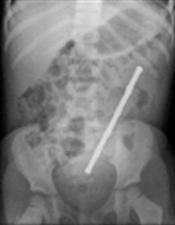
Credit: National Center for Biotechnology Information
(Medical Xpress)—With many new toys hitting store shelves this holiday season, there is a lot to consider when picking the perfect gift for a child. While young ones may be creating their wish lists with a focus on the coolest new gadgets, buyers need to pay careful attention to product warning labels regarding what is age appropriate. Cases of children swallowing toys are becoming more prevalent in emergency rooms and could lead to emergency surgery, and possible long-term hospitalization.
The risk of ingestion is especially worrisome with magnets, like those used in building sets and other toys. Just this month, the popular magnetic Buckyballs and Buckycubes, marketed as desk toys, were discontinued because of the threat they posed to children when swallowed.
"When multiple high-powered magnets are swallowed, their attraction is so strong they can tear through internal walls, creating holes in the intestines and causing life threatening situations that require surgery," said Vibha Sood, M.D., pediatric gastroenterology fellow at Golisano Children's Hospital at University of Rochester Medical Center (URMC). "Any exposure to a magnetic object should be strongly cautioned and avoided."
The North American Society for Pediatric Gastroenterology, Hepatology and Nutrition (NASPGHAN) has stated that warning labels are not enough to prevent children from ingesting magnetic toys. The group released results of a recent survey of more than 1,700 doctors, who reported at least 480 toy magnet ingestions in the past decade, with 204 occurring in the past year. The survey also reported that 50.4 percent of patients are between the ages of 1 and 6, while 33.6 percent are 6 to 12 years old.
Labels that distinguish what is age appropriate are repeatedly disregarded and individuals are often too young or embarrassed to convey what they have swallowed.
As we near the holiday shopping season, Anne Brayer, M.D., pediatrician in Emergency Medicine at URMC and director of Injury Free Coalition for Kids of Rochester, offers tips on how to prevent ingestion of toy parts and overall advice as to what consumers should be paying attention to while purchasing safe items for children.
Read the labels – Always check labels to make sure a toy is right for a child's age. Consider the child's temperament, habits, and behavior when picking out a new toy. Use the age and safety recommendations, created by national standards, as a guide. Even if you feel a child can developmentally handle a toy labeled as being appropriate for older individuals, stay on the safe side and do not purchase it.
Avoid toys with small, detachable parts – Toy parts should be larger than the child's mouth. Pay attention to the durability of the toy and that it has tightly secured parts. Parents should purchase a Choke Tube Tester, or use the top of a gallon-size milk jug, to examine the safety level of the toy. If a toy can fit in the opening of the tube, or jug, it is a choking hazard for children 3 years of age or younger.
Know the child's surroundings – Consider the ages of all who may have access to the toy. An item that is meant for an older child could get in the hands of younger family members or neighbors and become a choking hazard.
Stay informed and aware – After purchasing toys, regularly survey the child's play area for any small pieces, missing parts or dislodged magnets. Be sure that the child knows how to play with the toy safely.
"It is important for consumers to be aware of the dangers many toys pose to children," said Brayer. "Being proactive about toy safety can help prevent emergency situations before it may be too late."
Individuals can also check government sites on the Internet, such as the U.S. Consumer Product Safety Commission and www.recalls.gov, to see if the toy they are interested in purchasing has been recalled.
Provided by
University of Rochester Medical Center
-
The Medical Minute: New toy safety standards bring parents confidence
Dec 16, 2009 |
not rated yet |
0
-
Holiday gift guide: Choosing safe toys for children
Dec 15, 2011 |
not rated yet |
0
-
The Medical Minute: Toy safety tips when shopping for holiday gifts
Dec 15, 2010 |
not rated yet |
0
-
Parents be aware this holiday season: Magnets in children's toys pose significant health risk
Dec 10, 2008 |
not rated yet |
0
-
Buying Toys for Children with Disabilities Often Leaves Shoppers Unsure
Dec 18, 2008 |
not rated yet |
0
-
Motion perception revisited: High Phi effect challenges established motion perception assumptions
Apr 23, 2013 |
3 / 5 (2) |
2
-
Anything you can do I can do better: Neuromolecular foundations of the superiority illusion (Update)
Apr 02, 2013 |
4.5 / 5 (11) |
5
-
The visual system as economist: Neural resource allocation in visual adaptation
Mar 30, 2013 |
5 / 5 (2) |
9
-
Separate lives: Neuronal and organismal lifespans decoupled
Mar 27, 2013 |
4.9 / 5 (8) |
0
-
Sizing things up: The evolutionary neurobiology of scale invariance
Feb 28, 2013 |
4.8 / 5 (10) |
14
-
Classical and Quantum Mechanics via Lie algebras
Apr 15, 2011
- More from Physics Forums - Independent Research
More news stories
Driving and hands-free talking lead to spike in errors, study shows
Talking on a hands-free device while behind the wheel can lead to a sharp increase in errors that could imperil other drivers on the road, according to new research from the University of Alberta.
Health
10 hours ago |
not rated yet |
0
About one in four uninsured could be excluded from ACA
(HealthDay)—More than one in four of those eligible for new premium assistance tax credits under the Affordable Care Act (ACA) do not have a checking account and will not be able to receive premiums from ...
Health
12 hours ago |
not rated yet |
0
Audiologists recommend smart phone apps to monitor noise levels
After studying noise in one French Quarter neighborhood of New Orleans to determine whether or not noise levels exceeded municipal ordinances, Annette Hurley, PhD, Assistant Professor of Audiology at LSU Health Sciences Center ...
Health
13 hours ago |
not rated yet |
0
Young children who miss well-child visits are more likely to be hospitalized
Young children who missed more than half of recommended well-child visits had up to twice the risk of hospitalization compared to children who attended most of their visits, according to a study published today in the American Jo ...
Health
13 hours ago |
not rated yet |
0
Do doctors understand the individualisation of treatments?
The individualisation of drug treatments to support patients to self-manage their conditions is a concept that sits at the heart of policy, but a recent study in BMJ Open shows that there is no concrete defini ...
Health
16 hours ago |
3 / 5 (1) |
0
Engineered cytomegalovirus protects monkeys from HIV equivalent
(Medical Xpress)—A new study by researchers in the US has shown that an ancient virus can be modified to help in the fight against the simian immunodeficiency virus SIV, which is the equivalent in monkeys ...
Researchers identify first drug targets in childhood genetic tumor disorder
Two mutations central to the development of infantile myofibromatosis (IM)—a disorder characterized by multiple tumors involving the skin, bone, and soft tissue—may provide new therapeutic targets, according to researchers ...
Hormone levels may provide key to understanding psychological disorders in women
Women at a particular stage in their monthly menstrual cycle may be more vulnerable to some of the psychological side-effects associated with stressful experiences, according to a study from UCL.
Going live: Immune cell activation in multiple sclerosis
Biological processes are generally based on events at the molecular and cellular level. To understand what happens in the course of infections, diseases or normal bodily functions, scientists would need to ...
Help at hand for people with schizophrenia
How can healthy people who hear voices help schizophrenics? Finding the answer for this is at the centre of research conducted at the University of Bergen.
Alzheimer's disease, the soft target of the euthanasia debate
(Medical Xpress)—The way Alzheimer's disease is portrayed by advocacy groups and the media is having undue influence on the euthanasia debate, according to a Deakin University nursing ethics professor.
Nov 20, 2012
Rank: 1 / 5 (1)