Moral evaluations of harm are instant and emotional, brain study shows
November 29, 2012 by William Harms in Neuroscience

Moral evaluations of harm are instant and emotional, brain study shows

Enlarge

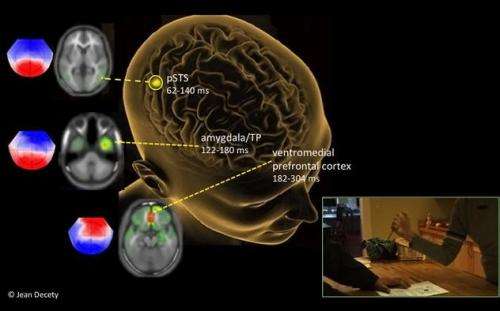
Researchers found that areas of the brain linked to moral decision-making were activated in adults who watched videos of people suffering intentional harm. There was no such response when the harm was accidental. Credit: Jean Decety

(Medical Xpress)—People are able to detect, within a split second, if a hurtful action they are witnessing is intentional or accidental, new research on the brain at the University of Chicago shows.

The study is the first to explain how the brain is hard-wired to recognize when another person is being intentionally harmed. It also provides new insights into how such recognition is connected with emotion and morality, said lead author Jean Decety, the Irving B. Harris Professor of Psychology and Psychiatry at UChicago.

"Our data strongly support the notion that determining intentionality is the first step in moral computations," said Decety, who conducted research on the topic with Stephanie Cacioppo, a research associate (assistant professor) in psychology at UChicago. They published the results in a paper, "The Speed of Morality: A High-Density Electrical Neurological Study," to be published Dec. 1 and now on early preview in the Journal of Neurophysiology.

The researchers studied adults who watched videos of people who suffered accidental harm (such as being hit with a golf club) and intentional harm (such as being struck with a ). While watching the videos, was collected with equipment that accurately maps responses in different regions of the brain and importantly, the timing between these regions. The technique is known as high-density, event-related potentials technology.

The intentional harm sequence produced a response in the brain almost instantly. The study showed that within 60 milliseconds, the right posterior superior temporal sulcus (also known as TPJ area), located in the back of the brain, was first activated, with different activity depending on whether the harm was intentional or accidental. It was followed in quick succession by the amygdala, often linked with emotion, and the (180 milliseconds), the portion of the brain that plays a critical role in moral decision-making.

There was no such response in the and ventromedial prefrontal cortex when the harm was accidental.

Other studies with functional MRI scans, including those in Decety's lab, have shown that those areas of the brain become activated when people see others intentionally harmed, but those studies have been unable to separate or time the way the various parts of the may work together.

"High-density EEG/ERPs can identify spatio-temporal patterns of communication between regions that contrast analyses (such as fMRI) with low temporal resolution may not detect, and such methods are necessary to advance knowledge of neuroscience of morality," said Cacioppo.

The ability to recognize and respond emotionally to the intentional infliction of harm is a critical source of morality that is universal across cultures, researchers believe. "It is part of humans' evolutionary heritage," Decety said. "The long history of mammalian evolution has shaped our brains to be sensitive to signs of suffering of others. And this constitutes a natural foundation for morality and sensitivity to justice."      

Philosophers have debated the origins of this moral response for ages. Some maintain that moral judgments begin with an immediate aversive reaction to perceived or imagined harm to victims, though the full moral judgment may form only after the fact. Other philosophers maintain that moral principals develop from reason alone and are not connected to emotion.

The new research suggests that emotion and the perception of intentionality, rather than deliberate reasoning, comprise the vital first component of moral responses—at least for responses that stem from care for others Decety said.

The research may help inform other areas of neurodevelopment research, including studies of the moral responses of psychopaths and of children who lack empathy for others, displaying what are called callous-unemotional traits.

More information: www.ncbi.nlm.nih.g… med/22956794

Provided by University of Chicago search and more info website

2.7 /5 (3 votes)  

Filter


Move the slider to adjust rank threshold, so that you can hide some of the comments.


Display comments: newest first

VendicarD
Nov 29, 2012

Rank: 1 / 5 (1)
Republicans seem to be missing this area of their brain.

Research needs to be done to explain this.
Tausch
Nov 29, 2012

Rank: not rated yet
"Our data strongly support the notion that determining intentionality is the first step in moral computations," said Decety

The only response to a morale dilemma will be a random response - one left to chance. A random event. Whether observed or not observed. You can not show intentionality. Much less map it.

And this constitutes a natural foundation for morality and sensitivity to justice."

No. There is no "natural foundation" for morality and sensitivity.
"...and sensitivity." is added as obfuscation.

Let's correct this:
"The long history of mammalian evolution has shaped our brains to be sensitive to signs of suffering of others. And this constitutes a natural foundation for morality and sensitivity to justice."


to this:
"The long history of mammalian evolution has shaped our brains to be INsensitive to signs of suffering of others. And this constitutes a natural foundation for indifference."


What quote describes humans?
Yes. Correct.

kochevnik
Nov 29, 2012

Rank: not rated yet
Thank GOD that HE DESIGNED a part of the brain to acknowledge when victims are bludgeoned with a baseball bat. There are no fossil records of baseball bats! Where is Kevin?
MrVibrating
Nov 29, 2012

Rank: not rated yet
This concept of intentionality is interesting in a number of respects:

Whether or not one accepts the concept of "theory of mind" as commonly held, the elements of intentionality are the recognition of one's own perception of self-determination, followed by its extension to others.

An inability to differentiate intent from happenstance might mean the difference between survival or being eaten - not to mention witch hunts, theism / animism and paranoia.

The morality issue is tangential - emotional responses are faster than intellectual ones, period. It's generally held that the limbic system evolved to prioritise flight-or-fight responses, and 'malicious' intent is as primal a concern as it gets...
Tausch
Nov 30, 2012

Rank: not rated yet
Moral dilemmas (evaluations) have been treated extensively:
http://medicalxpr...son.html

The solution to the hypothetical dilemma - see link - is to form or morph the event into an event that is random.
Astute readers noted that the event is already random when the person placed in the dilemma remains inactive (does nothing but observe.) The position of the switch is a random event before being touched.

If you 'need' to show a 'token' of intent, you switch the switch with closed eyes back and forth not knowing the moment of position of the switch that decides the outcome.

That solution is an intellectual solution inducing the least emotional response to the dilemma - there is no 'morality' in a random event.

Refuse to bow to the lateralization of function when the function is to serve the concept of morality.
Rank 2.7 /5 (3 votes)
Related Stories
Relevant PhysicsForums posts

More news stories

B vitamins could delay dementia

(Medical Xpress)—Despite spending billions of dollars on research and development, drug companies have been unable to come up with effective treatments for dementia and Alzheimer's Disease (AD). Now, A. ...

Neuroscience created 2 hours ago | popularity 4.7 / 5 (3) | comments 0 | with audio podcast report

Waiting for a sign? Researchers find potential brain 'switch' for new behavior

You're standing near an airport luggage carousel and your bag emerges on the conveyor belt, prompting you to spring into action. How does your brain make the shift from passively waiting to taking action when ...

Neuroscience created 2 hours ago | popularity not rated yet | comments 0 | with audio podcast

If you can remember it, you can remember it wrong

(Medical Xpress)—Native peoples in regions where cameras are uncommon sometimes react with caution when their picture is taken. The fear that something must have been stolen from them to create the photo ...

Neuroscience created 4 hours ago | popularity 4 / 5 (3) | comments 0 | with audio podcast report

Study shows where scene context happens in our brain

In a remote fishing community in Venezuela, a lone fisherman sits on a cliff overlooking the southern Caribbean Sea. This man –– the lookout –– is responsible for directing his comrades on the water, ...

Neuroscience created 6 hours ago | popularity 4 / 5 (1) | comments 0 | with audio podcast

Clouds in the head

Many brain researchers cannot see the forest for the trees. When they use electrodes to record the activity patterns of individual neurons, the patterns often appear chaotic and difficult to interpret.

Neuroscience created 7 hours ago | popularity not rated yet | comments 0


Drugs found to both prevent and treat Alzheimer's disease in mice

Researchers at USC have found that a class of pharmaceuticals can both prevent and treat Alzheimer's Disease in mice.

Genetic variation among patients with pulmonary fibrosis associated with improved survival

Variation in the gene MUC5B among patients with idiopathic pulmonary fibrosis was associated with improved survival, according to a study published online by JAMA. The study is being released early online to coincide with i ...

Genetic risk for obesity found in many Mexican young adults

As many as 35 percent of Mexican young adults may have a genetic predisposition for obesity, said a University of Illinois scientist who conducted a study at the Universidad Autónoma de San Luis Potosί.

Low radiation scans help identify cancer in earliest stages

A study of veterans at high risk for developing lung cancer shows that low-dose computed tomography (LDCT) can be highly effective in helping clinicians spot tiny lung nodules which, in a small number of patients, may indicate ...

Shorter duration steroid therapy may offer similar effectiveness in reducing COPD exacerbations

Among patients with acute exacerbations of chronic obstructive pulmonary disease (COPD) requiring hospital admission, a 5-day glucocorticoid treatment course was non-inferior (not worse than) to a 14-day course with regard ...

Race and gender influence diagnosis of COPD

African-Americans are less likely than whites and women are more likely than men to have had a prior diagnosis of chronic obstructive pulmonary disease (COPD) regardless of their current disease severity, according to a new ...